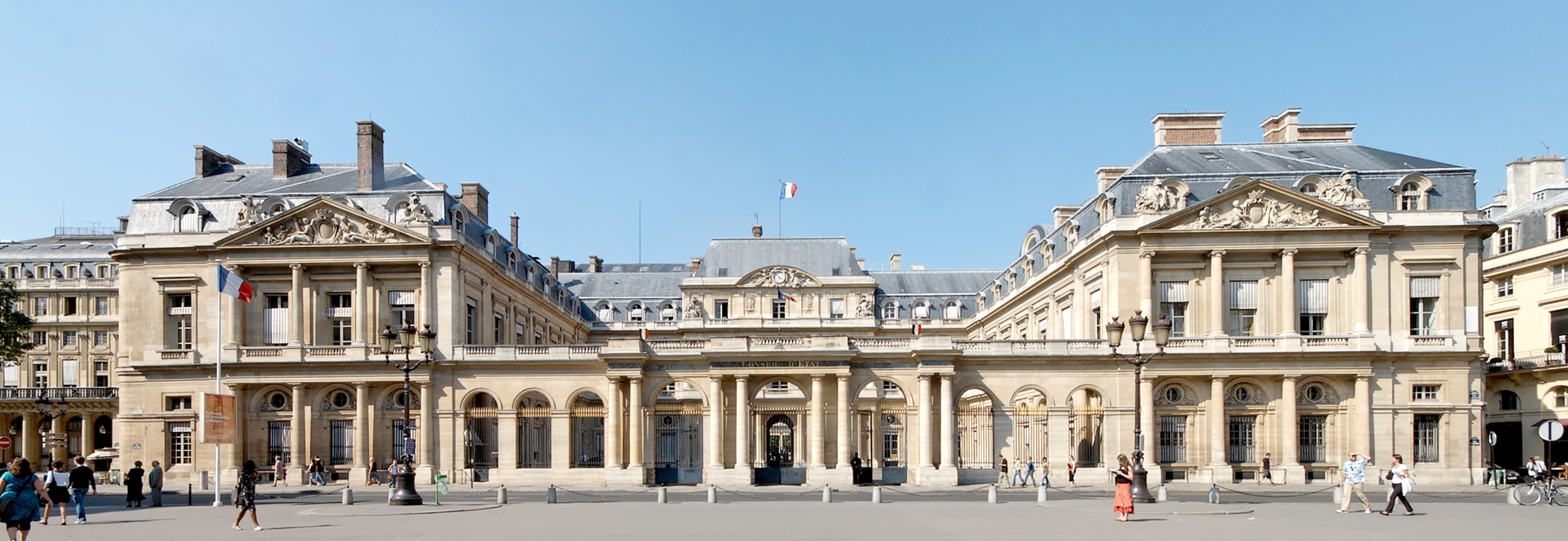
Palais-Royal
The French Revolution may have started in a garden. On July 12, 1789, two days before the storming of the Bastille, a young journalist named Camille Desmoulins leaped onto a café table in the arcades of the Palais-Royal, drew two pistols from his coat, and rallied the crowd to arms. He chose this location because the Palais-Royal was the one place in Paris where police could not enter -- it was private property belonging to the Duke of Orléans. That peculiar legal immunity had already made the palace's colonnaded galleries the most vibrant, scandalous, and politically dangerous public space in the city. Bookshops sold banned pamphlets. Cafés hosted radical debate. Prostitutes worked the upper floors. The Palais-Royal was the internet of 18th-century Paris -- ungoverned, chaotic, and revolutionary.
A Cardinal's Ambition
Cardinal Richelieu commissioned architect Jacques Lemercier to build the palace between 1633 and 1639, originally calling it the Palais-Cardinal. Richelieu, chief minister to Louis XIII and arguably the most powerful man in France, wanted a residence that reflected his status -- and his proximity to the king. The palace faced the Louvre across what is now the Place du Palais-Royal. When Richelieu died in 1642, he bequeathed the building to the crown, and it acquired its current name. The young Louis XIV lived here briefly with his mother Anne of Austria and her advisor Cardinal Mazarin. During the Fronde uprisings, a Parisian mob nearly broke into the palace one night; the terrified boy-king pretended to be asleep to avoid capture. That childhood trauma helped forge his later determination to move the court to Versailles, far from the volatile streets of Paris.
The Orléans Transformation
Louis XIV gave the palace to his younger brother, Philippe I, Duke of Orléans, and for the next century it became the social headquarters of the rival Orléans branch of the royal family. Henrietta Anne of England, Philippe's first wife, created celebrated ornamental gardens. The court gatherings she hosted attracted the cream of French society. After the death of Louis XIV in 1715, the Duke of Orléans served as regent for the five-year-old Louis XV and governed France from this palace, which housed the magnificent Orléans Collection of some 500 paintings -- open for public viewing until the collection was sold abroad in 1791. The palace accumulated layers of artistic patronage: André Le Nôtre redesigned the gardens around 1674, and successive dukes commissioned interiors in the emerging Rococo style from designers like Gilles-Marie Oppenord.
The World's First Shopping Arcade
In the 1780s, the heavily indebted Louis Philippe II, Duke of Orléans, made a radical decision: he would commercialize the palace grounds. He hired architect Victor Louis to construct six-story apartment buildings with ground-floor colonnades around three sides of the garden. When the complex opened in 1784, it offered 145 boutiques, cafés, salons, bookshops, and refreshment kiosks -- the prototype for the modern shopping mall. Glass storefronts allowed window-shopping, a novel experience. The arcades sold luxury goods to the wealthy while the upper galleries catered to less reputable tastes. Because the duke's private property was exempt from royal police jurisdiction, the Palais-Royal became a haven for free speech, political agitation, gambling, and prostitution. It was, as contemporaries noted, a place where you could buy anything and say anything.
From Revolution to Republic
The duke who opened these arcades became Philippe Égalité during the Revolution, voting for the execution of his cousin Louis XVI before himself going to the guillotine in 1793. His son, raised amid the radical politics of the Palais-Royal, eventually became King Louis-Philippe I in 1830 -- the last king of France to reside in this building. After the monarchy fell for good in 1848, the palace became government property. Today it houses the Constitutional Council, the Council of State, and the Ministry of Culture. The garden remains open to the public, a quiet oasis steps from the Louvre. In 1986, artist Daniel Buren installed 260 black-and-white striped columns of varying heights in the palace's main courtyard, a controversial work called "Les Deux Plateaux" that has since become one of the most photographed sites in Paris.
Quiet Center
Walk through the Palais-Royal's arcade today and the contrast with its revolutionary past is striking. The boutiques now sell vintage fashion, antique music boxes, and rare medals. The garden -- a rectangular lawn bordered by linden trees -- is one of the most peaceful spots in central Paris, hidden from traffic noise by the surrounding buildings. Molière's theater company performed here beginning in 1661, and the Comédie-Française, France's oldest active theater, still occupies the southwest corner in a building Victor Louis designed in the 1780s. Nearly four centuries after Richelieu laid the first stone, the Palais-Royal continues to serve its original dual purpose: seat of power and stage for public life.
From the Air
Located at 48.8633°N, 2.3369°E in the 1st arrondissement of Paris, directly north of the Louvre. The rectangular garden and surrounding buildings are visible from the air at 2,000-3,000 feet AGL. The complex sits between Rue Saint-Honoré and the garden, with the Comédie-Française at its southwest corner. Nearest airports: Paris-Orly (LFPO) 15 km south, Paris-Le Bourget (LFPB) 11 km northeast, Paris-Charles de Gaulle (LFPG) 25 km northeast.