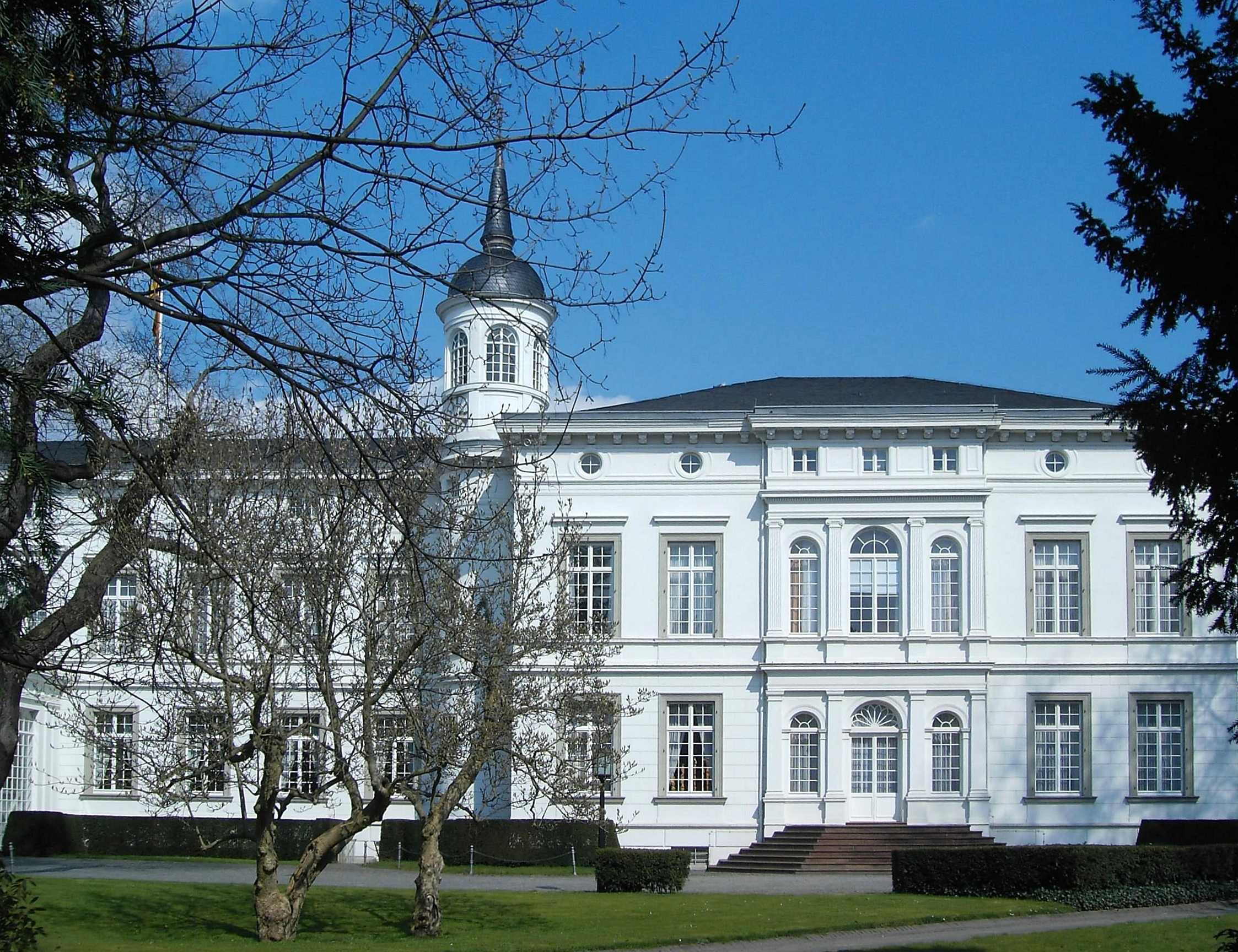
Palais Schaumburg
In November 1949 a seventy-three-year-old man named Konrad Adenauer set up shop in a yellow neoclassical villa on Bonn's Adenauerallee — a building put up by a cloth manufacturer ninety years earlier and most recently used as a staff billet by the Belgian Army. He had been Chancellor of West Germany for two months. The country he led was less than half a year old, partitioned, occupied, broke, and not yet trusted by anyone, including itself. Two months later he received the new republic's first state guest, the French foreign minister Robert Schuman, in this same villa. The Palais Schaumburg's life as the Federal Chancellery had begun, and for the next twenty-seven years almost every consequential decision of West German politics would pass through these rooms.
From Cloth Manufacturer to Prince
The building started as a private commission. Between 1858 and 1860 the cloth manufacturer Wilhelm Loeschigk had a late-neoclassical palais built on the Rhine flats south of Bonn's old town, the kind of crisp, symmetrical villa a successful nineteenth-century Rhineland merchant could afford. Soon afterwards Prince Adolf of Schaumburg-Lippe bought it, expanded it, and gave the building its current name. The Schaumburg-Lippes kept it until 31 January 1939, when Ernst Wolrad of Schaumburg-Lippe sold the palace to the Wehrmacht. The army's plans for it ended with the war. Belgian occupation staff moved in next. By the time the new West German government went looking for a chancellor's residence in 1949, the palace had been a princely seat, an army property, and an occupier's office — but never a working seat of democratic power.
Adenauer's House
Hans Schwippert, the architect already at work on the nearby Bundeshaus, rebuilt the palais for chancellery use in 1950. Annexes followed — the prefab-feeling Houses 2 and 3 — and in 1963 the architect Sep Ruf slipped a low, glass-walled modernist pavilion into the back garden: the Kanzlerbungalow, a semi-official residence where chancellors could host guests in a building that looked more like a Californian house than a state palace. Adenauer governed from the Palais Schaumburg until 1963. Ludwig Erhard followed, then Kurt Georg Kiesinger, then Willy Brandt, then Helmut Schmidt. The Ostpolitik treaties of the early 1970s — Brandt's strategy for reaching across the Iron Curtain — were drafted in these rooms. So were the responses to the Red Army Faction kidnappings in the autumn of 1977 that came to be called the German Autumn.
Outgrowing the Palace
By 1976 there was simply not enough room. The chancellery's staff and remit had grown beyond what a nineteenth-century villa could absorb, and the new low-rise Bundeskanzleramt on the meadow next door took over the working offices. The palais kept a ceremonial role: state dinners, treaty signings, photographs of chancellors with foreign leaders against the pale stuccoed walls. The most extraordinary of those signings came in 1990, when representatives of West Germany and the GDR met here to seal the treaty creating a currency, economic, and social union — the financial scaffolding of reunification. After the seat of government moved to Berlin in 1999 the palais quieted again, becoming from 2001 the secondary residence and seat of the Federal Chancellery, used by departments that still needed Bonn offices.
Trees in the Park
A tree has been planted in the surrounding Park Schaumburg for every former Federal Chancellor, one per term, a quiet rolling memorial that you can read like a chronology if you know which species to look for. Public access is limited — the palais is not generally open, and since August 2013 it has been closed for an extensive restoration the federal authorities estimated at five years and which has, in the manner of such projects, kept going. The Haus der Geschichte offers an online panorama tour for visitors who can't get in. Stand at the front gate today and you see a building that looks, from the street, like a comfortable Rhineland mansion. Its long second life as the modest stage on which the Federal Republic learned to govern itself is one of those facts you have to be told before you can quite believe.
From the Air
50.7202 N, 7.1174 E on Adenauerallee in Bonn's Gronau district, on the west bank of the Rhine just north of the former Federal Chancellery. Cologne-Bonn (EDDK / CGN) lies about 20 km north; Bonn-Hangelar (EDKB) is around 6 km northeast. From 2,500 feet on a clear day you can pick out the cream-yellow palace and its tree-planted park between the river and the Bundesstraße 9, with the low brown chancellery building just to the south.