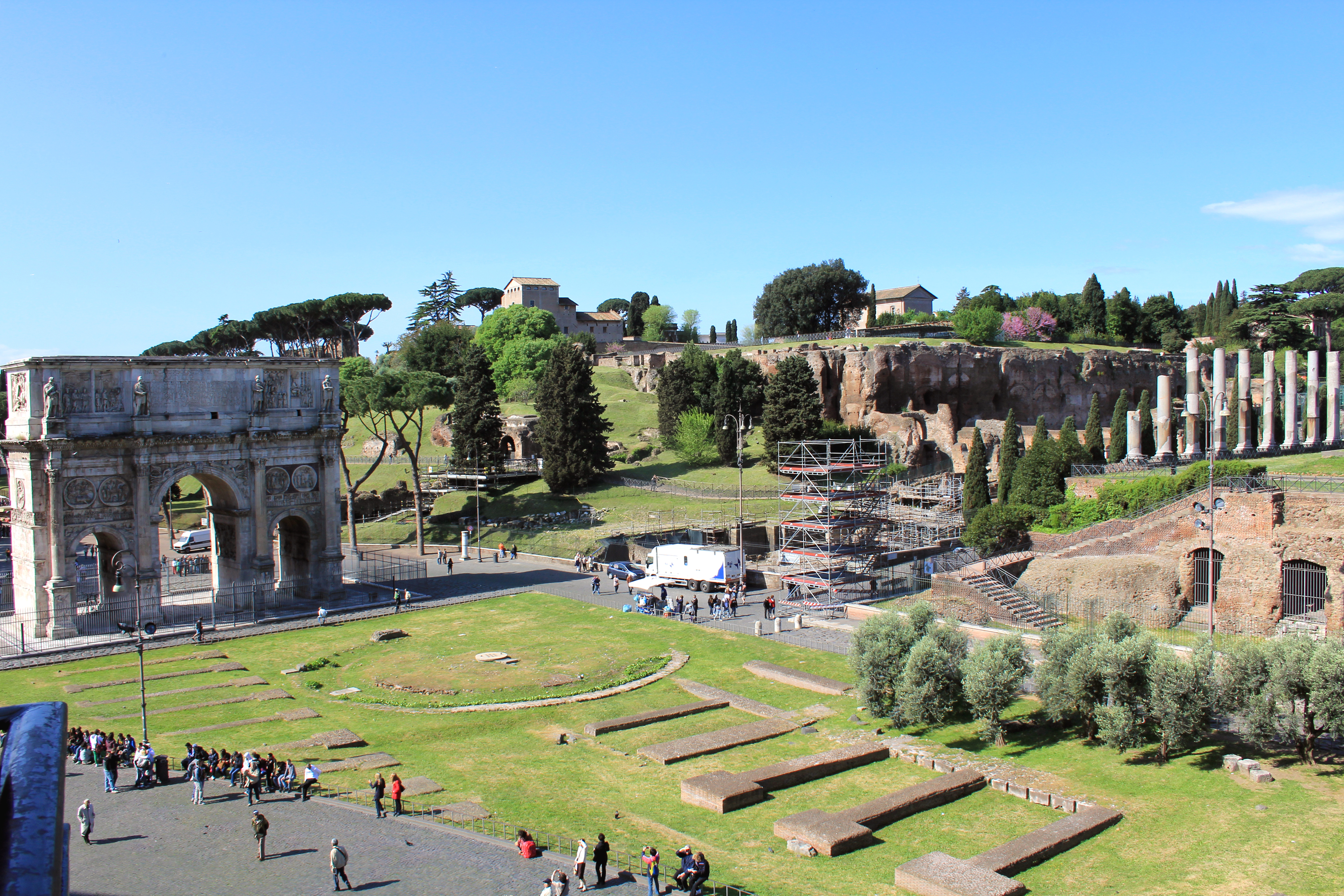
Palatine Hill: The Birthplace of the Word 'Palace'
Every palace on earth owes its name to this hill. The Latin "Palatium" became "palazzo" in Italian, "palais" in French, "Palast" in German - all descended from the 40-meter-high ridge where Rome's emperors chose to live, and where, according to myth, Romulus chose to found a city. The Palatine Hill stands at the geographic and symbolic center of Rome's seven hills, overlooking the Forum to the north and the Circus Maximus to the south. People have lived here since the 10th century BC, making it one of the oldest continuously inhabited sites in Europe. Today its summit is a vast open-air museum where umbrella pines shade the foundations of palaces that once governed half the known world.
The Wolf's Cave
Roman mythology placed the founding story here. According to legend, the she-wolf Lupa discovered the infants Romulus and Remus in a cave called the Lupercal on the Palatine's slopes, nursing them until a shepherd found and raised them. When Romulus grew to manhood, he chose this hill to found his city - and killed his brother Remus for jumping over the sacred boundary he had drawn around it. That ritualistic murder became a foundational myth, a blood offering woven into Roman identity and the concept of the Pomerium, the sacred boundary of the city. In 2007, archaeologists restoring the Domus Livia discovered a 16-meter-deep cavity beneath the ruins, its vault encrusted with mosaics and seashells. Some claimed it was the Lupercal itself; others identified it as a nymphaeum from Nero's era. The debate continues, but the discovery proved that Romans had been venerating something in these depths for centuries.
Where Emperors Made Their Homes
Republican-era aristocrats built their mansions on the Palatine, drawn by its elevation, breezes, and views. But it was Augustus who transformed the hill into an imperial precinct. After becoming Rome's first emperor in 27 BC, he established his residence here and built a temple to Apollo on the summit. Tiberius expanded the complex, though he spent much of his reign at villas in Campania and on Capri. The Great Fire of AD 64 destroyed Nero's palace, the Domus Transitoria, but he replaced it with the even grander Domus Aurea. Domitian then built over Nero's ruins between AD 81 and 96, creating a palace so enormous that it dominated the hill's skyline. The ruins of all three imperial residences remain visible today, their walls and foundations layered atop one another like geological strata - each emperor's ambitions literally built upon the last.
Excavating the Layers
The Palatine has been dug into for as long as people have lived on it. Augustus himself conducted a kind of archaeological expedition, uncovering Bronze Age pottery and tools and declaring the find site the "original town of Rome." Modern archaeology has confirmed he was not far wrong: excavations in 1907 and 1948 unearthed clusters of huts dating to between the 9th and 7th centuries BC, spanning the traditional period of Rome's founding. In 2006, researchers announced the discovery of what they believe to be Augustus's birthplace - a two-story aristocratic house with frescoed walls and mosaic floors, its ground-floor shops opening onto the Via Sacra, overlooking the Colosseum and the Arch of Constantine. Unlike other Republican-era houses that were buried beneath imperial construction after the Great Fire, this one was apparently preserved, perhaps deliberately, for nearly two thousand years.
Gardens Over Ruins
In the 16th century, the Farnese family acquired the hilltop and laid out the Farnese Gardens above the remains of Tiberius's palace - one of Europe's earliest botanical gardens, and a strange act of cultivation over empire. Parts of those gardens survive today, their terraces and plantings sitting directly atop the Domus Tiberiana. Nearby, the Villa Mattei was built between the Domus Flavia and the Domus Augustana, later purchased by the Scottish eccentric Charles Mills around 1830, who converted it into a neo-Gothic fantasy. That villa became a convent, then was partially demolished from 1928 onward to allow excavations. The surviving wing now houses the Palatine Museum, its collection spanning the full arc of the hill's habitation: Bronze Age tools, Republican-era frescoes, imperial marble, and the quiet testimony of a place where thirty centuries of human ambition lie stacked in the earth.
From the Air
Located at 41.888N, 12.487E in central Rome. The Palatine Hill rises approximately 40 meters above the surrounding terrain and appears from the air as a large, roughly trapezoidal plateau covered with umbrella pines, gardens, and visible ruins. It sits between the Roman Forum to the north and the Circus Maximus to the south, with the Colosseum visible to the east. The Farnese Gardens are identifiable on the northwest portion of the summit. Best viewed at 1,500-2,500 feet to appreciate the hill's relationship to the Forum and Circus Maximus. Nearest major airport: Leonardo da Vinci-Fiumicino Airport (LIRF), approximately 30 km southwest. Roma Urbe Airport (LIRU) is about 8 km north.