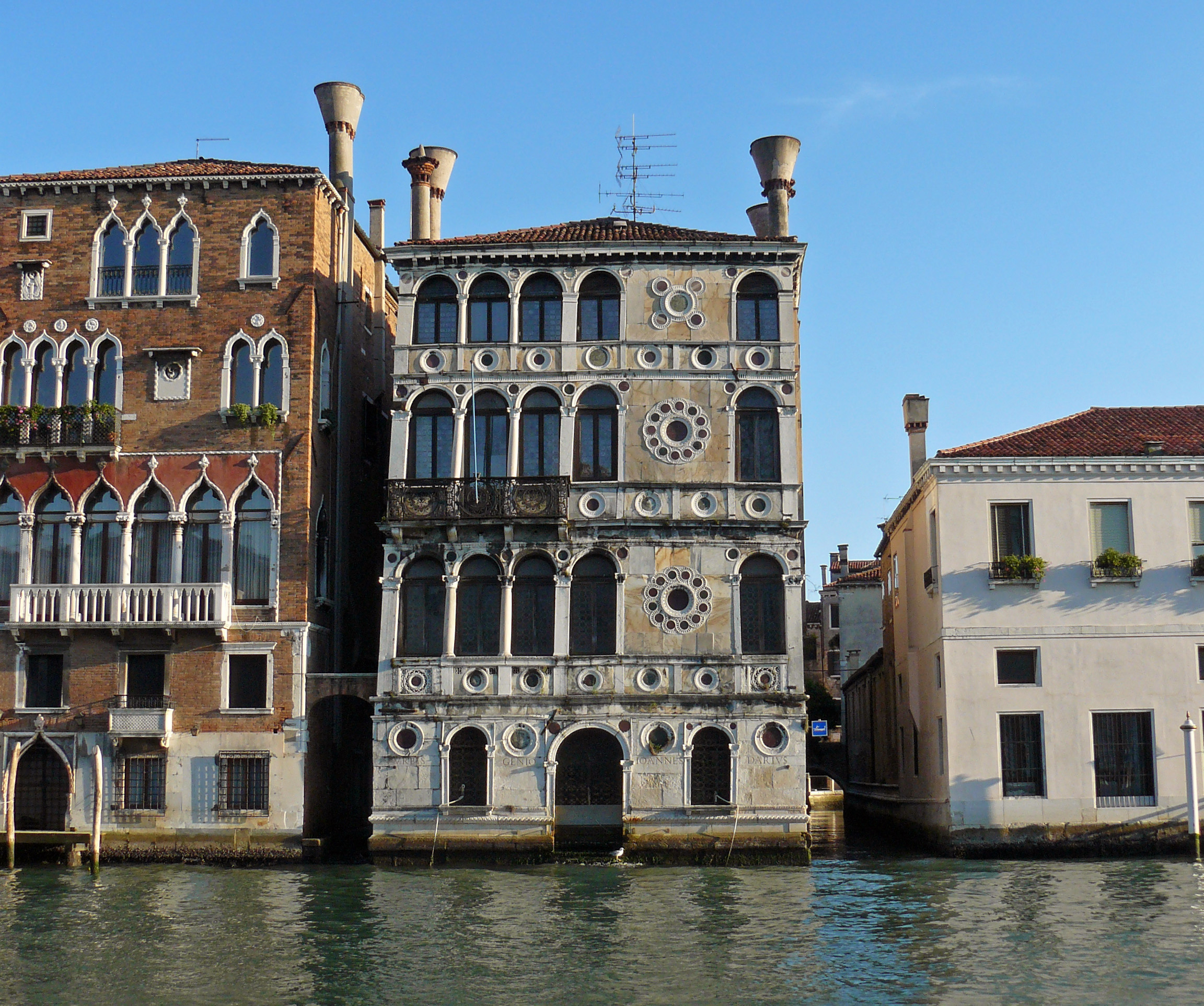
Palazzo Dario
In 2025, Venice put a price on its most infamous address: twenty million euros for a freshly renovated nine-bedroom palace that no one seems willing to inhabit. Palazzo Dario, wedged between the Palazzo Barbaro Wolkoff and the narrow Rio delle Torreselle on the Grand Canal, has been called Venice's cursed palace after at least seven of its owners and guests died violently or under mysterious circumstances. The building itself seems indifferent to its reputation, presenting the same marble-encrusted facade to the water that captivated John Ruskin in the 19th century and Claude Monet in 1908.
A Diplomat's Grand Gesture
The palazzo was remodeled after 1486 by a follower of Pietro Lombardo for Giovanni Dario, Secretary to the Venetian Senate, diplomat, and merchant. Dario was a patrician who had served the Republic in delicate negotiations, and his palace reflected that stature. The building began in the Venetian Gothic style before receiving its Renaissance renovation -- a transition visible in the architecture itself, where Gothic marble-encrusted oculi sit within a facade reorganized along Renaissance lines. When Dario died in 1494, the palazzo passed to his daughter Marietta, who had married Vincenzo Barbaro, son of Giacomo Barbaro and owner of the neighboring Palazzo Barbaro Wolkoff. By 1522, Marietta's sons held possession. Before that, the Venetian Senate occasionally rented the palace as a residence for Turkish diplomats -- a reminder that in the 15th century, even private homes served the Republic's foreign policy.
The Campiello and the Countess
Walk around to the land side and Palazzo Dario opens onto a small, tree-shaded square called the Campiello Barbaro, named for the patrician family that once dominated this corner of the Dorsoduro. The rear facade displays Gothic arches of the fifth order, a quieter counterpart to the canal-facing showpiece. At the end of the 19th century, the Countess de la Baume-Pluvinel, a French aristocrat who wrote under the pen name Laurent Evrard, undertook a major renovation. She added the staircase, external chimneys, majolica stoves, and fine carvings in the dining room on the second piano nobile -- work vaguely reminiscent of the Scuola di San Rocco. She also stabilized and replaced marble on the deteriorating facade. The Countess surrounded herself with French and Venetian writers. One of them, the poet Henri de Regnier, lived and wrote in the palazzo from 1899 to 1901. An inscription on the garden wall commemorates his stay in Italian: he lived and wrote here 'venezianamente' -- in the Venetian way.
Monet, Lambert, and the Curse
In 1908, Claude Monet created his impressionist depictions of Palazzo Dario, producing canvases now held at the Art Institute of Chicago and the National Museum of Art of Wales. The paintings capture the way the building leans slightly, its reflection broken by the canal's movement -- a quality that makes the palazzo appear alive, shifting with each passing boat. In the early 1970s, Kit Lambert, producer and manager of The Who, owned the palazzo. His tenure added another chapter to the building's dark reputation. The pattern of misfortune among its residents has earned Palazzo Dario a place in Venetian folklore, though whether one believes in curses may depend on how one weighs coincidence against five centuries of evidence. By 2025, the palace stood empty, freshly renovated, seeking a buyer willing to test the legend.
Between Gothic and Renaissance
What makes Palazzo Dario architecturally significant is its position at the hinge point between two eras. The corner treatments resemble those found at the Palazzo Priuli a San Severo, while the overall composition belongs to a new vocabulary that was just arriving in Venice. Ruskin was particularly taken with the Gothic oculi -- circular windows encrusted with colored marble -- that punctuate the facade. They are remnants of an older aesthetic persisting within a newer framework, which is perhaps the most Venetian quality a building can possess. From the Grand Canal, the palazzo reads as a compact, jewel-like structure, its polychrome marbles catching light in ways that shift from hour to hour. It is smaller and more intimate than many of its neighbors, which only makes its troubled history feel more concentrated, more personal.
From the Air
Located at 45.431N, 12.332E on the Grand Canal in Venice's Dorsoduro district, near the Peggy Guggenheim Collection. The palazzo's distinctive leaning facade with polychrome marble is identifiable from low altitude. Nearest airport: Venice Marco Polo (LIPZ), 8 km north. Venice Lido (LIPV) is closer to the southeast. Approach from the south over Giudecca for the best canal views.