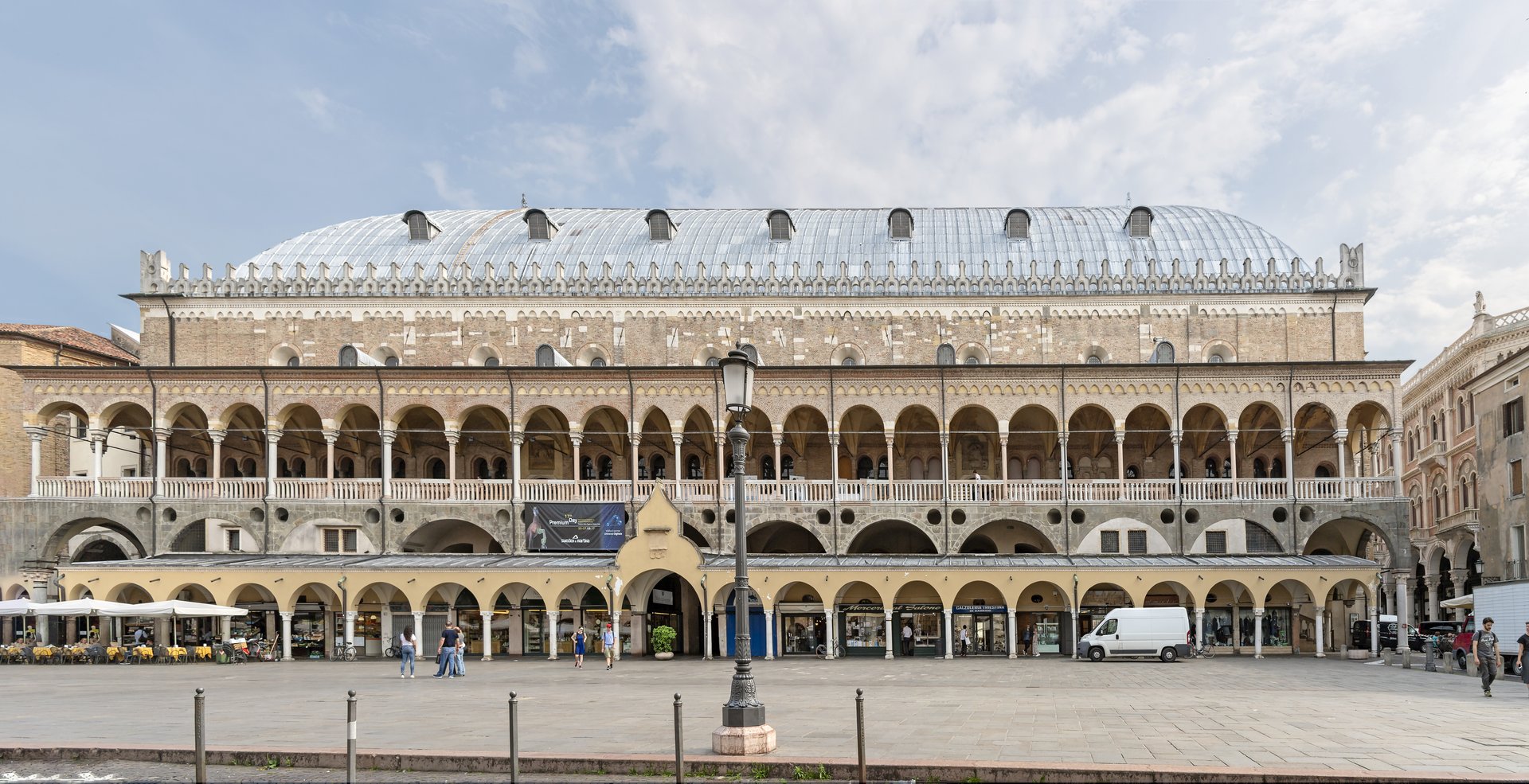
Palazzo della Ragione, Padua
Insolvent debtors once sat on a black stone stool in the middle of this hall, exposed to public ridicule while the city conducted its business around them. The Pietra del Vituperio — the "Stone of Shame" — still occupies a corner of Padua's Palazzo della Ragione, a reminder that this building was never merely decorative. For more than eight hundred years, the Palazzo has sat between two market squares, its ground floor selling food and its upper floor dispensing justice. Locals call the upper hall simply il Salone, "the big hall," and the understatement is characteristically Paduan. The room is 81.5 meters long, 27 meters wide, and 24 meters high — one of the largest medieval halls still standing anywhere in Europe.
Three Roofs Become One
Construction of the Palazzo began in 1172 and finished in 1219, giving Padua a civic building that combined governance, commerce, and justice under a single structure. The upper floor originally consisted of three separate chambers, each covered by its own roof. In 1306, an Augustinian friar named Fra Giovanni undertook the ambitious project of covering the entire building with a single roof, but the internal partition walls remained. It took a catastrophe to complete the transformation. A fire swept through the building in 1420, and the Venetian architects who rebuilt it removed the dividing walls entirely, creating the vast single hall that visitors see today. Between 1425 and 1440, painters Nicolò Miretto and Stefano da Ferrara covered the new interior with frescoes. Then, in August 1756, a tornado tore the roof away. The building was repaired once more. Each disaster stripped something away; each reconstruction left the Palazzo grander than before.
Stars and Seasons on the Walls
Every surface of the great hall is painted. More than three hundred frescoed scenes cover the four walls, organized into two horizontal bands. The upper band, dating to the fifteenth century, unfolds across three tiers linking each month of the year to its corresponding zodiac sign, its associated trades, and the character traits it supposedly bestows. The system follows the astrological theories of Pietro d'Abano, a professor at the University of Padua in the thirteenth century whose ideas about the influence of celestial bodies on human affairs were controversial enough to attract the attention of the Inquisition. Below this cosmic calendar, older fourteenth-century frescoes survive in fragments, their subjects shaped by the original function of the rooms they once decorated — courtrooms whose tribunal benches left visible traces on the walls when they were removed. On the southern wall, a golden sun relief serves a purpose that has nothing to do with decoration: at noon, a beam of sunlight passes through the sun's mouth and strikes the floor along a meridian line, a feature added by Bortolomeo Ferracina in 1761.
A Market That Never Closed
While scholars debate frescoes upstairs, the ground floor has been conducting business without interruption for eight centuries. The covered market beneath the Palazzo della Ragione is likely the oldest continuously operating market in the European Union. In the medieval period, vendors sold everything from spices and jewels to cloth and meat beneath the arched arcades. Today the stalls focus on food and drink — cheese wheels, cured meats, fresh produce — and the market remains the daily grocery stop for Paduans who prefer their shopping with a side of history. The building sits between the Piazza delle Erbe and the Piazza dei Frutti, squares whose names preserve the memory of what was sold there: herbs on one side, fruit on the other. Above the market, the open loggia running along the upper floor inspired Andrea Palladio when he designed his famous Basilica Palladiana in nearby Vicenza, making the Palazzo della Ragione not just a civic building but an architectural prototype.
The Wooden Horse and Its Famous Model
A gigantic wooden horse dominates the western end of the great hall, its presence as unexpected as it is commanding. Built in 1466, it was modeled after Donatello's celebrated bronze Equestrian Statue of Gattamelata, which stands in front of the Basilica of Saint Anthony across the city. The bronze original, completed around 1453, was the first large equestrian statue cast since Roman antiquity and helped establish Padua as a center of Renaissance sculpture. The wooden replica inside the Palazzo served a different purpose entirely — a piece of civic theater, bringing the grandeur of public monuments into the space where citizens gathered. In 2021, UNESCO inscribed the Palazzo della Ragione as part of "Padua's fourteenth-century fresco cycles," a World Heritage Site composed of eight historic buildings across the city center. The recognition confirmed what Paduans had known for centuries: the Salone is not a museum piece but a living room for an entire city.
From the Air
Located at 45.407°N, 11.875°E in central Padua, Veneto, Italy. From 3,000–5,000 feet AGL, the Palazzo's distinctive elongated rectangular roof is visible between the two market squares in the old city center. The building sits approximately 2 miles south of the Padua train station. Nearest airports include Padova (LIPU) about 3 miles southwest, and Venice Marco Polo (LIPZ) approximately 22 miles east. The Euganean Hills are visible to the southwest on clear days.