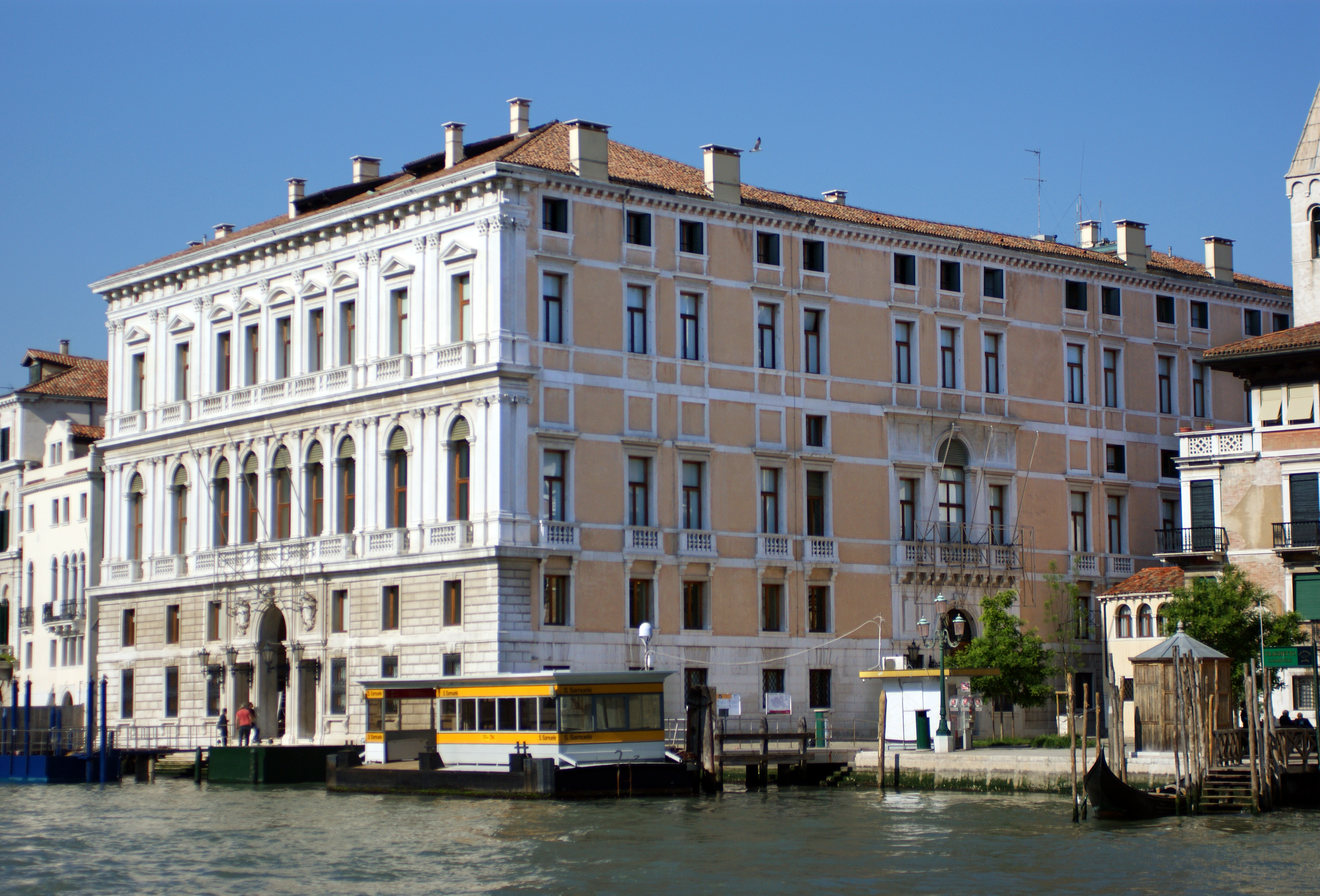
Palazzo Grassi
In 1990, the architect Aldo Rossi stood inside Palazzo Grassi to accept the Pritzker Architecture Prize, the highest honor in his profession. The ceremony was held in a building designed by someone else -- Giorgio Massari, who began rebuilding the palazzo in 1748 and finished in 1772, while simultaneously completing the Ca' Rezzonico directly across the Grand Canal. The Palazzo Grassi was the last grand palace erected on the Grand Canal before the fall of the Venetian Republic in 1797, and the largest-sited. Two centuries later, when French billionaire Francois Pinault needed a Venice venue for his contemporary art collection, he chose this palace and hired Pritzker laureate Tadao Ando to reimagine its interiors. The result is a collision of centuries: 18th century frescoes by Michelangelo Morlaiter and ceilings by Giambattista Canal framing installations by Damien Hirst and Rudolf Stingel. Venice has always recycled its buildings. Palazzo Grassi simply does it with more ambition than most.
Before the Grassi
The building on this site has a history older than its famous facade. During the 16th century, the property belonged to the Cini family. In 1605, Alamanno Aragon Hocheppan, grandson of Cosimo I de' Medici, Grand Duke of Tuscany, acquired it -- a Medici connection that tied this corner of Venice to Florence's most powerful dynasty. The Grassi family took possession in 1655, and it was they who commissioned the reconstruction that produced the building that stands today. Giorgio Massari designed a palace in the Venetian classical style, its white marble facade deliberately restrained amid the Byzantine, Romanesque, and Baroque palazzi that crowd the Grand Canal. The formality was intentional: unlike most Venetian patrician palaces, Palazzo Grassi lacks the lower mercantile openings through which goods were once loaded from canal barges. This was a residence built purely for display, not commerce -- a distinction that says something about the Republic's direction in its final decades.
The Classical Outlier
Walking the Grand Canal by vaporetto, you register Palazzo Grassi as a break in the visual rhythm. Where neighboring buildings present Gothic tracery, ogival windows, and the layered ornamentation of Venetian Baroque, the Palazzo Grassi offers symmetry, restraint, and clean classical proportions. Massari's design reflects the 18th century turn toward Neoclassicism that was sweeping Europe -- a style more associated with Rome, Paris, and London than with Venice. Inside, the main stairwell is frescoed by Michelangelo Morlaiter and Francesco Zanchi, and the ceilings bear decorative work by Giambattista Canal and Christian Griepenkerl. These are not the overwhelming visual programs of Tiepolo or Veronese; they are elegant, measured, consistent with a building that values proportion over spectacle. The palazzo sits between the Palazzo Moro Lin and the campo San Samuele, facing the Grand Canal with a confidence that comes from knowing it will be the last of its kind.
Pinault's Gamble
Francois Pinault, the French luxury goods magnate, purchased Palazzo Grassi in 2005 and began transforming it into a showcase for his private art collection -- one of the largest holdings of contemporary art in the world. The first exhibition opened in April 2006. In 2007, Pinault acquired the nearby Punta della Dogana, Venice's former customs house at the tip of Dorsoduro, and commissioned Tadao Ando to convert it into a second exhibition space. Ando, the self-taught Japanese architect known for his stark concrete geometries, brought a sensibility to these Venetian interiors that risked jarring but instead achieved something clarifying. His interventions are minimal -- smooth concrete surfaces, precise lighting, uncluttered sightlines -- creating neutral containers for art that is anything but neutral. In 2013, Ando redesigned the palazzo's Teatrino into a 225-seat auditorium. Between 1984 and 1990, before the Pinault era, the Swedish curator Pontus Hulten had run the space as an art museum with a 600-seat outdoor theater, establishing the building's identity as a cultural venue that the Pinault foundation expanded dramatically.
Where Centuries Collide
The exhibitions at Palazzo Grassi have ranged from blue-chip provocations to scholarly surveys: Rudolf Stingel carpeted the entire building in oriental rugs for his 2013 solo show, Damien Hirst filled both the palazzo and the Punta della Dogana with his fantastical Treasures from the Wreck of the Unbelievable in 2017, and Irving Penn's photographs shared the building with installations exploring the nature of light. The building absorbs these interventions because Venice itself absorbs contradiction -- sacred and commercial, ancient and reinvented, crumbling and magnificent. Palazzo Grassi is a palace built for an 18th century family that no longer exists, redesigned by a 21st century architect for a French collector displaying international contemporary art in a former republic that became an Italian city. Each layer makes sense only in the context of the others. The white marble facade still faces the Grand Canal with the same composed expression it offered passing gondolas in 1772, indifferent to what happens inside, confident that Venice will find a use for beautiful buildings long after their original purposes have been forgotten.
From the Air
Palazzo Grassi (45.43N, 12.33E) is located on the east bank of the Grand Canal in Venice's San Marco sestiere, identifiable by its white classical facade that contrasts with surrounding Gothic and Baroque palazzi. It faces the Grand Canal near the San Samuele vaporetto stop. The Ca' Rezzonico, designed by the same architect, sits directly across the canal. Venice Marco Polo Airport (LIPZ/VCE) is approximately 12km north-northeast. From altitude, the Grand Canal's S-curve is the primary navigational reference; Palazzo Grassi is roughly at the canal's midpoint.