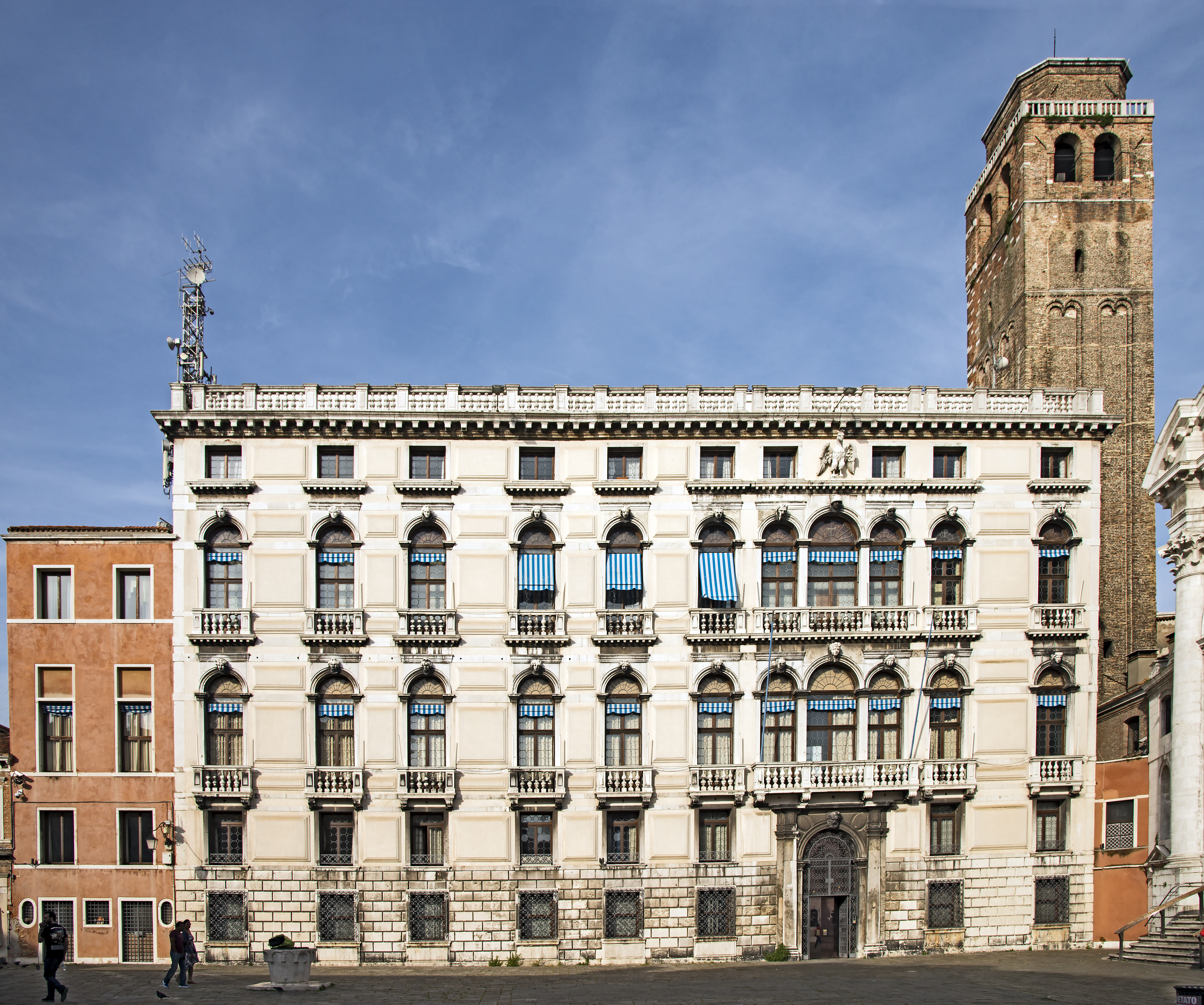
Palazzo Labia
On September 3, 1951, a thousand costumed guests arrived at Palazzo Labia for Le Bal Oriental, a masquerade so extravagant it launched Pierre Cardin's career and had Christian Dior and Salvador Dali designing each other's costumes. Cecil Beaton's photographs from that night capture a world that seemed to be consciously reenacting the final days of the Venetian Republic -- glittering, excessive, aware of its own impermanence. The palazzo that hosted this spectacle had been built three centuries earlier by a family that understood spectacle as survival strategy.
Buying a Bloodline
The Labia family was originally Catalan, and they did something that old Venetian aristocracy found unforgivable: they purchased their way into nobility in 1646. The Republic of Venice, its treasury depleted by wars with the Ottoman Empire, had begun selling inscriptions into the patrician class -- a transaction that bought political standing but not social acceptance. The Labias compensated for their lack of ancestors with a blinding display of wealth. They hired two relatively unknown architects, Andrea Cominelli and Alessandro Tremignon, and chose a site at the junction of the Cannaregio Canal and the Grand Canal, next to the church of San Geremia -- a position so prominent that the church's campanile appears to be part of the palazzo itself. While the selection of obscure architects seems strange for a family desperate to impress, the location made the gamble irrelevant. Three facades, facing the Cannaregio, the Grand Canal, and the Campo San Geremia, ensured the Labia wealth was visible from every possible direction.
Cleopatra in the Ballroom
The palazzo owes its fame to two brothers, Angelo Maria and Paolo Antonio Labia, who in 1746-47 commissioned Giovanni Battista Tiepolo at the height of his powers to fresco their double-height ballroom. The Salone delle Feste is entirely covered with scenes from the romantic encounters of Marc Antony and Cleopatra, framed by Girolamo Mengozzi Colonna's trompe-l'oeil architecture -- painted doorways, windows, and balconies from which members of Cleopatra's court seem to peer down at the room below. In one scene, Cleopatra dissolves a priceless pearl in a goblet of wine to demonstrate her wealth to Marc Antony. Maria Labia, the brothers' mother and the intellectual force behind the family, would have recognized the metaphor perfectly: the nouveau riche queen proving she could outspend any rival. It is said that Maria herself was the model for Cleopatra, though no documentary evidence confirms this.
Marionettes and Informers
The brothers who commissioned Tiepolo were, by most accounts, unremarkable in everything except their patronage. Angelo Maria became an abbe to avoid the political obligations of aristocratic life, yet curiously this did not prevent him from marrying -- though his wife was a commoner, suggesting a near-morganatic arrangement. His true passion was a marionette theater that concealed real singers behind its scenes, performing satirical plays he wrote himself. In later life, Angelo endeared himself to no one by becoming an informer to the Venetian Inquisition. His brother Paolo married into the old aristocracy -- families willing to accept Labia money and hospitality, if not equality -- but never took on public duties. Their mother Maria proved the most interesting figure: painted in her youth by Rosalba Carriera, she possessed what the French commentator Charles de Brosses described in her old age as a lively wit, a flirtatious nature, and the finest collection of jewels in Europe.
Three Facades, Three Centuries of Decay
Architecturally, the palazzo broke with Venetian convention. Where most buildings reserved their decoration for the waterfront facade alone, leaving rear elevations as mismatched afterthoughts, Cominelli and Tremignon gave all three sides equal attention. The five-story structure mixes baroque richness with a simplicity that departed from the heavy, column-laden style of earlier architects like Baldassarre Longhena. Heraldic eagles of the Labia family divide the oval windows of the top-floor mezzanine; balustraded balconettes line the tall segmented windows of the piano nobile. After the fall of the Republic in 1797, the Labia fortunes declined and the palazzo decayed. In 1945, an exploding munitions boat shattered its foundations and sent fragments of Tiepolo's frescoes falling to the ground.
From Beistegui to Television
Salvation came in 1948 when Don Carlos de Beistegui, a French-born heir to a Mexican fortune, purchased the ruins and began an intensive restoration. He filled the palazzo with frescoes by Raphael, Annibale Carracci, and Guido Reni acquired from less fortunate neighboring palaces, creating an interior so distinctive that his approach became known as le gout Beistegui. His 1951 masquerade ball remains one of the most legendary social events of the 20th century. But Beistegui suffered a series of strokes in the 1960s and sold the palazzo to RAI, Italian state television, which used it as regional headquarters. When Beistegui's French estate and the former Palazzo Labia furnishings were auctioned by Sotheby's in 1999, it became France's largest and most highly priced auction. Occasionally the ballroom still hosts international conferences, and during the 2019 Venice Biennale, Dior staged the Tiepolo Ball in the spirit of Le Bal Oriental -- proof that the palazzo's talent for spectacle has outlasted every family that ever owned it.
From the Air
Located at 45.443N, 12.325E at the junction of the Cannaregio Canal and the Grand Canal in Venice. The palazzo is identifiable by its prominent three-facade position adjacent to the church of San Geremia, whose campanile appears incorporated into the building. Nearest airport: Venice Marco Polo (LIPZ), 7 km north. Best viewed from low altitude approaching from the north along the Cannaregio Canal.