Pale Male
For more than thirty years, a red-tailed hawk with an unusually light-colored head lived on one of the most expensive addresses in the world. His nest sat on a twelfth-floor ledge at 927 Fifth Avenue, overlooking Central Park's Model Boat Pond, and each spring New Yorkers would line up with telescopes to watch him raise his chicks. Birdwatcher and author Marie Winn named him Pale Male for that distinctive pale plumage. He arrived in Central Park in 1991 as a first-year bird, was driven from his initial tree nest by crows, and made the unconventional decision to roost on a building across the street from the park instead. It was one of the first recorded instances of a red-tailed hawk nesting on a building rather than a tree, and it launched a dynasty.
Eight Mates and a Legacy
Pale Male's romantic life rivaled any soap opera. His first mate, dubbed "First Love," was injured and taken to the Raptor Trust in New Jersey. During her absence, he found another partner. After several failed attempts, he and a mate successfully hatched three chicks in 1995 -- the first to fledge from his now-famous ledge. First Love eventually returned, banded and released, and the pair reunited to raise several more broods. Over the decades, Pale Male took at least eight mates. Blue, Lola, Lima, Zena, Octavia -- each earned a name from the devoted community of birders who tracked his life with an intimacy usually reserved for royalty. Lima, also called Ginger for her dark neck feathers, died in early 2012 after apparently eating a poisoned rat. Zena disappeared that September. The cycle of loss and renewal became part of his story.
The Nest War of 2004
In December 2004, the co-op board at 927 Fifth Avenue removed Pale Male's nest and the anti-pigeon spikes that anchored it, citing concerns about debris falling to the street. The decision sparked an international outcry. The New York City Audubon Society organized impassioned protests outside the building. Mary Tyler Moore, a resident of 927 Fifth Avenue and animal rights advocate, joined the demonstrators on the sidewalk. Within days, the building, city agencies, and the Audubon Society agreed to replace the spikes and install a new cradle for the nest. By December 28, scaffolding came down and the hawks began bringing twigs back. But the damage was done in a subtler way: eggs laid by his mate Lola in March 2005 did not hatch, and no chicks successfully fledged from the original nest for years. A 2008 investigation found that stainless steel spikes were protruding through the nest bowl, preventing Lola from properly rolling her eggs during incubation. The Audubon Society arranged for all 92 spikes to be removed.
A City Learns to Look Up
Pale Male changed how New Yorkers thought about the wildlife above their heads. A 2007 Audubon Society study found red-tailed hawks breeding at 32 locations across the five boroughs. Pairs nested in Washington Square Park, Tompkins Square Park, the Fordham University campus, and the grounds of Columbia University. A couple called Tristan and Isolde claimed Central Park's Great Hill and nested at the Cathedral of St. John the Divine, fledging 28 young red-tails by 2020. Pale Male inspired a PBS Nature documentary, a feature film by Frederic Lilien, children's books, and a Steve Earle song. A puppet version appeared on Late Night with Conan O'Brien. He became the mascot of PS 6, an elementary school on the Upper East Side. He was, in the truest sense, a neighborhood character -- one who happened to have a six-foot wingspan.
The Last Flight
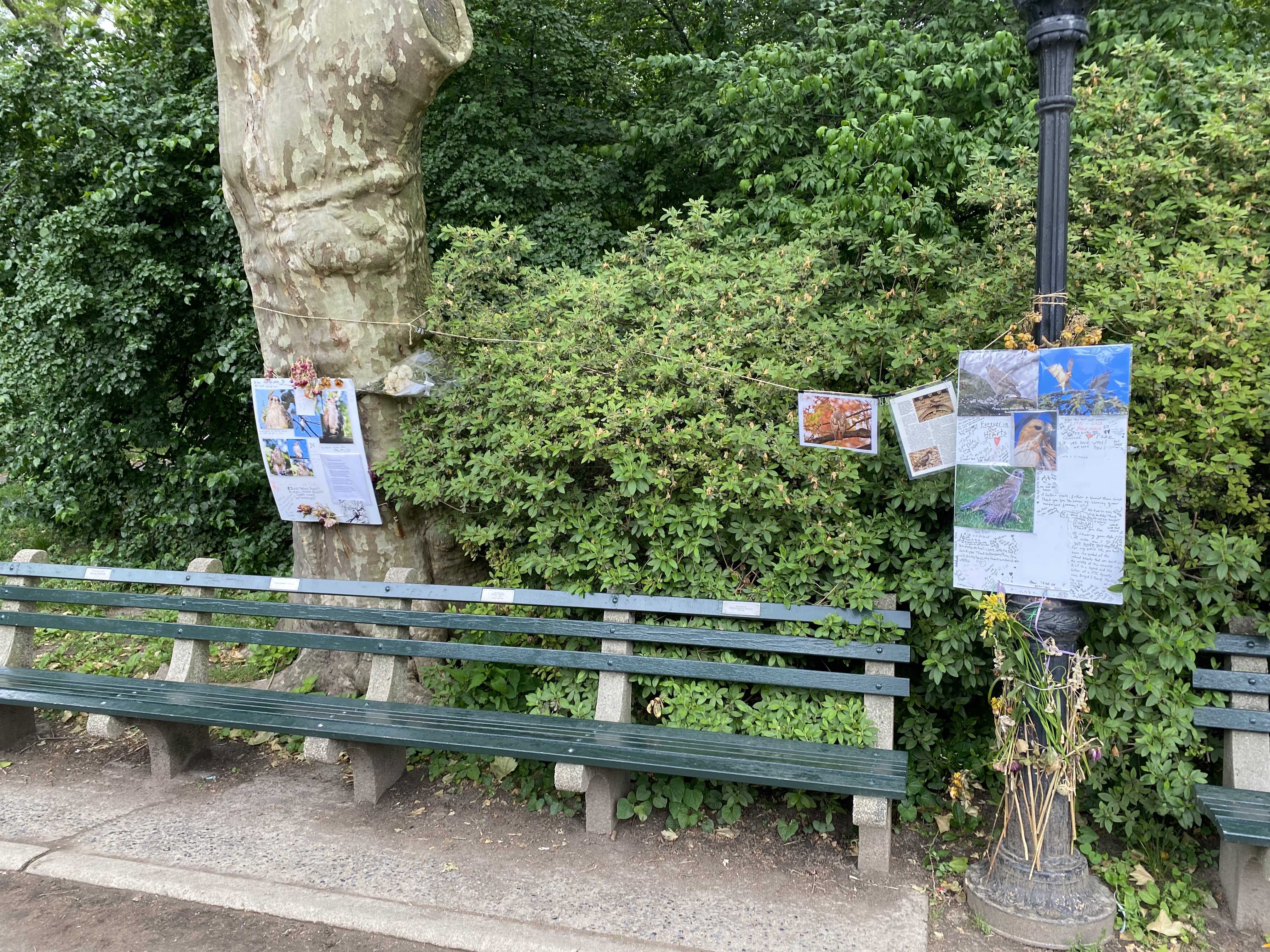
On May 15, 2023, New York City Urban Park Ranger Nick Baisley found Pale Male sick and grounded in Central Park. Wildlife rehabilitator Bob Horvath rushed him to a veterinarian for blood work and X-rays, then transferred him to WINORR for supportive care. Pale Male died the following evening, May 16, 2023, at the age of 33 -- remarkably old for a red-tailed hawk, whose typical lifespan in the wild is closer to 15 years. A makeshift memorial appeared near Conservatory Water, the pond where birders had spent decades aiming their telescopes at his ledge. Whether Pale Male was truly one bird for all those years, or whether a similarly colored hawk replaced him at some point without anyone noticing, remains an open question. What is not in question is the effect: a single raptor convinced a city of eight million people that wilderness was not something they had left behind.
From the Air
Pale Male's nest was at 927 Fifth Avenue on Manhattan's Upper East Side, overlooking Central Park's Model Boat Pond (Conservatory Water). Coordinates: 40.775N, 73.966W. From altitude, look for the distinctive green rectangle of Central Park with the dense Upper East Side grid to the east. The nest building is on Fifth Avenue at approximately 74th Street. Nearby airports: KLGA (LaGuardia, 6nm NE), KJFK (JFK, 14nm SE). Best viewed at 2,000-3,000 ft AGL for the park-to-city edge where the hawks hunted.