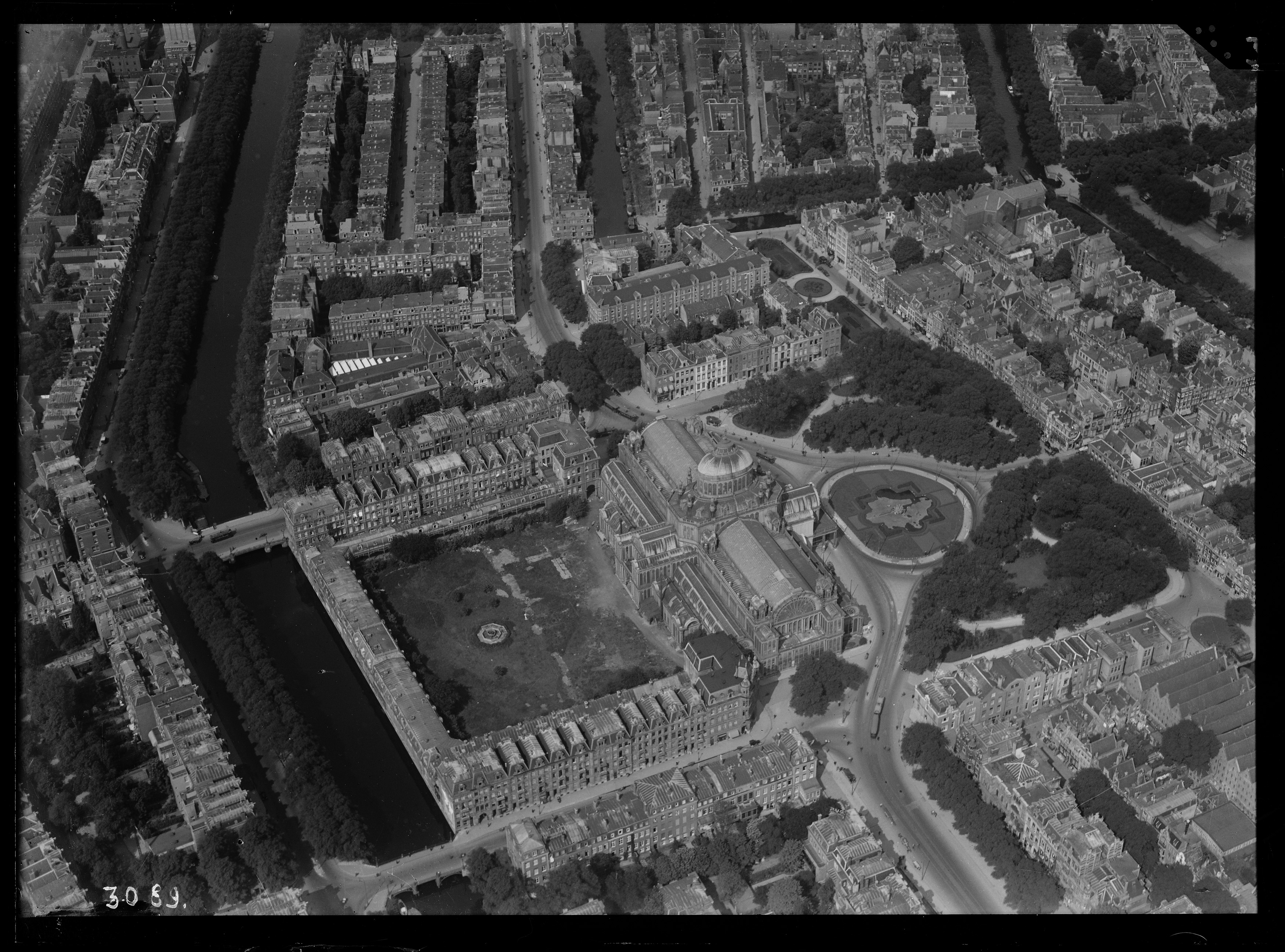
Paleis voor Volksvlijt
The fire took less than a night. By morning on April 18, 1929, the great iron skeleton at the foot of the Frederiksplein had collapsed into itself, and Amsterdam stood looking at the gap where its Crystal Palace had been. For sixty-five years, the Paleis voor Volksvlijt had been the proudest building on the eastern side of the canal ring: a vast hall of glass and iron lattice that locals used to call a cathedral built for industry. Now it was twisted metal, broken panes, and the smell of burnt timber drifting across the Amstel. The shopping arcade that wrapped around it survived the flames. The palace itself never came back.
A Doctor's Obsession
The whole thing began with a Jewish physician named Samuel Sarphati, who walked through Joseph Paxton's Crystal Palace in London in 1851 and could not stop thinking about it. Sarphati was already a public-health crusader in Amsterdam, the kind of restless reformer who pestered city councils about clean water, bread quality, and proper schools. When he came home, he founded the Vereeniging voor Volksvlijt, the Association for Popular Diligence, with one goal: Amsterdam needed a building that would announce, in glass and iron, that the Netherlands belonged in the industrial age. He petitioned the municipality in 1853. He got approval in 1855. He outlasted a failed design competition. On September 7, 1859, with King William III standing in the autumn cold, the first stones went into the ground. The building opened on August 16, 1864.
The Cathedral of Industry
Cornelis Outshoorn's design rose 64 meters at its central dome, a transparent vault held up by an iron frame so slender it seemed to defy gravity. Inside, the hall held machinery exhibits, orchid shows, balloon ascents, weekly concerts. The Palace Orchestra played here every week from 1865, and in 1875 the French organ-builder Aristide Cavaille-Coll installed a concert organ that ranked among Europe's finest. Alexandre Guilmant opened it on October 26 of that year. Over the following decades, Charles-Marie Widor, Louis Vierne, and Camille Saint-Saens all sat at its keyboard. The Belgian Jean-Baptiste de Pauw was the resident organist from 1879. For a stretch of years, if you wanted to hear the great organ music of the late nineteenth century in the Netherlands, the Paleis voor Volksvlijt was the room to be in.
The Slow Decline
It never quite paid for itself. Exhibitions did not draw the crowds Sarphati had imagined, and the building drifted from industrial showcase to all-purpose entertainment hall. Part of the garden was carved off for a luxury shopping arcade, designed by Adolf Leonard van Gendt and built between 1881 and 1883, which wrapped along Sarphatistraat in glass-roofed elegance. When the Concertgebouw opened across town in 1888 with its own grand organ, audiences quietly migrated. The operatic company that performed here went bankrupt in 1895. The orchestra was dismissed. The Cavaille-Coll organ was sold to Haarlem, where two wealthy patrons named Adriaan Stoop and Julius Carl Bunge sponsored the move, and it still plays today at the Philharmonie Haarlem. By the 1920s, the Palace was a glamorous shell hosting circuses and trade shows.
The Night It Burned
Around midnight on April 17, 1929, fire broke out in the main hall. The cause was never definitively settled. What is certain is that an iron-and-glass building stuffed with dry timber flooring and decades of accumulated stage equipment goes up the way a torch does. Firefighters could only contain the edges. The arcade survived; the main palace did not. The site sat as ruined ground for years. The novelist Gerard Reve lived in one of the arcade apartments in the 1950s, writing in rooms that looked out onto absence. In 1960 the arcade itself came down to make way for the headquarters of De Nederlandsche Bank, the central bank that now occupies the Frederiksplein. Stand on the square today and you can trace the old footprint in the paving stones if you know where to look.
From the Air
Frederiksplein sits at 52.36 N, 4.90 E in central Amsterdam, just east of the canal ring and south of the Amstel river bend. From cruising altitude, look for the dense ring of curved canals around the city core and the modern block of De Nederlandsche Bank on the plein's southern edge - the palace once stood directly behind it. Nearest airport: Amsterdam Schiphol (EHAM), 12 km southwest. Best viewing in clear weather at 3,000-5,000 feet.