Palenque
The jungle took Palenque back slowly. Cedar, mahogany, and sapodilla trees grew over the temples, swallowing a city that had rivaled Tikal in its prime. For centuries, the ancient Maya capital known in the Itza language as Lakamha -- meaning 'big water' -- lay hidden 150 meters above sea level in what is now southern Chiapas, near the Usumacinta River. The ruins that archaeologists have uncovered span roughly a thousand years, from about 226 BC to 799 AD, though only an estimated five percent of the total city has been excavated. What that fraction has revealed is staggering: one of the richest royal tombs in the pre-Columbian Americas, hieroglyphic texts that unlocked the first dynastic history of any Maya city, and architecture so refined that it changed how scholars understood an entire civilization.
The King Who Rebuilt from Ruin
Palenque's most famous structures were not born from prosperity but from disaster. In 599 and again in 611, the rival city of Calakmul invaded and sacked the city. The second attack was devastating -- the king of Calakmul entered Palenque in person, and the inscriptions record that fundamental religious ceremonies went unperformed in 613. 'Lost is the divine lady, lost is the king,' the glyphs state. Into this chaos came Kinich Janaab Pakal, who ascended the throne in 615 at the age of twelve. His mother, Queen Sak Kuk, had governed for three years to hold the dynasty together until her son was old enough to rule, and she remained a powerful force for the first 25 years of his reign. Pakal governed for 68 years, marrying the princess Lady Tzakbu Ajaw in 624 and transforming a broken city into the most splendid in the Maya world. Most of Palenque's surviving palaces and temples date from his reign, including the great Palace complex that was enlarged in 654, 661, and 668.
Buried in Jade
Despite two centuries of visits by explorers, nobody suspected that the Temple of the Inscriptions contained a royal tomb until 1952, when Mexican archaeologist Alberto Ruz Lhuillier lifted a stone slab from the temple floor and found a rubble-filled stairway descending into the pyramid. It took two more years to clear the passage. At the bottom lay Pakal's burial chamber, the richest scientifically excavated tomb then known in the ancient Americas. His sarcophagus, built for a very tall man, held the largest collection of jade ever found in a Maya burial. A jade mosaic mask covered his face, its eyes made of shell, mother of pearl, and obsidian. A full suit of jade adorned his body, each piece hand-carved and held together by gold wire. The carved sarcophagus lid depicts Pakal as a manifestation of the Maya maize god, emerging from the jaws of the underworld. A hollow duct called a psychoduct runs from the tomb up through the stairway to the temple above -- perhaps a path for the soul, mirroring the Maya phrase ochbihaj sak ikil: 'the white breath road entered.'
Written in Stone
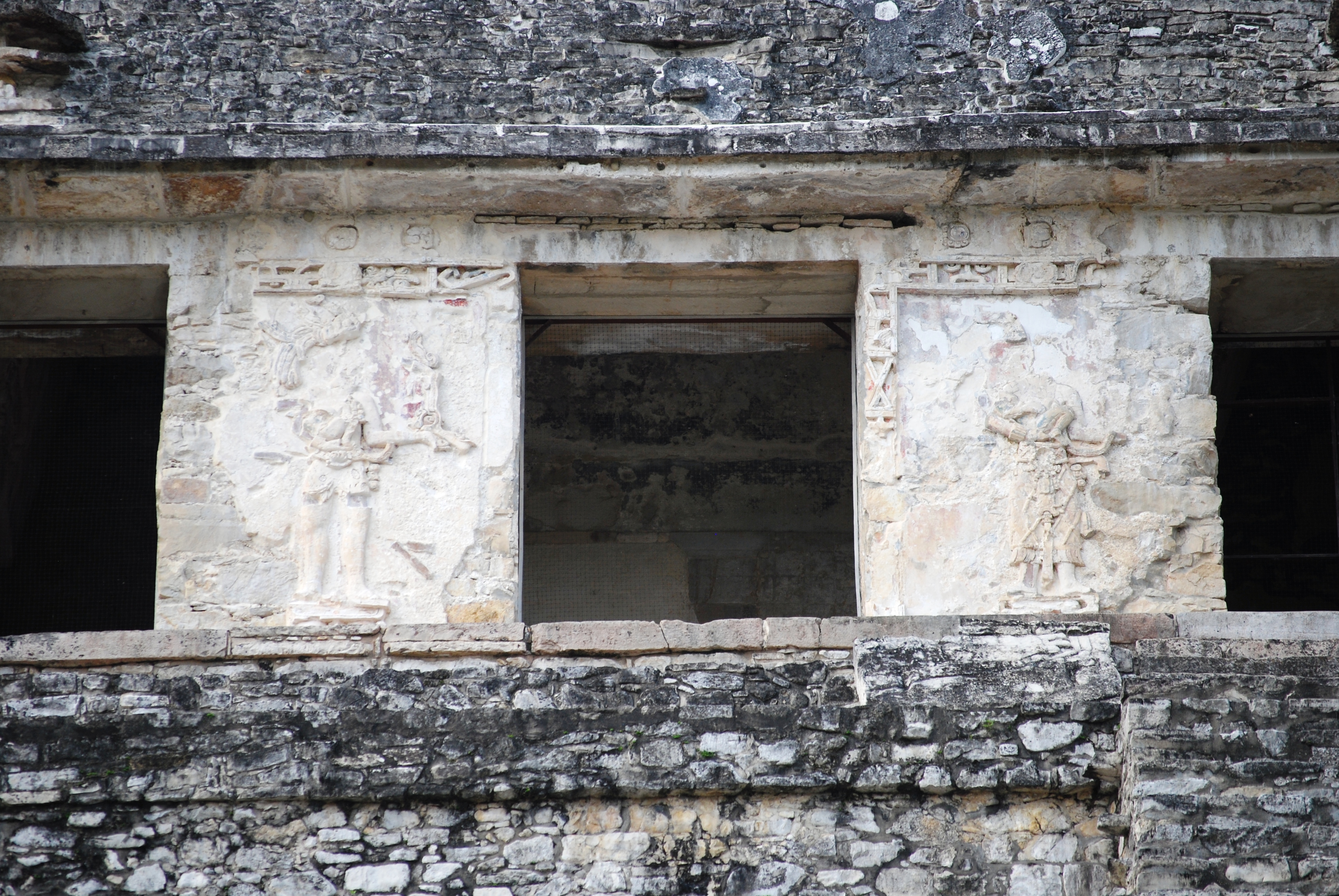
Palenque's hieroglyphic corpus is among the most extensive in the Maya world, and it was here that the modern decipherment of Maya history began. Heinrich Berlin first identified what he called 'emblem glyphs' at Palenque, and later Linda Schele and Peter Mathews used the site's inscriptions to reconstruct the first complete dynastic list for any Maya city. The Temple of the Inscriptions houses three great tablets -- the East, Central, and West -- that together form one of the longest known Maya texts at 617 glyphs. They record roughly 180 years of Palenque's history, from Pakal's ritual activities to the announcement of his death and the naming of his son Kan Bahlam II as heir. Nearby, the Cross Group temples -- the Temple of the Cross, the Temple of the Sun, and the Temple of the Foliated Cross -- contain elaborately carved reliefs that were once vividly painted in red, yellow, and blue. The cross-like images that gave the temples their names actually depict the Maya tree of creation at the center of the world.
Fossils Beneath the Temples
The limestone from which Palenque's temples were built carries a hidden record far older than the Maya. Paleontologists studying the building stones and the quarries they came from have found remarkably well-preserved fossils of marine fish and invertebrates dating to the Early Paleocene, shortly after the asteroid impact that ended the age of dinosaurs. These fossils document the recovery of marine ecosystems following the Cretaceous-Paleogene extinction event, including some of the earliest known modern reef fish -- serranids, damselfish, and syngnathiforms -- alongside some of the last members of extinct groups like pycnodontids. The site lies relatively close to the Chicxulub impact crater, making these fossils evidence of resilience at the doorstep of catastrophe. The Maya, of course, knew nothing of this deeper history. They quarried the stone, shaped it into temples, and carved it with glyphs recording their own dynasties -- never suspecting that the rock itself held the record of an extinction 65 million years earlier and the life that followed.
From the Air
Located at 17.484N, 92.047W in the lowland jungle of northern Chiapas, roughly 130 km south of Ciudad del Carmen at 150 meters elevation. The archaeological zone is surrounded by dense tropical forest; the cleared temple complexes and the Palace tower are visible from moderate altitude. Nearest airports include Palenque (MMPQ) immediately adjacent to the modern town, and Villahermosa (MMVA) approximately 150 km to the north. Humid conditions with roughly 2,160 mm of annual rainfall; morning mist is common.