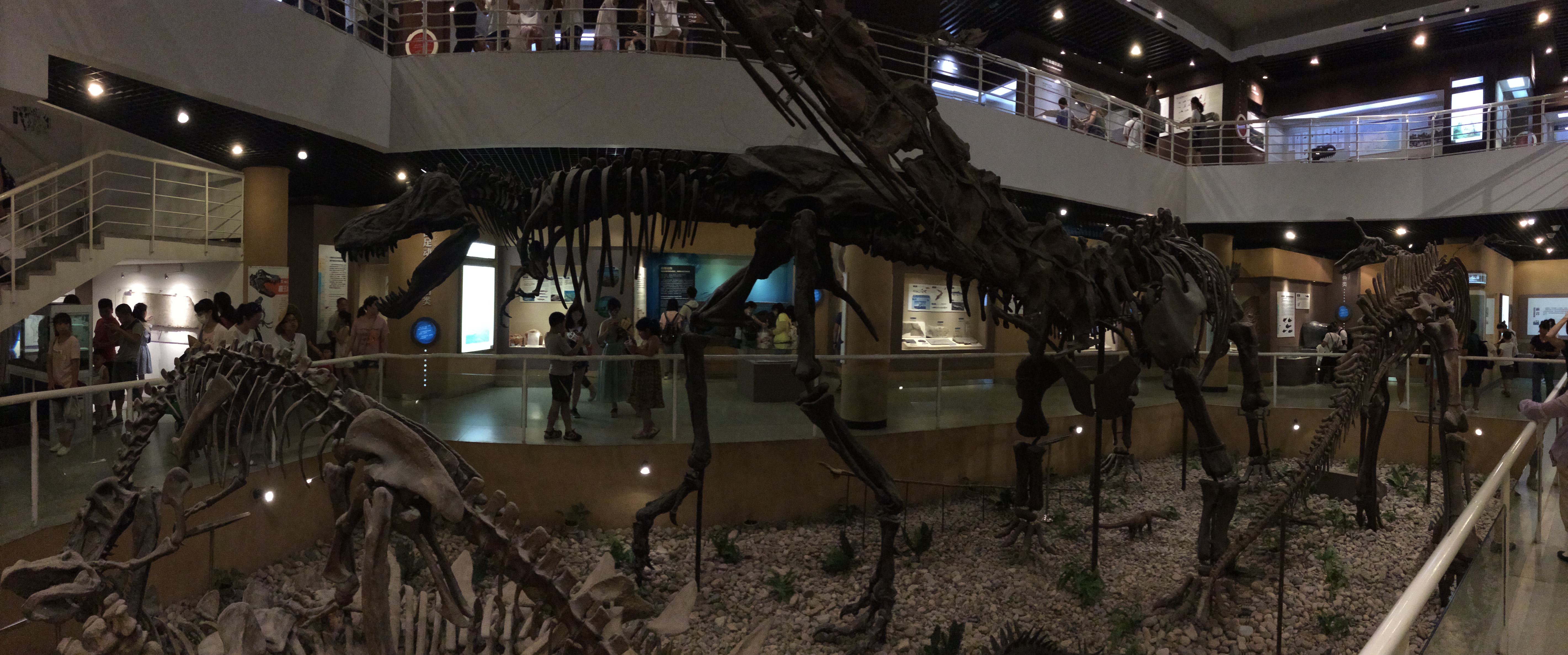
Paleozoological Museum of China
The skeleton of Lufengosaurus stands at the center of the gallery, mounted in the same pose it held when Chinese excavators uncovered it decades ago -- the first dinosaur fossil ever found in China. Around it, on three floors of a building shared with the Institute of Vertebrate Paleontology and Paleoanthropology, hundreds of specimens tell a story of life on the Chinese landmass stretching back to the Cambrian. This is not a museum that merely displays the ancient dead. Behind the public galleries, researchers including the prolific paleontologist Xu Xing continue to name and describe new species, some of which visitors can see mounted just meters from the lab doors.
Fossils Found Nowhere Else
What makes the Paleozoological Museum distinctive is not its size but its exclusivity. Many specimens on display represent extinct animals found only within the boundaries of modern-day China, creatures like Sinokannemeyeria that tell a uniquely Chinese chapter of Earth's biological history. The collection contains numerous holotypes -- the original specimens used in scientific journals to formally describe new species. Among the most celebrated are the holotypes of Confuciusornis, an early bird from the Cretaceous, and Microraptor, the four-winged dinosaur whose feathered limbs helped reshape scientific understanding of the relationship between dinosaurs and birds. Both were recovered during field expeditions to Liaoning province, where exceptional geological conditions preserved soft tissue details rarely found elsewhere.
A Walk Through Deep Time
The museum's three floors are arranged as a journey through evolutionary time. The ground level opens with Cambrian fossils from southern China before moving through Mesozoic reptiles, where a dramatic central installation features mounted skeletons of Tsintaosaurus, Mamenchisaurus, Tyrannosaurus, and a Monolophosaurus in the act of attacking a Tuojiangosaurus. A preserved coelacanth from South Africa -- that living fossil once thought extinct for 65 million years -- sits in a nearby glass case. The second floor is devoted to Mesozoic life, including a section on dinosaur eggs and the notorious 'Archaeoraptor' composite fossil that generated controversy in 1999. On the third floor, the timeline jumps to the Cenozoic, where mounts of the ancient elephant relative Stegodon and the shovel-tusked Platybelodon stand alongside a woolly mammoth skull.
Peking Man and His Neighbors
An adjoining gallery on the main floor shifts from paleontology to paleoanthropology, housing the Shu-hua Museum. Here, the focus narrows to the origins of humanity in China. Casts of skulls from early hominids discovered at Zhoukoudian, about 50 kilometers southwest of Beijing, fill the display cases -- including a bronze bust of Peking Man, the Homo erectus specimen unearthed during excavations between 1923 and 1927. Life-sized dioramas depict what these ancient inhabitants may have looked like, making fire and fashioning stone tools. The proximity of these human ancestors to the dinosaur galleries creates a vertigo of scale: the Mamenchisaurus on the floor below lived roughly 160 million years ago, while Peking Man walked these hills perhaps 750,000 years ago.
Science in Progress
Unlike many natural history museums that function primarily as exhibition spaces, the Paleozoological Museum shares its building with an active research institute. The Institute of Vertebrate Paleontology and Paleoanthropology, part of the Chinese Academy of Sciences, continues to mount expeditions and publish discoveries. Xu Xing, one of the most productive paleontologists alive, has named and described dozens of dinosaur species, and examples of his finds are on display. The museum underwent a renovation in 2014, but its character remains that of a working scientific institution where the boundary between research and public education is deliberately thin. Visitors walk past the same specimens that appear in peer-reviewed journals, in a building where new pages of Earth's history are still being written.
From the Air
Coordinates: 39.936N, 116.328E. Located in western Beijing's Haidian District. Not individually distinguishable from the air, but the surrounding area includes Beijing Zoo and Purple Bamboo Park as visual landmarks. Nearest major airport is Beijing Capital International (ZBAA/PEK), about 30 km northeast. Beijing Daxing International (ZBAD/PKX) lies approximately 55 km to the south.