Palingsound
It is one of the strangest origin stories in European pop music. A working fishing village of a few thousand people, wedged between the dike and the IJsselmeer, somehow produced a generation of Dutch radio stars - and the sound they made together came to be named after the slippery silver fish their fathers and grandfathers had pulled from the water for centuries. The genre is called palingpop. Its signature is the palingsound. Both terms come from paling, the Dutch word for European eel.
A Sound Built on Harmony
Palingsound is not loud music. It does not demand attention; it lures it. Close vocal harmonies sit at the center, often in close thirds, sometimes layered three or four voices deep. The arrangements lean melodic and slightly melancholic, smoothed over by a continental European mixing approach that favors warmth and presence over edge. Many of the songs are sentimental in subject - love lost, harbors at dusk, the people who never came home from the sea. The style draws on beat music and soft rock, but it filters those influences through something older: the choral tradition of a tight-knit Catholic village where everyone could already sing, because everyone had grown up singing together in church and at the kitchen table.
The Cats Light the Fuse
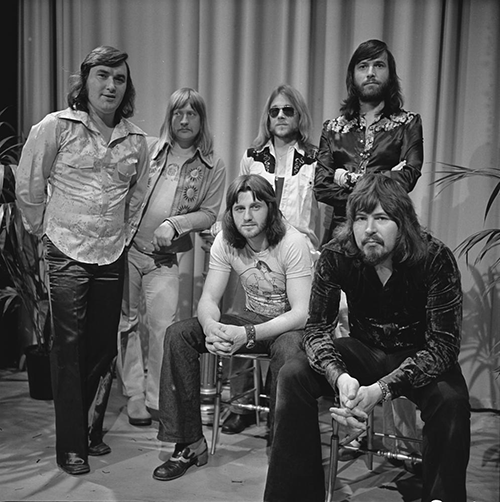
The genre's founding band was The Cats, formed in Volendam in 1964. They began as a beat group in the British Invasion mold, but their music shifted toward melody and harmony as the decade wore on. The pivot came in 1968, when Piet Veerman took over as lead singer. His voice - aching, slightly weathered, capable of going small in a way that made arenas feel intimate - became the template for what palingsound would sound like. Bass player Arnold Muhren wrote the hits. Songs like "Why" (1969) and "Marian" (1970) made The Cats one of the most successful Dutch acts of their era. The band recorded until 1985, sold millions of records, and proved something that mattered later: a village band could go national, and then keep going.
Where the Name Came From
The name itself was a joke that stuck. Joost den Draaijer, a DJ at Radio Veronica, is credited with coining "palingsound" - and the story behind it is small, domestic, and very Volendam. Jan Buijs, The Cats' manager, would drive into the Veronica studio with smoked European eel from the village, gifts for the DJ. The eel kept coming; the band kept coming back; eventually the music and the fish became inseparable in den Draaijer's mind. He started using the term on air. By the early 1970s, journalists in Het Vrije Volk were using it too. A genre had been named after a snack.
BZN, Next One, and the Long Run
The success of The Cats opened a door, and other Volendam musicians walked through it. BZN went pop after starting as a beat band, racking up European hits through the 1970s and 80s with the same harmony-forward approach. Maddog, Left Side, and Next One worked the same vein. The town became something close to a Dutch Liverpool in miniature, except that almost everyone involved had grown up within a few streets of each other and many of them were related. Later generations kept the line going - Nick and Simon, Jan Smit, and Monique Smit all came up through the same musical ecosystem, singing in Dutch for a Dutch audience and inheriting a sound that had been refined in Volendam's kitchens, churches, and small clubs since the 1960s.
Why Volendam
The honest answer is that nobody fully knows. There is the church-singing tradition, the village's small geography that forced musicians to play together rather than compete, the strong family networks that turned one successful band into a feeder system for the next, and the willingness of Volendammers to sing sentimentally in their own language at a time when most of European pop was switching to English. There is also the eel itself - the symbol that anchors the sound to a specific place, a specific work, a specific past. The fishing fleet has shrunk; the eel is endangered; the harbor is now mostly tourists. But the music made in the name of that fish keeps coming out of Volendam, generation after generation, sung in close harmony.
From the Air
Volendam sits on the western shore of the Markermeer at 52.50N, 5.07E. Amsterdam Schiphol (EHAM) lies 25 km southwest; Lelystad (EHLE) is 30 km east across the water. From altitude, the village reads as a small dense cluster on the inside of the IJsselmeer dike, with the long straight line of the Markermeerdijk running north toward Hoorn.