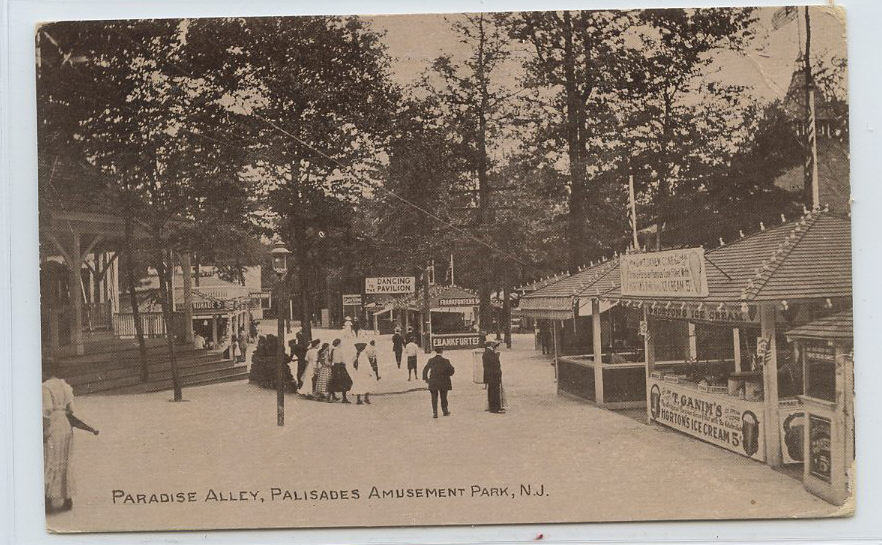
Palisades Amusement Park
There was a hole in the fence behind the music stage, and every kid in Bergen County knew about it. Irving Rosenthal, the man who ran Palisades Amusement Park for nearly four decades, knew about it too. He told his security guards to look the other way. Children who sneaked in for free, he reasoned, would spend whatever pocket change they had once inside. That combination of shrewd business sense and genuine affection for the crowds defined a place that, from 1898 to 1971, stood perched on the cliffs across the Hudson from Manhattan and drew millions who answered its famous jingle: "Come on over!"
From Trolley Stop to Thrill Ride
The park began as a scheme to sell trolley tickets. In 1898, the Bergen County Traction Company carved out 30 acres atop the New Jersey Palisades, straddling the border of Cliffside Park and Fort Lee, and called it "The Park on the Palisades." The idea was simple: give evening and weekend riders a reason to board the trolley. A Ferris wheel, a baby parade, diving horses -- the attractions were modest, but the setting was extraordinary. The park overlooked the Hudson River, with the northern tip of Manhattan spread out below like a postcard. In 1910, Nicholas and Joseph Schenck, who would go on to reshape Hollywood as heads of MGM and United Artists, bought the park and began adding real amusement rides. But the transformation that would define Palisades came in 1934, when brothers Jack and Irving Rosenthal -- Coney Island concessionaires who had built the famous Cyclone roller coaster -- purchased the site for $450,000 and poured their showmanship into every acre.
The Rosenthal Touch
The Rosenthals understood spectacle. They rebuilt the Skyrocket roller coaster and renamed it the Cyclone, after their Coney Island original. They added a Wild Mouse coaster in 1958 and erected a music pavilion that, by the mid-1950s, hosted rock and roll shows emceed by Clay Cole and "Cousin Brucie" Morrow. Motown acts followed in the 1960s. Irving Rosenthal printed free-admission coupons on matchbooks and in the back pages of comic books, recognizing that New York's youth represented the nation's largest comic-book market. Parking was free. From 1947 to 1971, the park averaged six million visitors a year, peaking at ten million in 1969. The jingle that blanketed radio and television -- written by Irving's wife, songwriter Gladys Shelley -- became one of the most recognized advertising earworms in the New York metropolitan area. In 1962, Chuck Barris composed "Palisades Park" for Freddy Cannon, and the song became a nationwide hit that pushed attendance even higher.
Shadows Behind the Lights
The park's history was not all cotton candy and carousel music. In 1935 and again in 1944, fires ravaged the grounds -- the second killed six people and shuttered the park until 1945. More troubling was the park's segregation policy. In 1946, management created the Sun and Surf Club, ostensibly a membership-only pool club, but in practice a mechanism to bar Black patrons. When eight Black visitors and two white companions tried to enter together that July, the white visitors were sold tickets while the Black visitors were turned away. African Americans organized protests, some carrying signs that read "Protest Jim Crow." The pool's discriminatory practices became a focal point for civil rights activism in northern New Jersey, a reminder that the fight for equality was not confined to the South.
The Last Season
Success, ironically, planted the seeds of the park's demise. Ten million visitors a year overwhelmed on-site parking. Overflow lots stretched from the George Washington Bridge to the Lincoln Tunnel. Local residents seethed over traffic, noise, and litter. When Jack Rosenthal died of Parkinson's disease in 1967, Irving, then in his seventies and without heirs, became sole owner of a park that developers wanted gone. The local government rezoned the site for high-rise apartments. In January 1971, the Winston-Centex Corporation of Texas acquired the property for $12.5 million, leasing it back to Irving for one final summer. The park closed on September 12, 1971. The last person to swim in its famous saltwater pool -- once billed as the world's largest outdoor saltwater pool -- was Curt Kellinger, son of the longtime pool manager. The rides were dismantled and shipped to parks across the United States and Canada. Vandals destroyed the pool's filtration system before anyone could save it.
Ghosts on the Bluff
Four high-rise apartment towers now stand where the Cyclone once roared. In 1998, on the centennial of the original Park on the Palisades, the Winston Towers complex dedicated a small monument called "The Little Park of Memories," its bricks inscribed with the names of long-gone rides. Five original Cyclone roller coaster cars were recovered from Pennsylvania in 2014, decades after the park closed, and brought back to Bergen County for restoration. The park lives on in an unlikely cultural afterlife: a glimpse of its lights across the Hudson in the 1945 film The Clock, a painted advertisement in the original West Side Story, a pink balloon in Mad Men, a jukebox playing Freddy Cannon in The Many Saints of Newark. For generations of New Yorkers and New Jerseyans, Palisades Amusement Park was summer itself -- a place where the admission was free if you knew the right hole in the fence.
From the Air
Located at 40.828N, 73.978W atop the New Jersey Palisades in Cliffside Park/Fort Lee, NJ. The former park site is now occupied by four high-rise apartment towers (Winston Towers, Carlyle Towers, Royal Buckingham) visible from the air along the cliff edge overlooking the Hudson River. Look for the cluster of tall residential buildings between the George Washington Bridge to the north and the Palisades cliff line. Nearest airports: Teterboro (KTEB) 4nm northwest, LaGuardia (KLGA) 8nm east. Best viewed at 2,000-3,000 ft AGL following the Hudson River corridor.