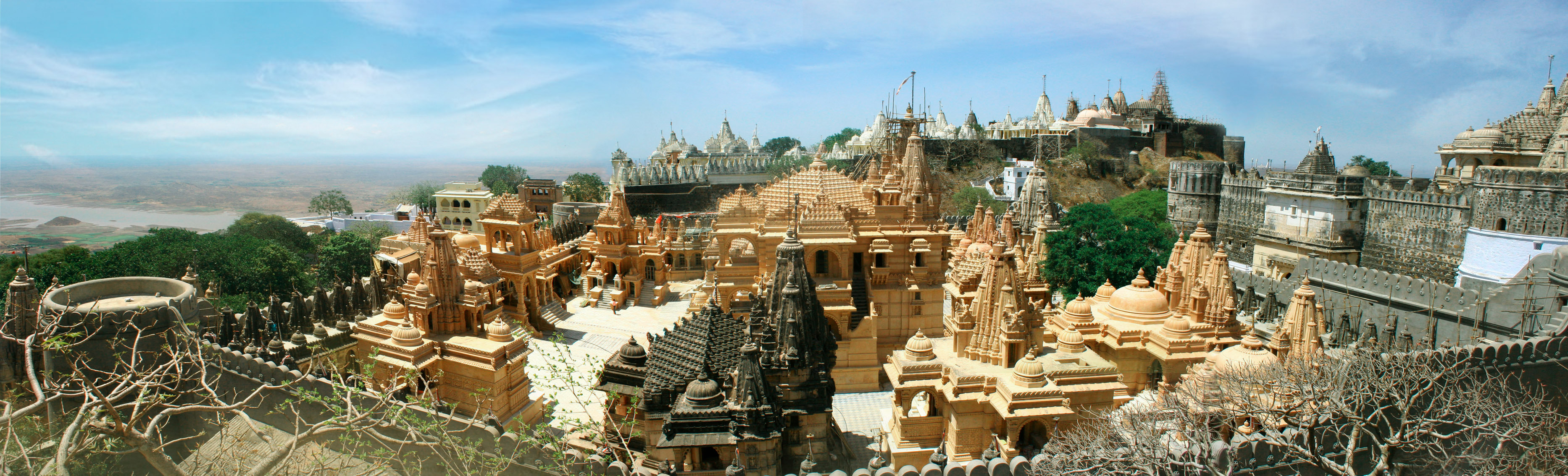
Palitana Temples
No one lives on Shatrunjaya hill after dark. Every evening, the priests descend the 3,500 stone steps, the temple doors are sealed, and the hilltop belongs to the gods alone. This has been the rule for centuries at Palitana, where nearly 900 Jain temples cluster across two ridges in Bhavnagar district, Gujarat, forming what may be the densest concentration of sacred architecture anywhere on Earth. The earliest structures here date to the 11th century, though Jain tradition holds that the first temple was built by Rishabhadeva's son Bharata, making Shatrunjaya one of the holiest pilgrimage sites in the Shvetambara tradition. Pilgrims call this place Siddha-kshetra, the land of the spiritually accomplished, and they climb toward it long before dawn.
A City That Empties at Sunset
The temples of Palitana are organized into nine fortified enclosures called tuks, each named for the merchant or family that funded its construction. The largest and most important is the Adinath temple, dedicated to Rishabhadeva, the first Tirthankara, and sitting at the highest point of the hill. Its central image draws pilgrims who have climbed since before first light, many barefoot, some carrying elderly relatives who can no longer manage the ascent alone. The complex is not a single architectural statement but an accretion, a thousand years of devotion layered in marble and sandstone. Temples were destroyed by Muslim invaders in the 14th and 15th centuries and rebuilt each time, the community pouring wealth into reconstruction with the same conviction that had built them originally. What stands today is mostly from the 16th century onward, though some foundations are far older.
Marble Against Monsoons
The architectural achievement of Palitana is extraordinary given its location. The hilltop sits exposed to Gujarat's fierce monsoon winds, yet the temples are carved with a delicacy that rivals the finest Mughal miniatures. Intricate latticework screens in marble filter sunlight into cool interiors. Pillars carry carvings so dense that every surface tells a story from Jain cosmology. The Chaumukha temples, with images of Tirthankaras facing all four cardinal directions, announce their spiritual message to every approach. The Kumarpal temple, one of the oldest surviving structures, features carved ceilings of exceptional refinement. Construction materials had to be carried up 3,500 steps by laborers and pack animals, a logistical undertaking that makes the sheer quantity of carved stone all the more remarkable. Each tuk operates as a kind of walled compound, creating a labyrinthine cityscape of spires and domes visible for miles across the flat Kathiawar peninsula.
The Economics of Devotion
Palitana's temples were built almost entirely by private donation, primarily from Jain merchants whose trading networks stretched across western India and beyond. Building a temple on Shatrunjaya was considered among the highest acts of merit, and wealthy families competed to leave their mark on the sacred hill. The Anandji Kalyanji Trust, whose origins trace to the 17th century and which formally took its current name in the early 18th century, remains one of the oldest religious trusts still operating in India. Its records document centuries of construction, repair, and renovation, tracking the flow of merchant wealth into stone. In 2014, Palitana became the world's first legally vegetarian city when the Gujarat government banned the sale of meat and eggs within city limits, a recognition of the Jain principle of ahimsa, or nonviolence, that permeates life around the sacred hill.
The Climb as Practice
Pilgrimage to Shatrunjaya is not merely visiting a temple. It is the climb itself that constitutes the act of devotion. The 3,500 steps rise over 600 meters from the town below, and pilgrims begin ascending well before dawn to avoid the heat that builds over the exposed hillside by midmorning. Some make the journey barefoot. Others hire dholis, teams of four men who carry the elderly or infirm in cloth slings suspended from bamboo poles, navigating the steep stone stairway with practiced coordination. Along the route, smaller shrines and rest stops mark the stages of ascent. The Jain concept of samvatsari, or the annual day of forgiveness, brings the largest crowds, when tens of thousands make the climb together. At the summit, the panorama extends across the Kathiawar plains to the Gulf of Cambay, a view that rewards the effort with a sense of elevation both physical and spiritual.
From the Air
The Palitana temples are located at 21.52N, 71.83E atop Shatrunjaya hill near Palitana in Gujarat's Bhavnagar district. From the air, the dense cluster of white marble temples and spires is visible on the hilltop, especially striking against the brown-green landscape. Best viewed at 2,000-4,000 feet AGL from the south or west. The nearest major airport is Bhavnagar Airport (VABV), approximately 50 km to the northeast. Ahmedabad's Sardar Vallabhbhai Patel International Airport (VAAH) is about 215 km north. Clear visibility is common outside monsoon season (October-May).