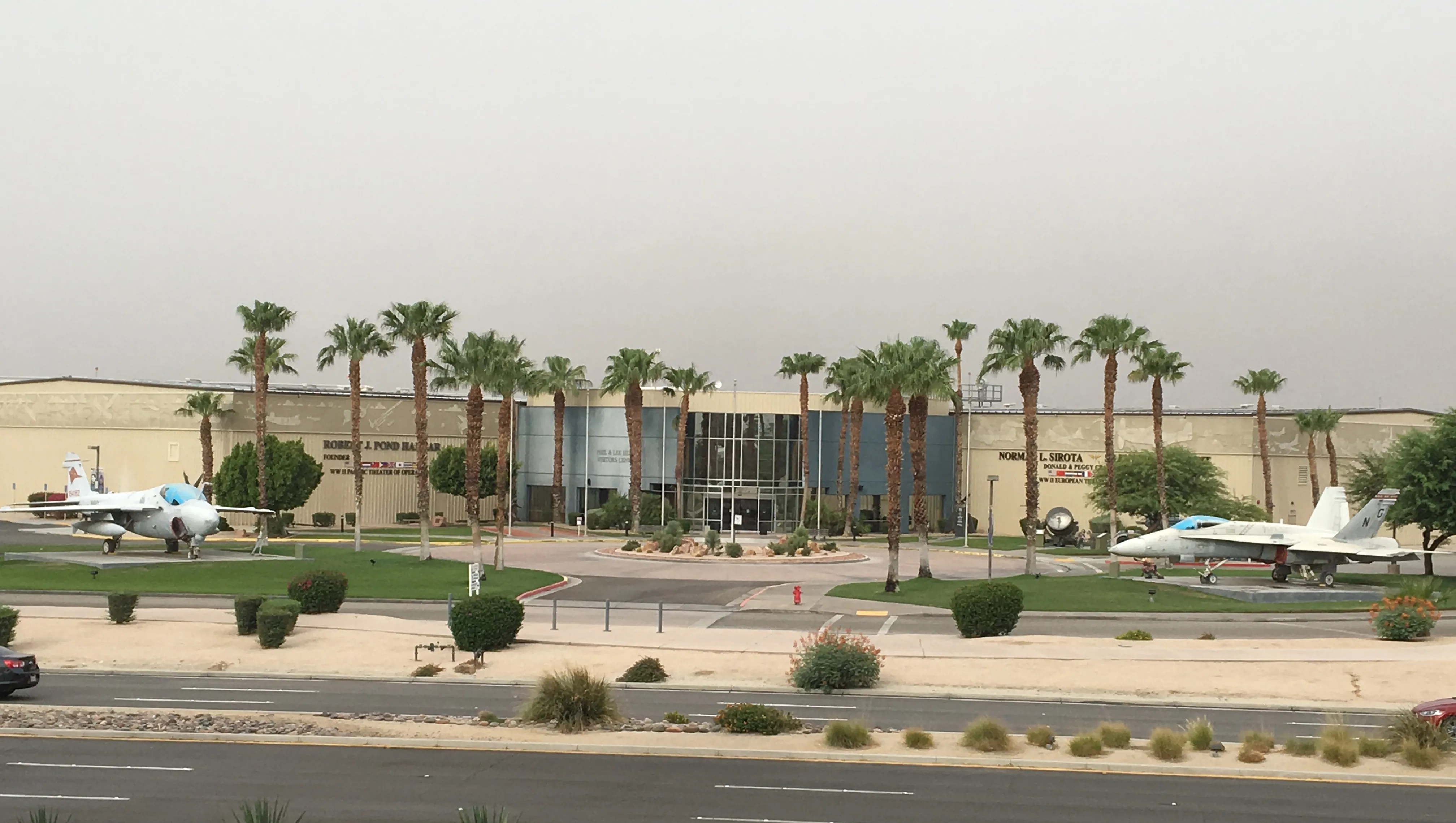
Palm Springs Air Museum
Fifty years in a lake does not improve most things, but the Douglas SBD-5 Dauntless dive bomber recovered from the bottom of Lake Michigan had the desert waiting for it. The aircraft, one of the type that helped turn the tide of the Pacific War at the Battle of Midway, was retrieved after half a century under water and eventually found its way to the Palm Springs Air Museum, where it joined one of the more eclectic collections of World War II aviation on the West Coast. The museum opened November 11, 1996 — Armistice Day, now Veterans Day — on 17 acres adjacent to Palm Springs International Airport, and the date was not an accident.
Three Men and a Collection
The museum was founded by Harold Madison, Charles Mayer, and Bill Byrne, who built its initial collection around aircraft donated by Robert Pond, a World War II veteran whose private holdings formed the nucleus of what would grow into a comprehensive WWII aviation collection. Pond's aircraft came with stories — not the institutional histories of war museums but the personal histories of men who had flown them and maintained them and sometimes survived them. The founders' goal was to preserve not just the machines but the human context that made them meaningful: the crews, the campaigns, the specific moments when mass-produced aircraft and individual courage intersected.
Famous Aircraft, Famous Stories
The museum's collection includes aircraft with specific film histories. A B-17, known as the Movie Memphis Belle, was used in the 1990 film about the famous bomber crew. A P-51 Mustang called Man O' War served as a prop in the 1957 film *Battle Hymn*. These are not replicas but actual aircraft, which means visitors are standing beside objects that have been in both combat and cinema — a combination that collapses the distance between documentary and dramatic history in an instructive way. Walt Disney's personal Grumman Gulfstream I is on loan from the Disney Archives, connecting the museum's aviation collection to a different kind of American cultural institution.
From Lake Michigan's Floor
During World War II, the Navy trained pilots on Lake Michigan using aircraft carriers — a safer option than the open ocean for student aviators. Many aircraft that ditched or crashed during training remained at the bottom of the lake for decades, preserved by the cold, fresh water. The SBD-5 Dauntless recovered and eventually displayed at the Palm Springs Air Museum is one of these recoveries, pulled from the lake bed after fifty years and painstakingly restored. The Dauntless was the dive bomber flown during the decisive Battle of Midway in June 1942, and the aircraft type's role in that engagement is fundamental to understanding how the Pacific War evolved. Having an actual specimen, with a specific service history, makes that history tangible.
Desert Preservation
The Palm Springs location is not accidental for a museum dedicated to preserving aluminum and steel aircraft. The desert air — low humidity, intense sun, minimal rainfall — is among the most hospitable environments for aircraft preservation in the world. The nearby Davis-Monthan Air Force Base in Tucson, Arizona hosts the largest aircraft boneyard in the world for the same reason. The Palm Springs Air Museum benefits from this natural advantage, and its location adjacent to the airport provides an authentic aviation context: visitors arrive at a working airport and walk into an institution where the aircraft on display were also, once, at working airports, engaged in the business of war.
From the Air
Located at 33.83°N, 116.51°W adjacent to Palm Springs International Airport (ICAO: KPSP). The museum's hangars are visible from the runway and from cruising altitude on approach. The airport is approximately 0.5 miles to the south.