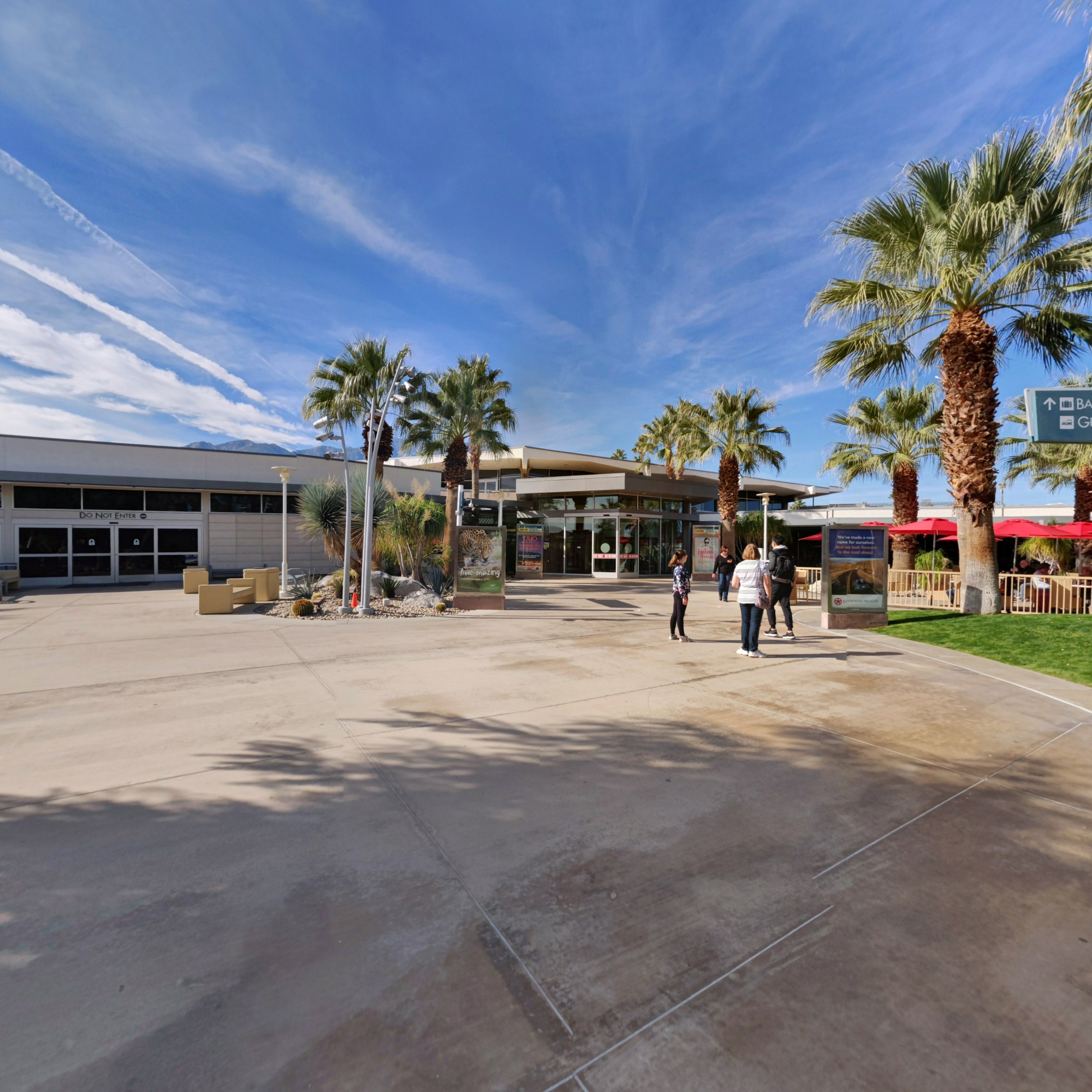
Palm Springs International Airport
The airport that became Palm Springs International began in 1939 as something considerably more functional and considerably less comfortable: an Army Air Corps emergency landing field, requisitioned from Agua Caliente land for the exigencies of wartime. Emergency strips do not think much about passenger experience, architecture, or amenities. They think about runway length and approach angles. The facility that grew from that utilitarian beginning has evolved into a regional airport handling more than three million passengers annually, with a concourse named for a man who arrived in Palm Springs as a singer, became the city's mayor, and went to Congress before dying in a ski accident in 1998.
From Ford Trimotor to International Gateway
The airport's first scheduled commercial service predates its wartime conversion: Ford Trimotor aircraft were flying passengers between Palm Springs and Burbank as early as 1934. The Ford Trimotor, an all-metal airliner that carried passengers in corrugated aluminum comfort, was the standard commercial aircraft of its era, and its appearance on the Palm Springs route reflected the city's growing status as a destination worth connecting to the metropolitan networks. After the war, commercial aviation returned and expanded, and the airport gradually acquired the infrastructure that transformed it from an emergency strip into a regional hub: additional runways, terminal buildings, gates, the apparatus of modern air travel.
The Sonny Bono Concourse
Sonny Bono — born Salvatore Phillip Bono in Detroit — arrived in Palm Springs' cultural life as half of Sonny and Cher, the pop duo whose television variety program was appointment viewing in the 1970s. After the entertainment career wound down, he ran for mayor of Palm Springs and won, serving from 1988 to 1992. He then won a seat in the US House of Representatives, where he served until his death in a skiing accident in January 1998. The concourse that opened in 1999 and bears his name is a recognition of someone who moved through the city's overlapping worlds — entertainment, civic life, national politics — with an accessibility that made him genuinely popular at home. The airport processes 940 acres with two runways and 19 gates.
A President's Final Departure
On December 30, 2006, Palm Springs International Airport served a solemn function when the body of President Gerald Ford departed from the facility for Washington D.C., where memorial services would be held. Ford, who had died at his Rancho Mirage home two days earlier, had long connections to the Coachella Valley. The departure was a public event of the kind that airport terminals occasionally witness: dignitaries assembled, protocols observed, the formal machinery of state put in motion. For an airport built on an emergency landing strip and named for a pop singer turned politician, it was a moment of unusual gravity.
Growth in the Desert
In 2025, Palm Springs International handled 3,307,140 passengers — a number that reflects both the enduring appeal of the destination and the expansion of direct routes connecting the Coachella Valley to major metropolitan areas across the United States and Canada. The airport's growth has been managed within constraints: it sits on land that includes Agua Caliente holdings, and the relationship between the airport authority and the tribe has evolved with the city's broader engagement with the land ownership questions that define Palm Springs. The facility's location, at the northeastern edge of the city with the San Jacinto Mountains rising immediately to the west, makes it one of the more visually dramatic approaches in Southern California.
From the Air
Palm Springs International Airport (ICAO: KPSP, IATA: PSP) is located at 33.83°N, 116.51°W at the northeastern edge of Palm Springs, California. The airport serves as the primary regional hub for the Coachella Valley and is visible as the dominant paved feature at the valley's western edge.