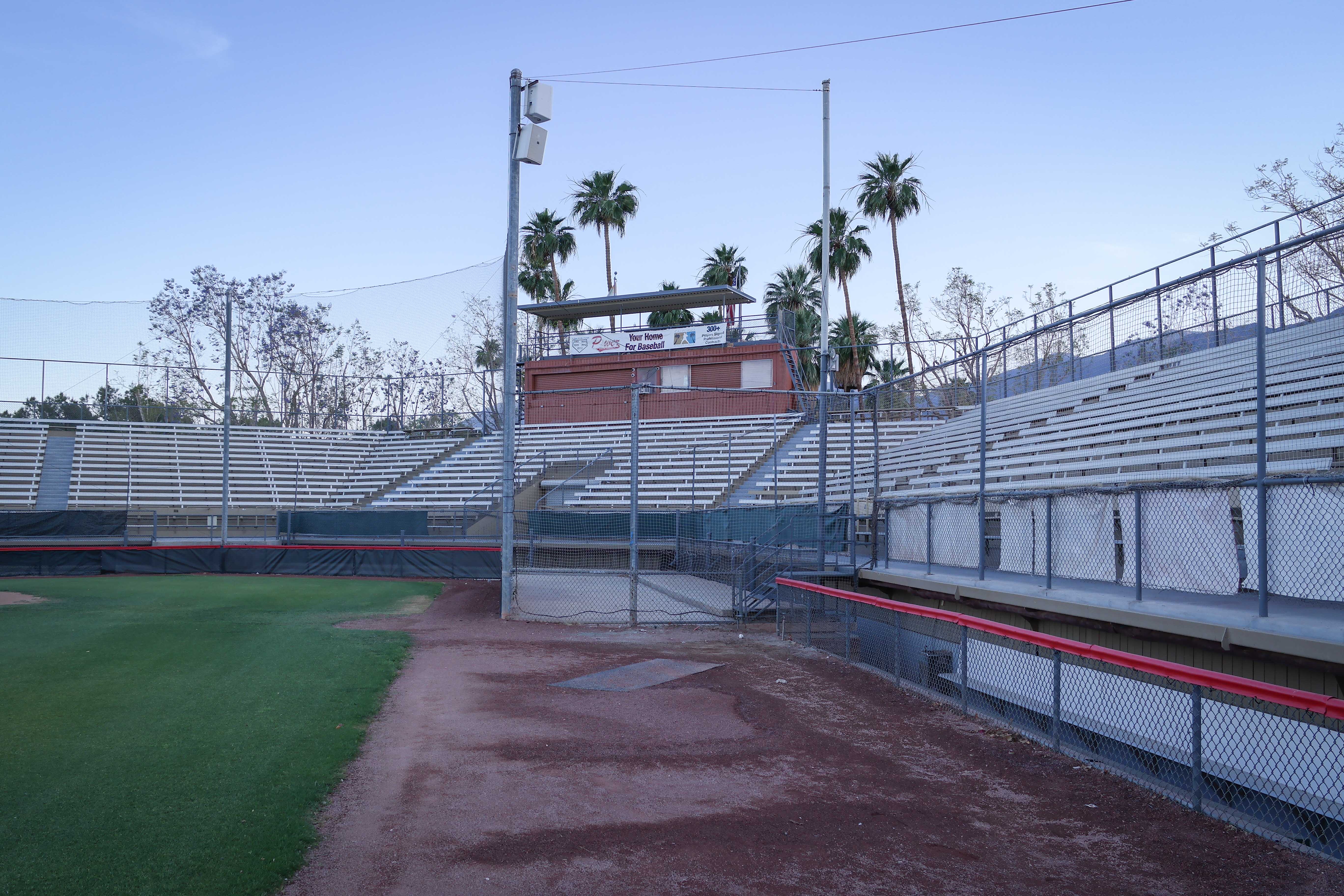
Palm Springs Stadium
Before there were bleachers, there were polo ponies. The site that became Palm Springs Stadium was originally a polo ground, and the sport of kings made a certain sense in a city that prided itself on offering California glamour at desert remove. The stands that replaced the polo fields opened in 1949, and the facility's evolution from gentleman's sport to professional baseball spring training reflects the broader arc of Palm Springs in the postwar decades: increasingly democratic in its entertainments, increasingly connected to the major league economy, still somewhat drunk on the romance of sunshine and celebrity.
Gene Autry and the Angels' Desert Home
From 1961 to 1992, the California Angels held their spring training at Palm Springs Stadium — a three-decade relationship that defined the facility's primary identity and tied it to one of the more colorful figures in American baseball history. Gene Autry, the singing cowboy who starred in westerns before becoming a businessman, was a part-time Palm Springs resident and the Angels' owner from the franchise's founding in 1961. His personal connection to the city made Palm Springs a natural choice for spring training, and the stadium hosted thirty-one years of Angels preparation for the season ahead, creating a tradition that local fans followed with the particular intensity that spring training inspires in desert communities where winter ball is the only game in town.
The White Sox, Winter Baseball, and What Came Between
Before the Angels arrived, the Chicago White Sox had used Palm Springs Stadium for their spring training in 1951, 1952, and 1953, briefly making the facility a destination for fans of the American League's south side Chicago franchise. The years between the White Sox departure and the Angels' arrival saw the stadium used for various purposes, and after the Angels relocated their spring training to Tempe, Arizona in 1993, the stadium entered a new phase. The California Winter League now operates at the facility, running its league from late January through mid-March — spring training in reverse chronology, using the desert's mild winter climate to give aspiring professional players a showcase opportunity when the major league camps are still months away.
A Pioneering Chapter
Between 1998 and 2003, Palm Springs Stadium was home to LGBT semi-professional baseball leagues — an experiment in inclusive sports infrastructure that predated much of the broader cultural conversation about LGBTQ participation in professional athletics. The leagues operated for five years, using the stadium as a venue for competitive play organized explicitly around the principle that sexual orientation should not define who gets to play the game. In a city that was simultaneously developing its identity as an LGBTQ destination, the baseball leagues were part of a larger project of building institutions that reflected the community's actual composition. They were, in retrospect, ahead of their time.
The Stadium Today
Palm Springs Stadium currently serves as the home of the Palm Springs Power, a collegiate summer league team that plays wooden-bat baseball in the tradition of the Cape Cod League and similar summer showcase circuits. The stadium's capacity of 5,185 is suited to the intimate scale of summer collegiate ball, where scouts mix with families and the atmosphere combines professional ambition with neighborhood warmth. The California Winter League continues to use the facility in the early part of the year. The site that once accommodated polo ponies and Angels pitchers has settled into a comfortable identity as a community baseball hub, part of the everyday life of a city that has never entirely lost its sporting ambitions.
From the Air
Located at 33.82°N, 116.53°W in Palm Springs, California. The stadium is visible from low-altitude approaches to Palm Springs International Airport (ICAO: KPSP), which is approximately 1.5 miles to the east.