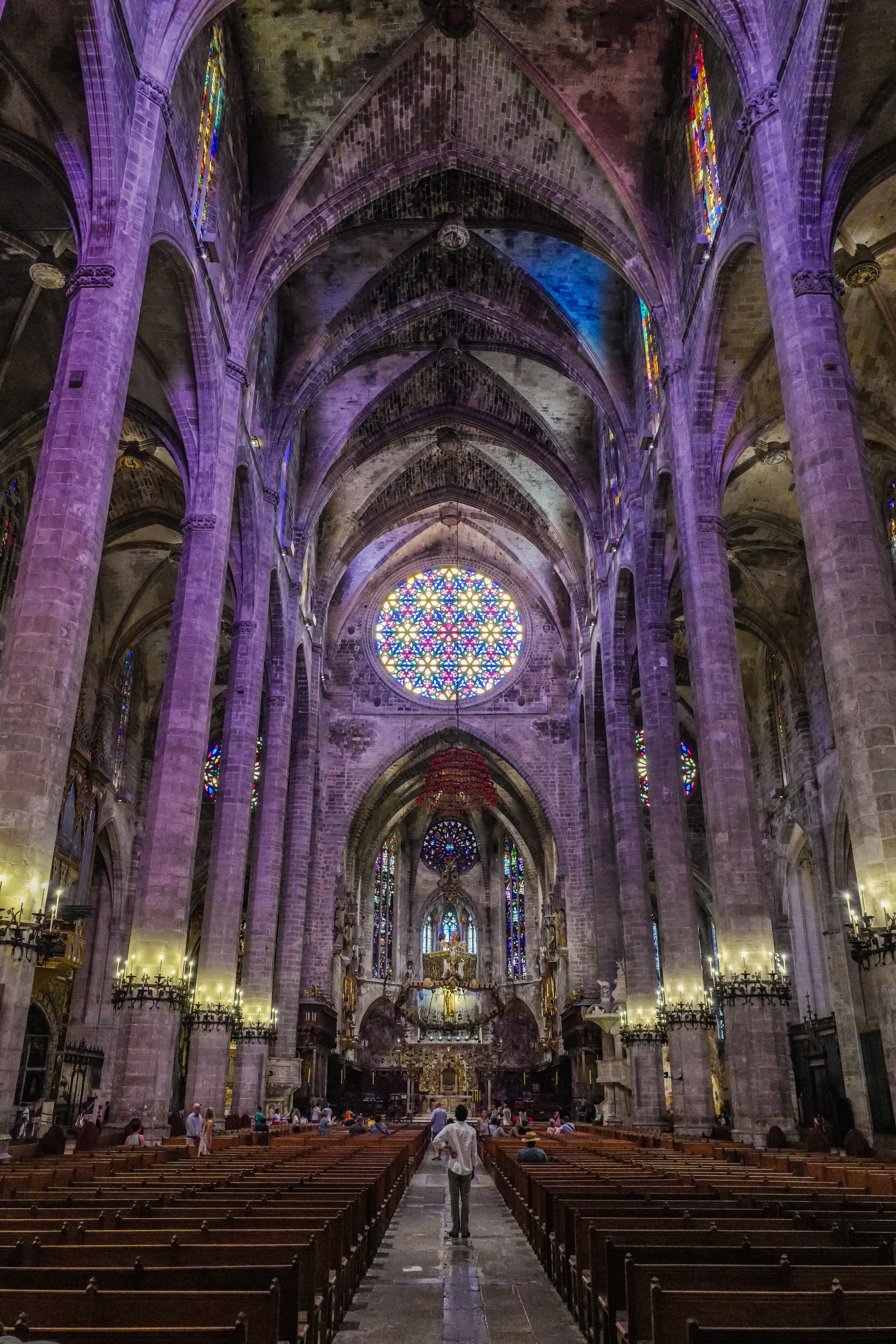
Palma Cathedral
Twice a year, on roughly February 2 and November 11, the morning sun projects the cathedral's eastern rose window onto the opposite wall, creating a kaleidoscope of colored light that aligns precisely beneath the western rose window. Locals call it the "figure eight of light." It is an accident of geometry and latitude, but it feels deliberate -- as if the builders who began this cathedral in 1229, on the site of Majorca's largest mosque, had planned for the sun itself to consecrate their work. La Seu, as Palma Cathedral is known, took four centuries to complete, and it carries the fingerprints of every era that touched it.
Built on Conquest
When King James I of Aragon conquered the city then called Madina Mayurqa from its Almohad rulers in 1229, he immediately reestablished the Diocese of Mallorca and ordered construction to begin on the site of the city's main mosque. Bishop Pere de Morella consecrated the site in 1230. The earliest surviving section, the Chapel of the Holy Trinity, was completed in 1327 as a burial place for the monarchs of Mallorca. The last traces of the mosque did not disappear until 1386, as the cathedral slowly consumed the footprint of the building it replaced. The bell tower was finished in 1498, the naves and vaults around the same time. An ornate rood screen and choir stalls were then placed in the center of the nave -- an unusual arrangement that would later provoke one of the cathedral's most dramatic interventions.
A Cathedral of Extremes
La Seu is a building of superlatives. Its nave rises 44 meters, making it the eighth-highest church nave in the world. The pillars supporting those vaults are extraordinarily slender -- just one-twelfth the width of the vault span, compared to one-sixth at Reims Cathedral. The effect is a cavernous interior flooded with light, the stone columns soaring upward like petrified trees in a forest of impossible height. The eastern rose window, with a diameter of nearly 14 meters, is the second-largest Gothic rose window in existence, surpassed only by Strasbourg's. The cathedral stretches 121 meters long and 40 meters wide, its exterior bristling with flying buttresses and pinnacles that give it a fiercely vertical silhouette against the Palma waterfront.
Gaudi's Unfinished Vision
In 1903, the young Antoni Gaudi was invited to oversee restoration works. His changes were sweeping and, to many, unwelcome. He removed the choir stalls and rood screen from the center of the nave and relocated them to the presbytery walls, opening up the interior to create a clearer sightline from entrance to altar. He designed a large canopy to hang above the altar, opened bricked-up windows to admit more natural light, and created ceramic panels with heraldic motifs for the choir. In the process, Baroque altarpieces and Mudejar decorations were destroyed or altered. The goal was to bring the liturgy closer to the congregation, but the cost in lost medieval and Baroque craftsmanship sparked fierce debate. Gaudi and his collaborators left the cathedral in 1914 after disputes with local authorities, his plans still unfinished. Yet the space he created -- light-filled, unobstructed, focused on the ancient Bishop's Chair and the tombs of Kings James II and James III -- remains the defining experience of visiting La Seu.
Every Style Under One Roof
Walk along the nave and you walk through the architectural history of Mallorca. Sixteen chapels line the walls, representing nearly every style practiced on the island across seven centuries. The Plateresque Chapel of Sant Jeroni sits near the Churrigueresque Chapel of Our Lady of the Crown, which neighbors modernist work from Gaudi's era. The Royal Chapel at the central nave's end houses the elaborate marble tombs of Kings James II and III, alongside the Episcopal Throne of 1346. The 110 choir stalls, rearranged by Gaudi but carved centuries earlier, are considered masterpieces of Catalan Gothic woodwork. Outside, the neo-Gothic renovation of the mid-19th century gave the western facade its gable and pinnacles -- in fact, the entire west front, save the main portal, was rebuilt in a French-inspired style. La Seu is not one cathedral but many, layered one atop the other like geological strata made of stone, glass, and centuries of devotion.
From the Air
Located at 39.57N, 2.65E on the Palma waterfront, directly adjacent to the Royal Palace of La Almudaina. The cathedral's massive Gothic silhouette dominates Palma's seafront skyline. Best viewed at 1,500-3,000 feet approaching from the bay. Palma de Mallorca Airport (LEPA) is approximately 8 km to the east. The cathedral, palace, and old city walls form a distinctive cluster visible from considerable distance.