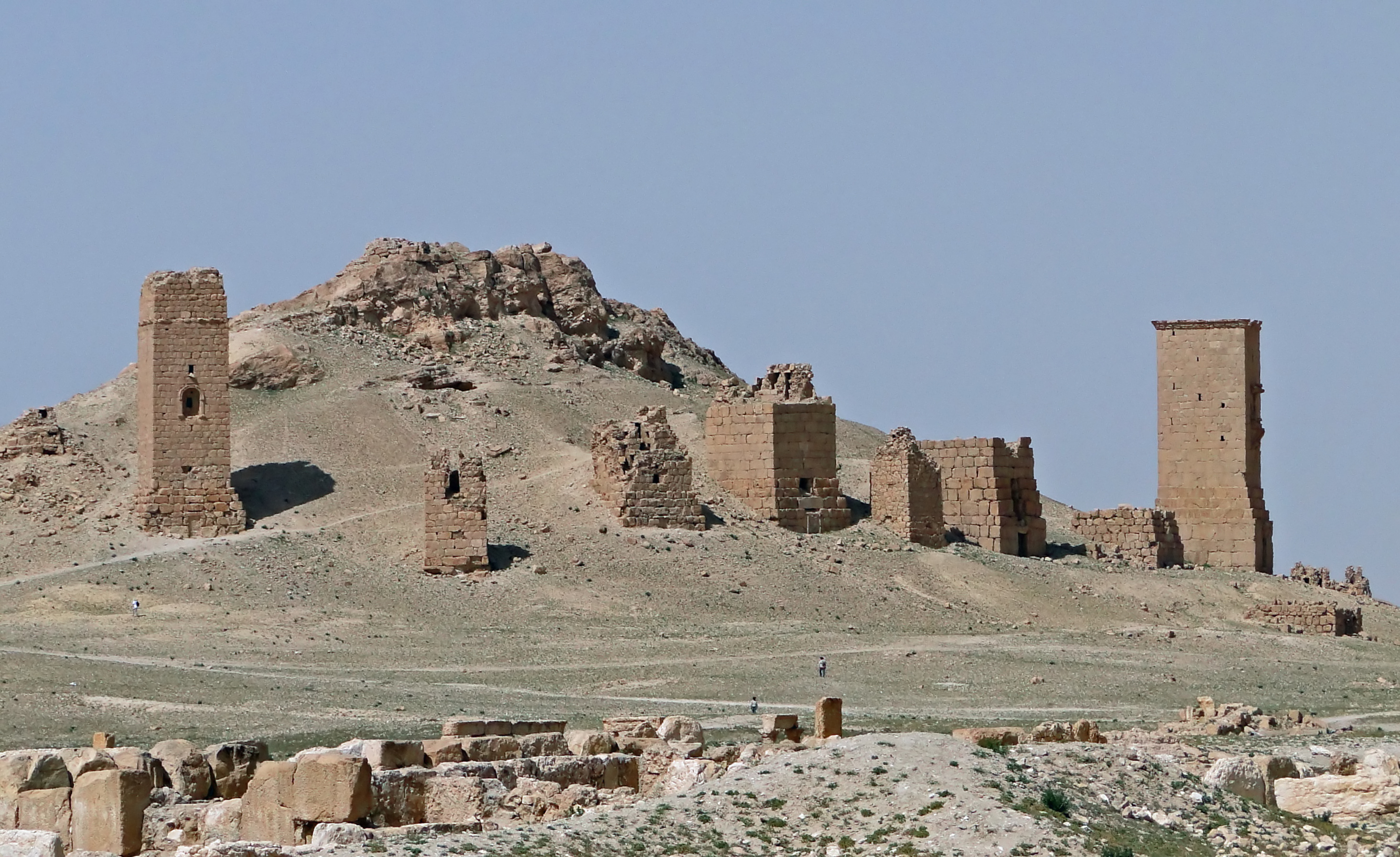
Palmyra
The name doubles itself across languages, each version pointing to the same thing. In Aramaic, Tadmor -- from tamar, the date palm. In Greek, Palmyra -- from palame, also the palm. The trees that made life possible in this patch of the Syrian Desert gave the city its identity in every tongue that passed through it. And everyone passed through: Persians, Romans, Arab caravans loaded with silk and spices, Mesopotamian priests, Greek architects. For centuries, Palmyra sat at the crossroads of the ancient world's trade routes, 215 kilometers northeast of Damascus, growing wealthy not by conquest but by being indispensable to everyone who needed to move goods between East and West.
Oasis of Ambition
Archaeological finds at the site date back to 7500 BC, when Neolithic settlers gathered near the Efqa spring on the southern bank of Wadi al-Qubur. But Palmyra entered the historical record around 2000 BC, when a Palmyrene named Puzur-Ishtar agreed to a contract at an Assyrian trading colony in Kultepe. From the start, the city existed because trade existed. The Mari tablets mention it as a stop for caravans; Assyrian kings marched through it; the Arameans, Amorites, and eventually Arabs all claimed it. By the Hellenistic period, Palmyra had grown wealthy enough that a Palmyrene commander named Zabdibel led ten thousand men to aid the Seleucids at the Battle of Raphia in 217 BC. When Rome absorbed the Seleucid kingdom in 64 BC, Palmyra remained independent -- trading with both Rome and Parthia, belonging to neither, until Tiberius brought it into the empire around 14 AD.
The Caravan Kingdom
Roman Palmyra was a city that looked Greek but thought Semitic. Its senate was called a boule, in the Greek fashion, but functioned as a gathering of tribal elders in the Near Eastern tradition. Palmyrene merchants established colonies along the Silk Road and throughout the Roman Empire, their wealth funding monumental construction: the 1.1-kilometer Great Colonnade, the Temple of Bel dedicated in AD 32, the distinctive tower tombs in the Valley of the Tombs that rose four stories high. The city's art combined Greco-Roman portraiture with a frontality that would later influence Byzantine traditions -- funerary busts that emphasized clothing and jewelry, staring directly at the viewer in a style Roman sculpture rarely attempted. At its peak around 270 AD, under the rule of Queen Zenobia, Palmyra had more than 200,000 residents. Ethnically it was a fusion: Amorite, Aramean, and Arab families who spoke Palmyrene Aramaic at home and conducted business in Greek.
The Queen Who Challenged Rome
Zenobia's husband, King Odaenathus, had saved Rome's eastern frontier by defeating the Sasanian emperor Shapur I in the 260s, earning the title Imperator Totius Orientis -- Governor of the East. When Odaenathus was assassinated in 267, his ten-year-old son Vaballathus inherited the title. Zenobia ruled as regent, and she was not content with regency. In 270, she conquered Roman Arabia. By October, Egypt had fallen to her forces. The following year, Palmyrene armies reached Ankara. For a brief moment, the Palmyrene Empire stretched from the Nile to central Anatolia. Emperor Aurelian ended it in 272, defeating Zenobia at the battles of Immae and Emesa. She fled east seeking Persian help but was captured. When Palmyra rebelled again the following year, Aurelian returned and razed the city. The temples were pillaged, residents massacred, the monuments hauled off to decorate his Temple of Sol in Rome.
Two Millennia of Survival
Palmyra never fully recovered, but it never fully died. Diocletian rebuilt it as a frontier fortress. Christians converted the Temple of Bel into a church. Arab conquerors turned it into a mosque in 1132, and villagers lived inside the temple courtyard for eight centuries. The Umayyad Caliphate restored its role as a trade stop; the Abbasids punished it for Umayyad loyalties. Timur destroyed it in 1400, reducing it to a village. By the 1920s, French archaeologists convinced the remaining 6,000 inhabitants to relocate to the new village of Tadmur, opening the ruins for excavation. Each successive power left its mark: mud-brick walls built among Roman columns, a medieval castle overlooking Hellenistic tombs, Ottoman garrisons watching over Byzantine churches.
What Remains
In May 2015, ISIS captured Palmyra and began systematically destroying what two millennia of war, earthquakes, and neglect had spared. The Temple of Baalshamin fell on 23 August. The cella of the Temple of Bel was blown up on 30 August. The tower tombs, the Monumental Arch, the Tetrapylon -- all destroyed. Archaeologist Paolo Matthiae, discoverer of Ebla, estimated that 20 to 30 percent of the site sustained serious damage, but that 98 percent could eventually be restored using traditional methods and advanced technologies. Restoration began in earnest after the Syrian Army's final recapture in March 2017. The Efqa spring, reopened in February 2022, flows again. The Roman Theatre's facade was comprehensively restored by late 2023. The Arch of Triumph's first reconstruction phase was completed in May 2023. The stones are being put back, one by one, into the geometry of a city that spent four thousand years refusing to disappear.
From the Air
Located at 34.55°N, 38.27°E in central Syria, 215 km northeast of Damascus. The ancient ruins sprawl across several square kilometers on the southwestern fringe of the modern town of Tadmur, easily visible from altitude as a grid of columns and walls against the surrounding desert. The Valley of the Tombs extends west of the ancient walls. Two mountain ranges frame the site: the northern and southern Palmyrene belts. Nearest airfield is T4/Tiyas Airbase (OSTY), approximately 60 km west. The Homs-Deir ez-Zor highway passes nearby. Excellent visibility in typical desert conditions; sandstorms possible seasonally.