Palo Alto Art Center
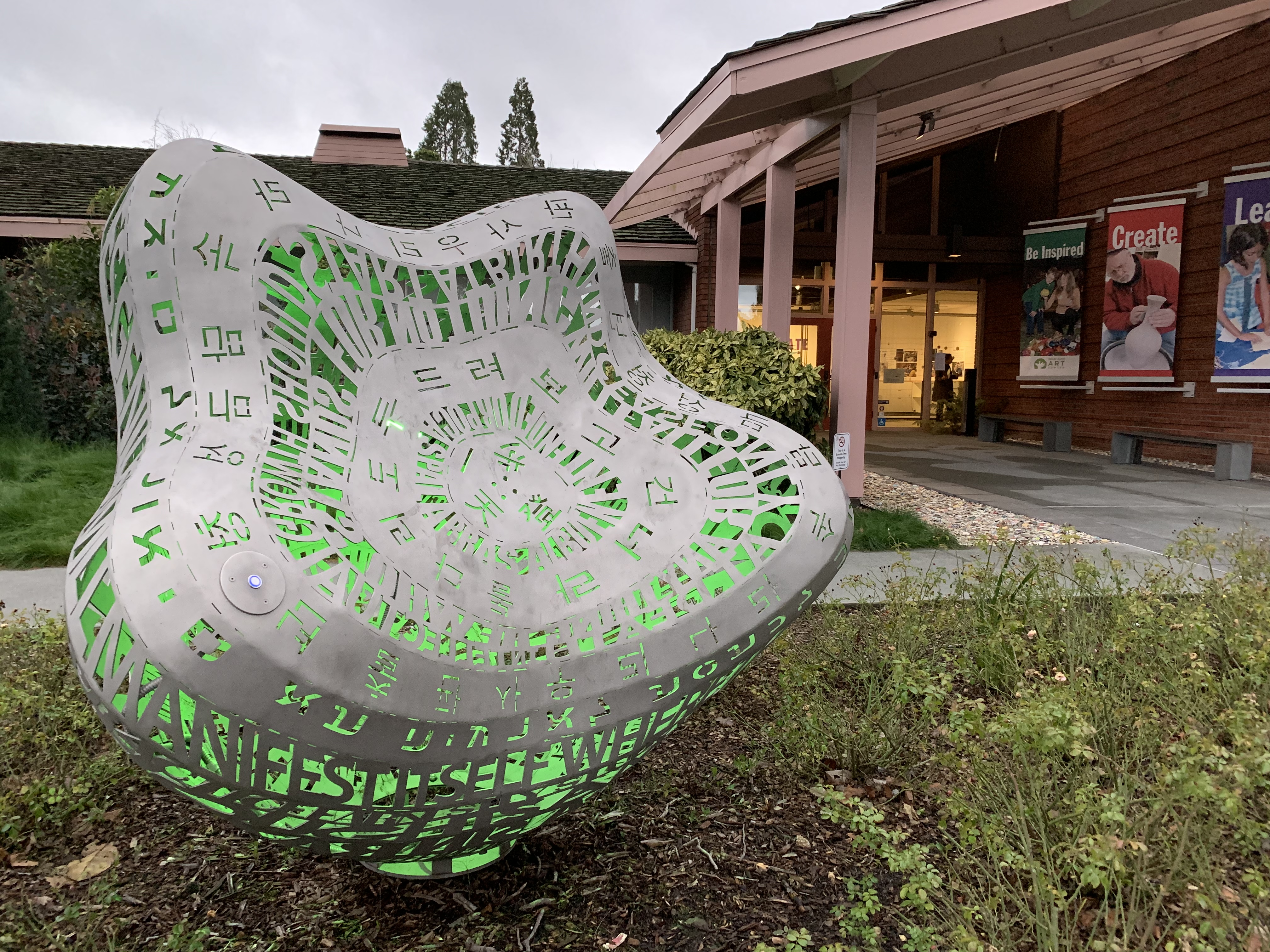
Every autumn, hundreds of hand-blown glass pumpkins appear on the lawn at 1313 Newell Road in Palo Alto. They glow amber and emerald in the California light, each one unique, arranged in rows like some fantastical harvest. The Great Glass Pumpkin Patch is one of the Palo Alto Art Center's signature events, and it captures something essential about this place: art here is not kept behind velvet ropes. It spills onto the grass, invites you to touch it, and occasionally asks you to help build it.
From City Hall to Art Hall
The building at 1313 Newell Road began its life in 1953 as Palo Alto's City Hall, designed by architect Leslie Nichols. When city government outgrew the space, the building found a second purpose. In 1971, it reopened as the Palo Alto Community Cultural Center, offering free exhibitions and art activities to anyone who walked through the doors. The transformation was fitting for a city that has always valued reinvention. Adjacent to Rinconada Park and the Rinconada Public Library, the center sits in a green corridor where families drift between books, playgrounds, and gallery openings without ever getting in a car. A major renovation from 2010 to 2012 added classrooms and a dedicated children's wing, cementing the center's identity as a place where making art matters as much as viewing it.
Where Sculpture Grows Wild
In 2016, sculptor Patrick Dougherty arrived with a vision and a truckload of willow branches. Over several weeks, with help from a team of volunteers and fifteen thousand dollars raised through crowdfunding, he wove an enormous structure of intertwined shelters on the lawn along Embarcadero Road. He called it Whiplash. The piece became one of the most photographed spots in Palo Alto, a place where children disappeared into tunnels of woven wood and adults posed for portraits framed by organic arches. Dougherty is known for his large-scale woven installations at institutions worldwide, and Whiplash was no exception to his rule that great art should invite participation. The sculpture stood for four years before it was removed in June 2020, its willow returning slowly to the earth.
A Gallery Without Barriers
What sets the Palo Alto Art Center apart from the region's better-funded museums is its insistence on accessibility. Admission is free. Exhibitions rotate frequently, spanning a wide range of media and ambition. A 2017 show called Play! explored the power of play through interactive pieces. The following year, Through That Which Is Seen celebrated the miniature worlds of dioramas. In 2019, The Sheltering Sky brought together eighteen artists working on sky-related themes, including Sukey Bryan's two-story photograph Sky Front. The center also hosts Friday Night at the Art Center, Family Days, and the Clay and Glass Festival, events designed to blur the line between audience and artist. An artists-in-residence program gives working artists studio space and public engagement opportunities, ensuring the center remains a place of active creation rather than passive display.
Silicon Valley's Creative Counterweight
Palo Alto is a city defined by its relationship to Stanford University and the technology industry. Venture capital offices line Sand Hill Road a few miles away, and the names of tech giants echo through every coffee shop conversation. Against that backdrop, the Art Center serves as a quiet counterweight, a reminder that creativity takes many forms. Managed by the City of Palo Alto and supported by the nonprofit Palo Alto Art Center Foundation, it has operated continuously since 1971, surviving budget pressures and shifting cultural priorities. The center's collection of exhibitions stretches back decades, from a 1980 show of contemporary presentation drawings featuring artists like Roy DeForest and Judith Linhares to recent installations that push the boundaries of what a community art space can be.
From the Air
Located at 37.44°N, 122.14°W in Palo Alto, adjacent to Rinconada Park. Nearest airport is Palo Alto Airport (KPAO), about 1.5 miles northeast. San Carlos Airport (KSQL) is 5 miles northwest. The center is nestled in a residential area near the Embarcadero Road corridor, visible from low altitude as a park complex.