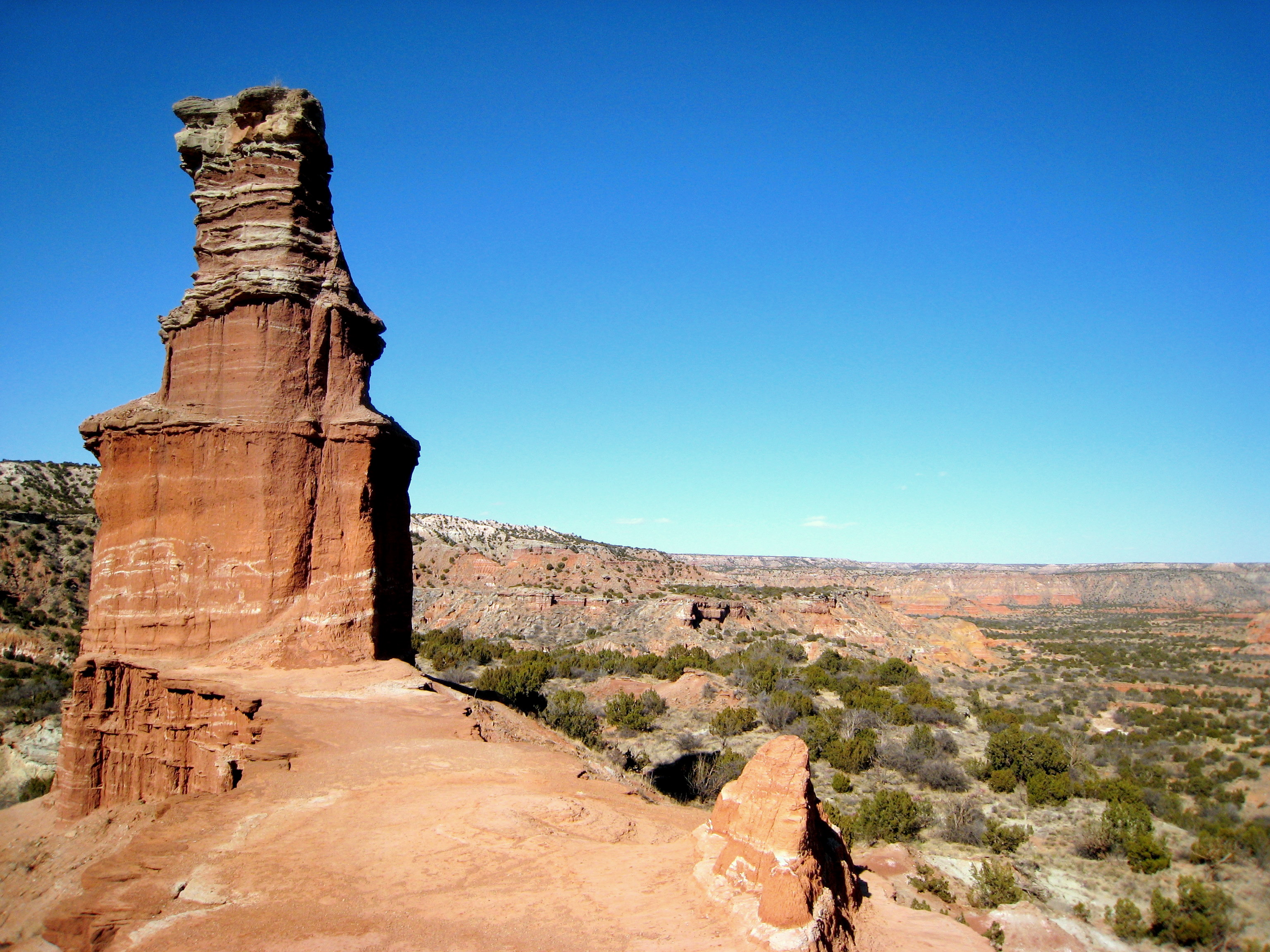
Palo Duro Canyon
Georgia O’Keeffe called it a burning, seething cauldron, filled with dramatic light and color. She was describing Palo Duro Canyon, and she was not exaggerating. Drive across the Texas Panhandle and the land is relentlessly flat -- the Llano Estacado stretching to every horizon like an ocean of grass. Then, without warning, the earth drops away. The second-largest canyon system in the United States opens beneath your feet, a chasm carved by the Prairie Dog Town Fork of the Red River through rock laid down when this land sat at the edge of an ancient sea. The Spanish named it Palo Duro -- hard wood -- for the juniper trees clinging to its walls. Texans call it the Grand Canyon of Texas, and for once the boast is not oversized.
A Quarter-Billion Years on Display
The canyon walls are a geology textbook sliced open and set on its side. At the bottom, the Permian-age Quartermaster Formation glows deep red -- siltstones and shales deposited in a shallow sea, their color a testament to ancient oxidation. Above it, the Triassic Tecovas Formation shifts through lavender, gray, white, and orange, the sediments of ancient streams and swamps that once harbored phytosaurs, amphibians, and lungfish. Fossils of Metoposaurus, Desmatosuchus, and Koskinonodon lie embedded in these layers alongside coprolites and petrified wood from Araucarioxylon trees. Higher still, the Ogallala Formation holds remains from a more recent bestiary: saber-toothed cats, bone-crushing dogs, mastodons, long-necked camels, rhinoceroses, and giant tortoises up to three feet long. The canyon’s signature landmark, Lighthouse Rock, stands as a hoodoo sentinel -- a column of harder stone left standing while softer layers eroded around it.
Blood and Horses in the Canyon
Captain Randolph B. Marcy led the first U.S. military mapping expedition through the canyon in 1852, searching for the headwaters of the Red River. For two more decades, the canyon remained under Comanche and Kiowa control. That ended in 1874, when Colonel Ranald S. Mackenzie led a military expedition into Palo Duro to force the tribes onto reservations in Oklahoma. The Battle of Palo Duro Canyon was less a battle than a devastating blow: Mackenzie’s forces captured approximately 1,200 horses and slaughtered them in nearby Tule Canyon. The Comanche and Kiowa conceded and left. Just two years later, in 1876, cattleman Charles Goodnight and Irish-born investor John Adair established the JA Ranch on the canyon floor, one of the great ranching operations of the American West. Goodnight managed the ranch until 1890, and the canyon remained in private hands for decades.
Dynamite, Pickaxes, and the CCC
In 1931, a landowner opened the canyon to public access through a contract with the local chamber of commerce. Texas purchased the upper canyon in 1934 and established Palo Duro Canyon State Park. But it was seven companies of the Civilian Conservation Corps who shaped the park visitors know today. From 1933 to 1937, CCC companies -- military veterans, African American workers, and young men aged 17 to 25 -- blasted and dug Park Road 5, a two-lane road from the canyon rim to its floor. Most of the work was done with pickaxes, shovels, and wheelbarrows. They also built the headquarters building, culverts, bridges, the Coronado Lodge interpretive center, overnight cabins, and picnic areas. In 1976, the National Park Service designated Palo Duro Canyon State Park as a National Natural Landmark. The park drew 442,242 visitors in 2022.
Art, Music, and the Panhandle Sky
Palo Duro has always drawn artists. O’Keeffe painted the canyon between 1916 and 1918, while she was an instructor and head of the art department at West Texas State Normal College in nearby Canyon, Texas. Her canvases of the Palo Duro helped launch the abstract vocabulary she would spend a lifetime refining. Since 1966, the Pioneer Amphitheatre on the canyon floor has hosted Texas, an outdoor historical and musical drama created by playwright Paul Eliot Green that has become the best-attended outdoor history drama in the nation. Composer Samuel Jones’s Symphony No. 3, titled Palo Duro Canyon, premiered at the same amphitheatre on May 1, 1992, performed by the Amarillo Symphony. A PBS documentary and recordings by the Seattle Symphony and the London Symphony Orchestra followed.
Trails Along the Canyon Floor
Today the park offers 16 trails for hiking, biking, and horseback riding, ranging from a tenth of a mile to 4.4 miles. The Lighthouse Trail, a round-trip loop to the canyon’s signature hoodoo formation, remains the most popular hike. Campers can pitch tents with water access or park RVs, and rim cabins offer views of both the canyon and the sunrise. For geologist Charles N. Gould, who mapped and named the canyon’s formations in 1905, Palo Duro was a scientific puzzle. For the Comanche, it was a homeland. For O’Keeffe, it was a burning cauldron of light. For the CCC workers who cut a road into its walls with hand tools, it was backbreaking labor. Stand at the rim where the plains dissolve into color and depth, and you understand why each of them -- and 400,000 visitors a year -- found it impossible to look away.
From the Air
Located at 34.95N, 101.667W in the Texas Panhandle. The canyon is dramatically visible from the air as a sudden gash in the otherwise flat Llano Estacado. Recommended viewing altitude: 3,000-5,000 feet AGL. Nearest airports: Rick Husband Amarillo International (KAMA) approximately 20 nm north. Approach from the south for the most dramatic rim-to-floor perspective.