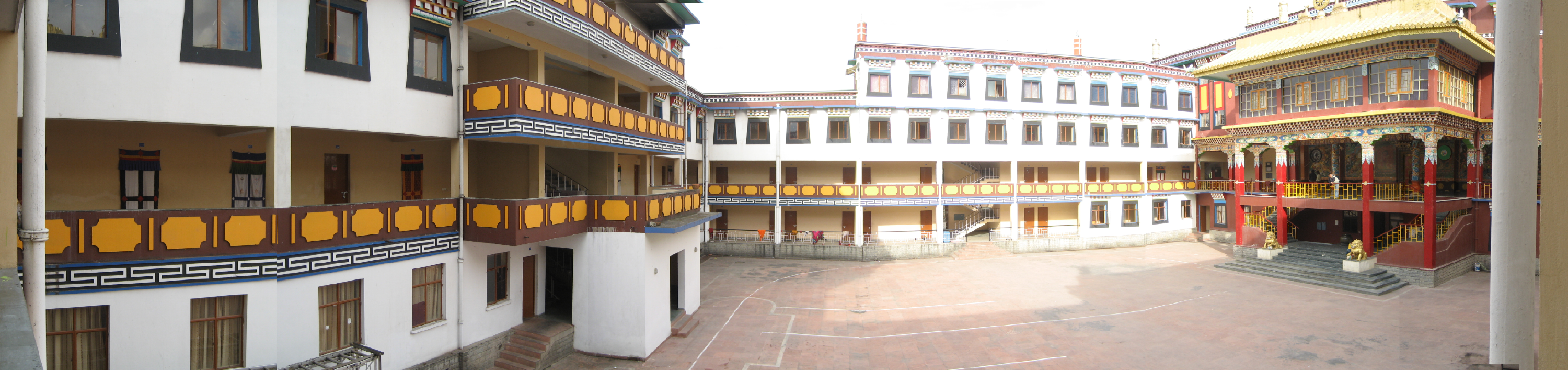
Palpung Monastery
The name means "glorious union of study and practice," and Palpung Monastery has spent nearly three centuries trying to live up to it. Founded in 1727 in a remote valley of Dege County, western Sichuan, this is the mother monastery of the Karma Kagyu tradition in Kham and the historic seat of the Tai Situ incarnation line. It is also the place where the ecumenical Rime movement found its center, where Karmapas were enthroned before traveling to their primary seat in central Tibet, and where roughly 800 monks still live today, maintaining a tradition that has survived political upheaval and geographic isolation alike.
Roots in 12th-Century Kham
Palpung's origins stretch back to the 12th century, when the earliest religious community was established at the site in Babang Township. The monastery as it exists today was founded in 1727 by the 8th Tai Situ Panchen, known as Situ Panchen, with the patronage of the Dharma King of Derge, Temba Tsering. Situ Panchen was himself a remarkable figure: court chaplain to the Derge Kingdom, he made lasting contributions to medicine, religion, and art. The monastery became the seat of four lines of incarnate lamas, the most prominent being the Tai Situ, the Jamgon Kongtrul, and the Beru Khyentse. It was Jamgon Kongtrul who, working from Palpung, became one of the principal architects of the Rime movement, the ecumenical approach that sought to preserve the teachings of all Tibetan Buddhist schools rather than privileging any single tradition.
Where Karmapas Were Crowned
The relationship between Palpung and the Karmapa lineage runs deep. The Karmapas and the Tai Situpas have been connected for centuries, alternating roles as master and disciple across successive incarnations. Rangjung Rigpe Dorje, the 16th Karmapa, was enthroned first at Palpung before making the long journey westward to Tsurphu Monastery in central Tibet's U-Tsang region, his primary seat. This pattern - enthronement at Palpung, then transfer to Tsurphu - reflected the monastery's status as a crucial node in the Karma Kagyu network. Palpung was not merely a regional outpost; it was the place where the lineage's continuity was confirmed and celebrated, a staging ground for the authority that would be exercised from Tsurphu. The monastery's extensive complex, surrounded by the high grasslands of Dege County in the Garze Tibetan Autonomous Prefecture, served as the spiritual and administrative hub for an entire tradition.
Flight and Rebuilding
When the 12th Tai Situpa, Pema Tonyo Nyinje, fled Kham at the age of six, he traveled through Bhutan to India, where he received his training under the 16th Karmapa. At twenty-two, he began building a seat in exile: Palpung Sherabling Monastery in Himachal Pradesh, northern India. The exile monastery now houses approximately 1,000 monks, with 250 enrolled in the monastic university curriculum. A companion nunnery, Palpung Yeshe Rabgyeling, near the city of Manali, is home to about 200 nuns. Both institutions offer the traditional Kagyu three-year retreat, an intensive meditation practice that requires participants to remain in seclusion for the full duration. The fact that a six-year-old refugee built an institution of this scale speaks to both the resilience of the Tibetan monastic tradition and the depth of the community's commitment to preserving it.
Three Hundred Branches, One Root
The Palpung congregation today encompasses more than 180 monasteries and temples across Tibetan and Chinese districts, with an additional 300 branch institutions worldwide spanning Europe, North America, Oceania, and Asia. Its European seat is Palpung Yeshe Chokhor Ling Europe. Back in Kham, the original monastery continues to function with its 800 resident monks and a larger population in the surrounding region. The congregation's global reach represents something unusual in the history of Tibetan monasticism: an institution that maintains continuity with its 18th-century origins in a remote Himalayan valley while simultaneously operating as a worldwide network. The name Palpung chose for itself nearly three centuries ago - "glorious union of study and practice" - turns out to describe not just a monastery but a principle flexible enough to travel from the highlands of Kham to the cities of Europe and back again.
From the Air
Located at 31.65°N, 98.80°E in Babang Township, Dege County, Garze Tibetan Autonomous Prefecture, western Sichuan. Elevation approximately 3,800 meters (12,500 feet). The monastery complex is situated in a valley surrounded by high grasslands. Nearest airport is Chamdo Bangda Airport (ZUBD) approximately 200 km to the west. The exile seat, Palpung Sherabling, is located near Baijnath in Himachal Pradesh, India, accessible via Gaggal Airport (VIGG).