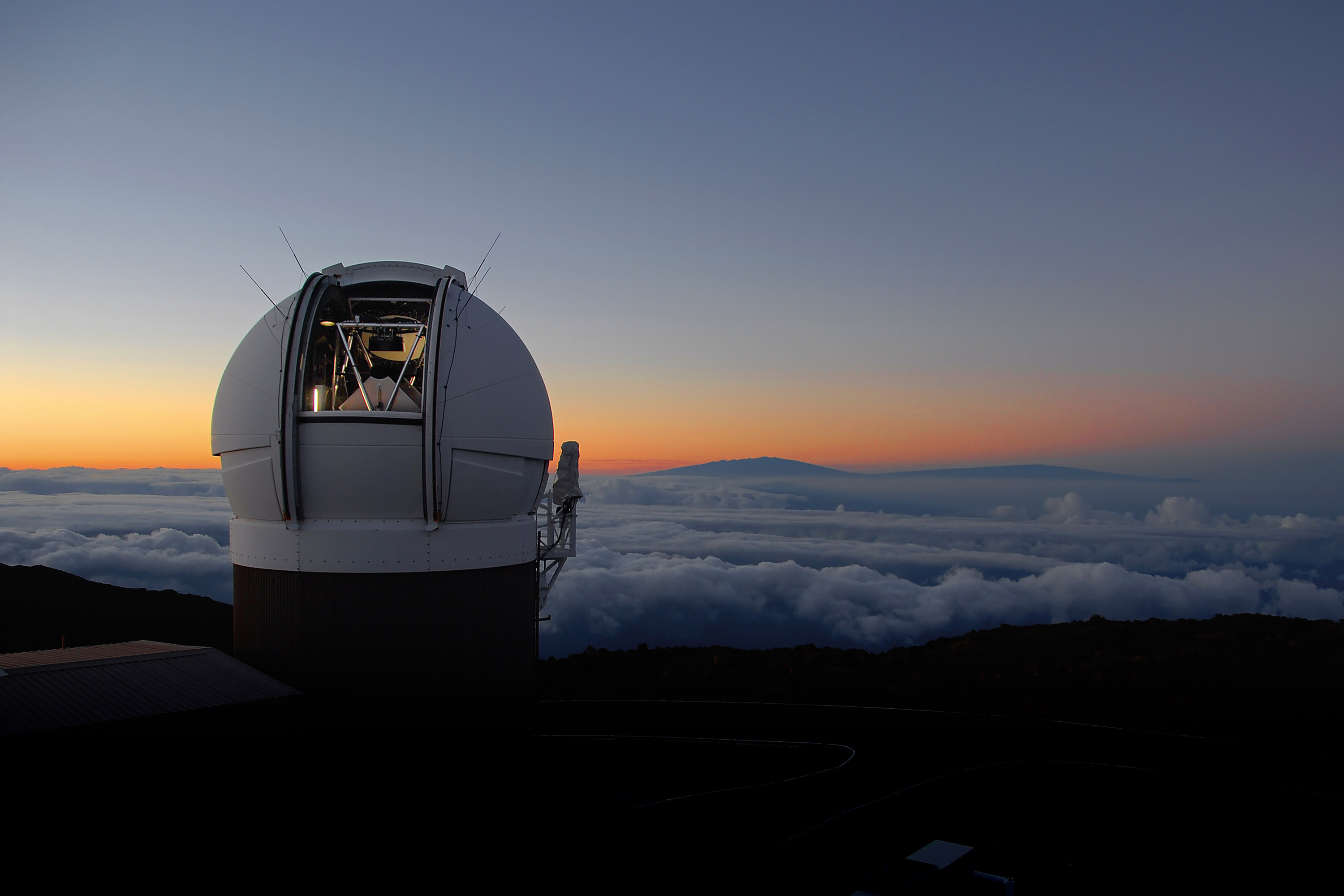
Pan-STARRS
On October 19, 2017, a telescope on Maui spotted a faint smudge moving against the background stars. Within days, astronomers confirmed what no one had ever seen before: an object from another star system was passing through our own. They named it 'Oumuamua, Hawaiian for "scout," and it became the first confirmed interstellar visitor in the history of astronomy. The telescope that found it, Pan-STARRS, was not looking for interstellar objects. It was looking for everything.
The Sentinel on Haleakala
Pan-STARRS, the Panoramic Survey Telescope and Rapid Response System, operates from Haleakala Observatory on the summit of Maui's dormant shield volcano, at an elevation of roughly 10,000 feet. The system consists of two 1.8-meter Ritchey-Chretien telescopes, PS1 and PS2, built through a collaboration between the University of Hawaii's Institute for Astronomy, MIT Lincoln Laboratory, and the Maui High Performance Computing Center. Telescope construction was funded by the U.S. Air Force, which had its own interest in tracking objects in the sky. PS1 saw first light in June 2006 and began full-time science observations on May 13, 2010. PS2 achieved first light in 2013. Today, Pan-STARRS spends 90 percent of its observing time on a single mission funded by NASA: searching for near-Earth objects that could pose a collision threat to our planet.
The Billion-Pixel Eye
What makes Pan-STARRS extraordinary is not the size of its mirrors but the size of its camera. The gigapixel camera on PS1, which saw first light on August 22, 2007, by imaging the Andromeda Galaxy, records nearly 1.4 billion pixels per image across 60 CCD detectors arranged in an 8-by-8 grid. Each detector contains 4,800 by 4,800 pixels subdivided into 64 cells. The telescope's field of view spans three degrees, enormous for a telescope of this aperture, allowing it to sweep across approximately 6,000 square degrees of sky every night. Since roughly 30,000 square degrees of sky are visible from Hawaii, Pan-STARRS can image the entire accessible sky in about four nights. Each exposure lasts 30 to 60 seconds, reaching objects as faint as apparent magnitude 22, and each image requires about two gigabytes of storage. The result is a torrent: roughly 10 terabytes of raw data pour in every night.
A Census of the Moving Universe
Pan-STARRS works by comparison. It photographs the same patches of sky repeatedly, then software identifies anything that has moved or changed brightness since the last observation. A new dot where none existed before might be a supernova in a distant galaxy. A faint streak could be a previously unknown asteroid. By its first data release, Pan-STARRS had cataloged three billion individual sources: stars, galaxies, and solar system objects. The second data release in January 2019, at 1.6 petabytes, stands as the largest volume of astronomical data ever released, equivalent to 30,000 times the text content of Wikipedia. The archive resides in the Mikulski Archive for Space Telescopes. Pan-STARRS has discovered comets from the Oort cloud, watched an asteroid disintegrate in real time through follow-up observations with the Hubble Space Telescope, and identified Kamooalewa, a quasi-satellite that orbits the Sun in near-lockstep with Earth.
Military Shadows and Open Skies
Because the U.S. Air Force funded the telescopes, the early years of Pan-STARRS came with strings attached. Until the end of 2011, streak-detection software nicknamed "Magic" censored pixels that contained images of military satellites, reducing the usable field of view to as little as 68 percent. Scientists worked around the gaps, but the censorship frustrated researchers who needed complete coverage for asteroid surveys and deep-sky studies. When the Air Force finally lifted all masking requirements at the end of 2011, applying the change retroactively to all past images, the full power of the instrument became available. The elimination of these restrictions coincided with Pan-STARRS entering its most productive period of discovery, free to photograph anything the sky contained.
What Comes Next from the Dark
Pan-STARRS has fundamentally changed our understanding of what populates the solar system. It is expected to detect at least 100,000 Jupiter trojans, compared to roughly 2,900 known before its surveys began, and at least 20,000 Kuiper belt objects, dwarfing the 800 known previously. It has found trojan asteroids of Uranus and identified candidates for Venus and Neptune trojans, objects whose existence was theorized but never confirmed. Perhaps most importantly, Pan-STARRS revealed that objects like 'Oumuamua are out there, visitors from other star systems drifting through our neighborhood. The discovery proved that interstellar objects are not merely theoretical. They pass through the solar system, and if you build a telescope patient enough and wide-eyed enough, you will catch them in the act.
From the Air
Located at 20.71N, 156.26W atop Haleakala on Maui at approximately 10,000 feet elevation. The observatory domes are visible from cruising altitude on clear days as white structures on the volcano summit. Nearest major airport is Kahului Airport (PHOG). Haleakala's summit often pokes above the cloud deck, making the observatory complex a reliable visual landmark when approaching Maui from the north or east.