Panam Nagar
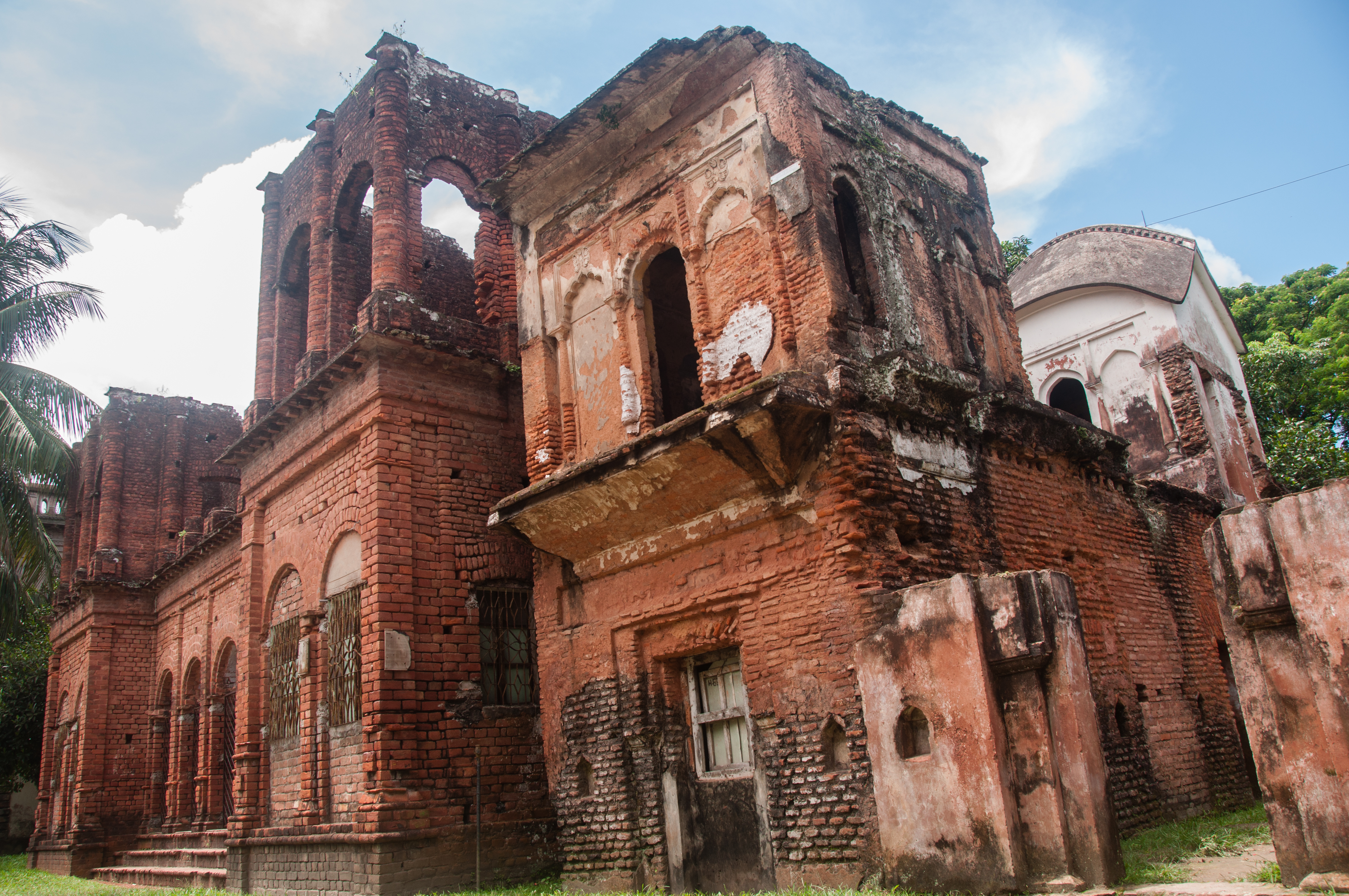
A single street, barely half a kilometer long, is all that remains visible of a city that once served as a capital. Panam Nagar sits in Sonargaon Upazila, Narayanganj District, flanked on both sides by canals -- the northern one still called Pankhiraj Canal -- and lined with ornate buildings that no one has lived in for decades. The mansions have ogee-shaped windows, Mughal-style pointed arches, cast-iron columns with floral ornamentation, and mosaic floors in patterns that mix European, Hindu, and Islamic aesthetics without apparent concern for stylistic consistency. Weeds push through checkered tile. Stucco ornaments crumble above doorways. The buildings are beautiful, empty, and slowly dissolving.
Three Cities, One Memory
Ancient Sonargaon comprised three settlements: Boro Nagar, Khash Nagar, and Panam Nagar. Of the three, Panam Nagar was considered the most appealing. Historical accounts place the Panam area within the capital during Hindu rule in the late 13th century. In the 15th century, Isa Khan, leader of the Baro-Bhuyans -- the twelve landlords who resisted Mughal expansion in Bengal's watery lowlands -- established his capital here. From Panam, Sonargaon was administered. During the Mughal era, the settlement gained bridges, a highway, and a direct link to the imperial capital. But the Mughal architectural elements visible today -- cusp mouldings above windows, rectangular facade panels, floral embellishments, small niches with pointed arches -- are remnants layered over older foundations. Pre-Muslim relics are absent, and Muslim-era remains are scarce. What survives is overwhelmingly from the settlement's final chapter.
The Muslin Merchants' Mile
In the 19th century, Sonargaon rose again -- not as a political capital but as a hub for cotton fabric trade, particularly muslin, under the British East India Company. Wealthy Hindu merchants, the taluqdars, settled in Panam Nagar and built the mansions that line its single street today. Kashinath House, number 38 on the row, dates to 1898. Building number 31, built in 1928, features cast-iron columns and arch openings with elaborate floral ornamentation. The Choto Sardar Bari displays eclectic influences that defy easy categorization: Hindu religious inscriptions in stucco relief sit beneath Mughal-style arches, while European-influenced mosaic plaques flank front doors. These merchants built for display and permanence, investing their textile profits in stone, tile, iron, and ornamental plaster.
Abandonment and Afterlife
The merchants eventually left. The reasons were multiple -- economic shifts, political upheaval, the communal tensions that accompanied Partition and its aftermath. The township emptied and the jungle began reclaiming it. Illegal occupants moved in, and were not fully removed until 2009. By then, decades of neglect, weather, and unauthorized alterations had taken their toll. Conservation studies from Jagannath University and others have documented the challenges: underfunding, bureaucratic indifference, and the sheer difficulty of preserving tropical-climate buildings made of plaster and brick. The 2011 Bangladeshi film Guerrilla, directed by Nasiruddin Yousuff, used Panam Nagar as a filming location, its atmospheric decay proving more cinematic than any set designer could fabricate.
Walking the Ghost Street
To visit Panam Nagar is to walk a street where time has pooled rather than passed. The buildings crowd close on both sides, their facades a catalog of decorative ambition: ogee windows beside Islamic-style arches beside European balustrades. Ornate ceilings survive in some interiors, their plasterwork still sharp. In others, trees grow through collapsed roofs. The canals that flank the settlement are quiet now, but they once connected Panam to the wider river network that made Sonargaon a trading power. The site sits roughly 27 kilometers southeast of central Dhaka, close enough for a day trip, remote enough to feel like another century. Bangladesh has signaled intentions to restore and protect the site, but Panam Nagar's condition remains precarious -- a single street of beautiful buildings waiting to see whether preservation or entropy wins the race.
From the Air
Located at 23.656N, 90.603E in Sonargaon Upazila, Narayanganj District, approximately 27 km southeast of central Dhaka. The site is a narrow settlement visible as a linear feature flanked by canals amid green agricultural land. Nearest airport is Hazrat Shahjalal International Airport (VGHS), about 35 km northwest. Best viewed at 1,500-2,500 ft AGL to distinguish the canal-flanked street from surrounding vegetation.