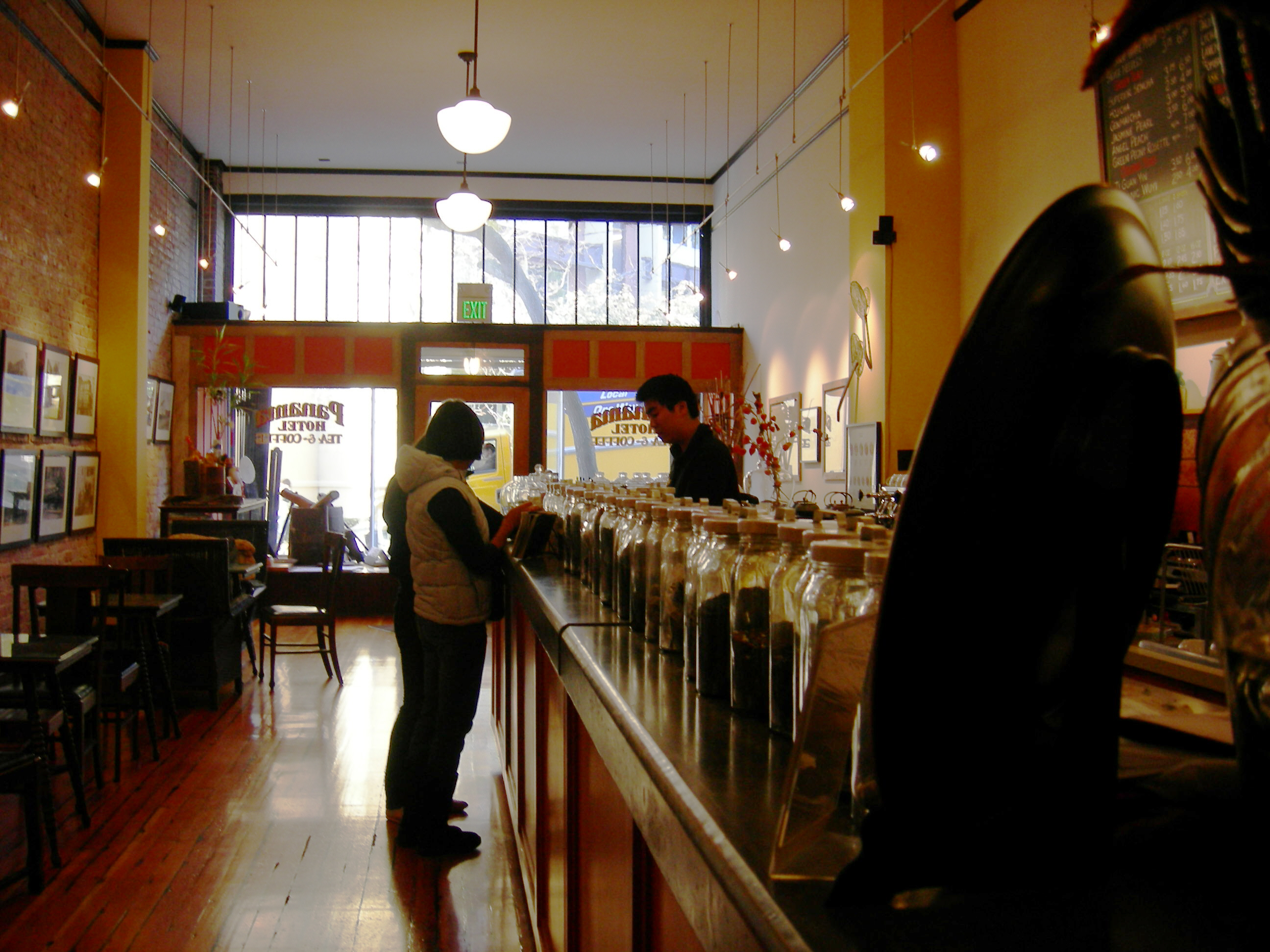
Panama Hotel
Look through the glass panel in the floorboards and you can see them: suitcases, trunks, wrapped bundles, personal belongings stacked in the basement darkness. They have been there since 1942, when Japanese American families in Seattle's Nihonmachi -- Japantown -- were given days to pack what they could carry and report for internment. What they could not carry, they brought to the Panama Hotel. Most never came back for their things.
Ozasa's Masterwork
Sabro Ozasa, the first Japanese American architect in Seattle and a University of Oregon graduate, designed the Panama Hotel at 605 South Main Street, in the heart of Nihonmachi. The building opened in the summer of 1910, and it was the largest structure Ozasa ever designed in the United States. With 94 rooms, the hotel served as far more than a place to sleep. It housed restaurants, small businesses, and sleeping quarters for both long-term residents and newly arrived immigrants. In the basement, Ozasa included something essential to the community: the Hashidate-Yu, a traditional Japanese bathhouse -- a sento -- with separate soaking areas for men and women. In a neighborhood where most residents lacked bathing facilities in their own quarters, the bathhouse became a social anchor. People gathered there not just to bathe but to talk, to share news from home, to maintain the rituals of a culture transplanted across the Pacific.
What They Left Behind
When President Roosevelt signed Executive Order 9066 on February 19, 1942, Seattle's Japanese American community faced an impossible task: reduce your life to what you can carry, then report for relocation. Families brought their most precious belongings -- photo albums, kimonos, dishware, family heirlooms -- to the Panama Hotel's basement for safekeeping, trusting they would return. Many did not. Some died in the camps. Others, unable to afford the return or unwilling to face a city that had allowed their removal, resettled elsewhere. The trunks and suitcases remained in the basement, untouched for decades, a physical archive of lives interrupted. Today, the belongings of those Japanese American families still sit in the hotel's basement, visible through a glass panel that the current owner installed in the floor, allowing visitors to peer down into a preserved moment of American injustice.
The Last Sento
Seattle once had multiple Japanese bathhouses serving Nihonmachi, but the Panama Hotel's Hashidate-Yu is the only one that survives intact anywhere in the United States. The sento consists of two furos -- traditional deep soaking tubs -- one for men and one for women. The tiled rooms, the plumbing, the spatial arrangement all remain as Ozasa designed them over a century ago. The bathhouse represents something larger than architecture: it is evidence of a community that built permanent institutions, that invested in infrastructure and daily ritual, that intended to stay. Internment tried to erase that permanence. The survival of the Hashidate-Yu is a rebuttal, physical proof that Japanese Americans were not temporary visitors but rooted members of Seattle's urban fabric.
Guardian of Memory
Since 1985, the Panama Hotel has been owned by Jan Johnson, only the third owner in the building's history. Johnson has spent decades restoring the hotel to evoke its condition before internment, working to preserve both the physical building and the stories it holds. She has attempted to locate the original owners of the basement belongings or their descendants, returning what she could and preserving the rest as a museum. In 2006, the Panama Hotel was designated a National Historic Landmark -- one of only a handful of buildings in Seattle to receive the distinction. In 2015, the National Trust for Historic Preservation named it a National Treasure. In 2020, the Panama Hotel received the Japanese Foreign Minister's Commendation for promoting mutual understanding between Japan and the United States. The building also inspired Jamie Ford's novel Hotel on the Corner of Bitter and Sweet, which brought the Nihonmachi story to a national audience. The Panama Hotel stands as both witness and keeper -- a building that remembers what a nation tried to forget.
From the Air
Located at 47.5999°N, 122.3259°W in Seattle's Chinatown-International District, just south of downtown. The Panama Hotel sits at 605 South Main Street, a small historic building in a dense urban neighborhood -- not individually visible from altitude but located in the recognizable grid of the International District between the stadiums to the west and the I-5 corridor. King Street Station (Amtrak) and the sports stadiums (T-Mobile Park, Lumen Field) are nearby landmarks visible from the air. Boeing Field (KBFI) is approximately 2nm south, and Seattle-Tacoma International (KSEA) is about 10nm south-southwest. The International District is best appreciated at lower altitudes where the neighborhood's historic character becomes apparent.