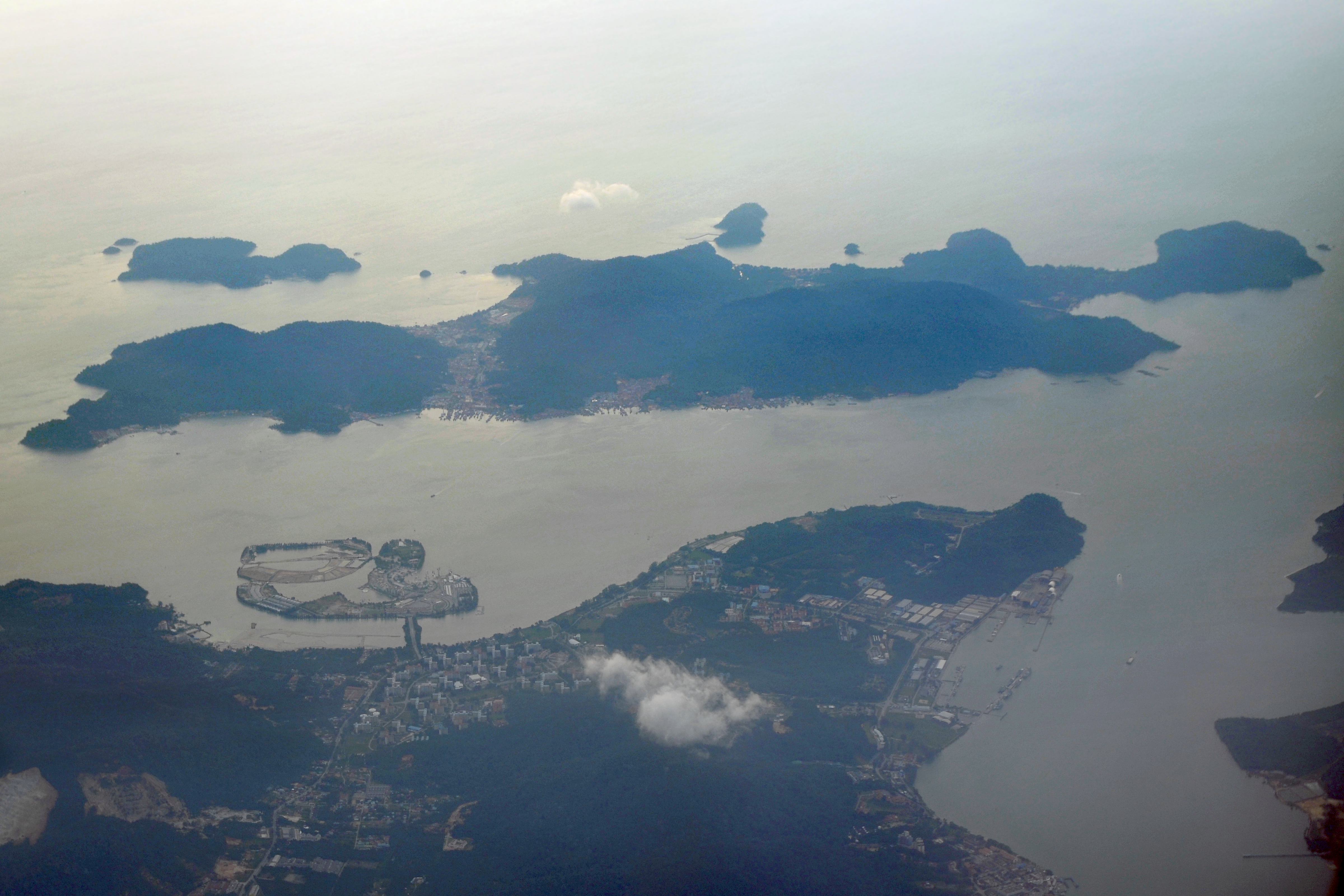
Pangkor Island
Every evening at Teluk Nipah, oriental pied hornbills line up on the electricity wires like commuters waiting for a train. Then, one by one, they swoop down in acrobatic dives to snatch fruit from the hands of visitors gathered on the beach. It is a strange and wonderful scene -- wild prehistoric-looking birds performing for an audience on a tiny island that most of the world has never heard of. But Pangkor Island, just 3.5 kilometers off the coast of Perak in western Peninsular Malaysia, has been drawing people for centuries, and not always for the sunsets.
Tin, Treaties, and Colonial Ambition
Pangkor's strategic position in the Strait of Malacca made it irresistible to empire builders. In 1670, the Dutch constructed Fort Dindingh on the island's eastern shore, a squat stone garrison built to guard the Perak tin trade. The Dutch wanted monopoly control of the tin flowing from the sultanate's rich alluvial deposits, and Pangkor gave them a chokepoint. The fort's crumbling walls still stand today, shaded by jungle that has spent centuries reclaiming the stonework. But the island's most consequential moment came two centuries later. On January 20, 1874, aboard the colonial steamer Pluto anchored off Pangkor's coast, the British Governor of the Straits Settlements, Andrew Clarke, brokered the Pangkor Treaty. The agreement recognized Raja Abdullah as Sultan of Perak in exchange for his acceptance of a British Resident -- an advisor whose counsel could not be refused. It was a polite word for control. The treaty effectively began the British colonial domination of the Malay Peninsula, and it started right here, in the waters off this quiet fishing island.
The Two Coasts
Pangkor splits neatly in character between its eastern and western shores. The east coast is the working side -- fishing villages strung along the waterfront, dry fish factories filling the air with brine, boat workshops where hulls are scraped and repainted in blues and greens. Sungai Pinang Besar and Sungai Pinang Kecil are the heart of island life, home to most of the roughly 10,000 residents who make their living from the sea. Walk through the east coast in the morning and you will find fishermen sorting the night's catch while cats wait with professional patience beneath the sorting tables. The west coast belongs to the visitors. Pasir Bogak stretches 1.5 kilometers of soft white sand along the island's southwestern shore, its shallow waters calm enough for families. Further north, Teluk Nipah draws the backpacker crowd with its budget chalets and proximity to the uninhabited islands of Mentagor and Giam, reachable by kayak and ringed with coral reefs.
Creatures of the Canopy
The interior of Pangkor is dense tropical forest that has never been fully developed, and it harbors a surprising density of wildlife for such a small island. Researchers have documented 65 reptile species, 17 amphibian species, and 82 total herpetofaunal species -- a remarkable count for eight square kilometers of land. Long-tailed macaques own the forest edges and are bold enough to investigate unattended bags. Monitor lizards patrol the quieter beaches. But it is the hornbills that define Pangkor's character. The rhinoceros hornbill and the oriental pied hornbill are both present, their massive casqued beaks and heavy wingbeats unmistakable overhead. Near Teluk Nipah, a daily sunset feeding has become one of the island's signature experiences -- the birds descending from the canopy to accept fruit from visitors in a ritual that feels ancient even though it is thoroughly modern.
Duty-Free and the New Chapter
No bridges connect Pangkor to the mainland. That is deliberate -- a policy designed to limit vehicles and prevent the road congestion that has marred other Malaysian island destinations. Instead, ferries make the 30-to-40-minute crossing from Lumut, the port town on the mainland, depositing visitors at jetties on the east coast. A newer, faster route from Marina Island cuts the trip to 15 minutes. For decades, Pangkor remained a modest domestic getaway, overshadowed by better-known islands like Langkawi and the Perhentians. That began to change on January 1, 2020, when the federal government granted Pangkor duty-free status. The effect was immediate: visitor numbers surged 40 percent, from roughly one million to 1.42 million. The island also has its own airport, a short strip that accepts charter flights and small scheduled services. Whether the duty-free boom will transform Pangkor or merely amplify what was already there remains an open question -- but for now, the hornbills still show up at sunset, and the fishermen still sort their catch at dawn.
From the Air
Pangkor Island sits at 4.22N, 100.555E in the Strait of Malacca, roughly 3.5 km off the Perak coast. The island is clearly visible from altitude as a forested oval surrounded by turquoise shallows, with the smaller Pangkor Laut to its south. Pangkor Airport (WMPA) has a 792-meter runway oriented 04/22 at 19 ft elevation, suitable for small aircraft. Ipoh's Sultan Azlan Shah Airport (WMKI) is the nearest major field, about 90 km inland. The Lumut Naval Base is visible on the mainland shore opposite the island. Best viewed at 3,000-5,000 ft for island detail; the contrast between the forested interior and white sand western beaches is striking from above.