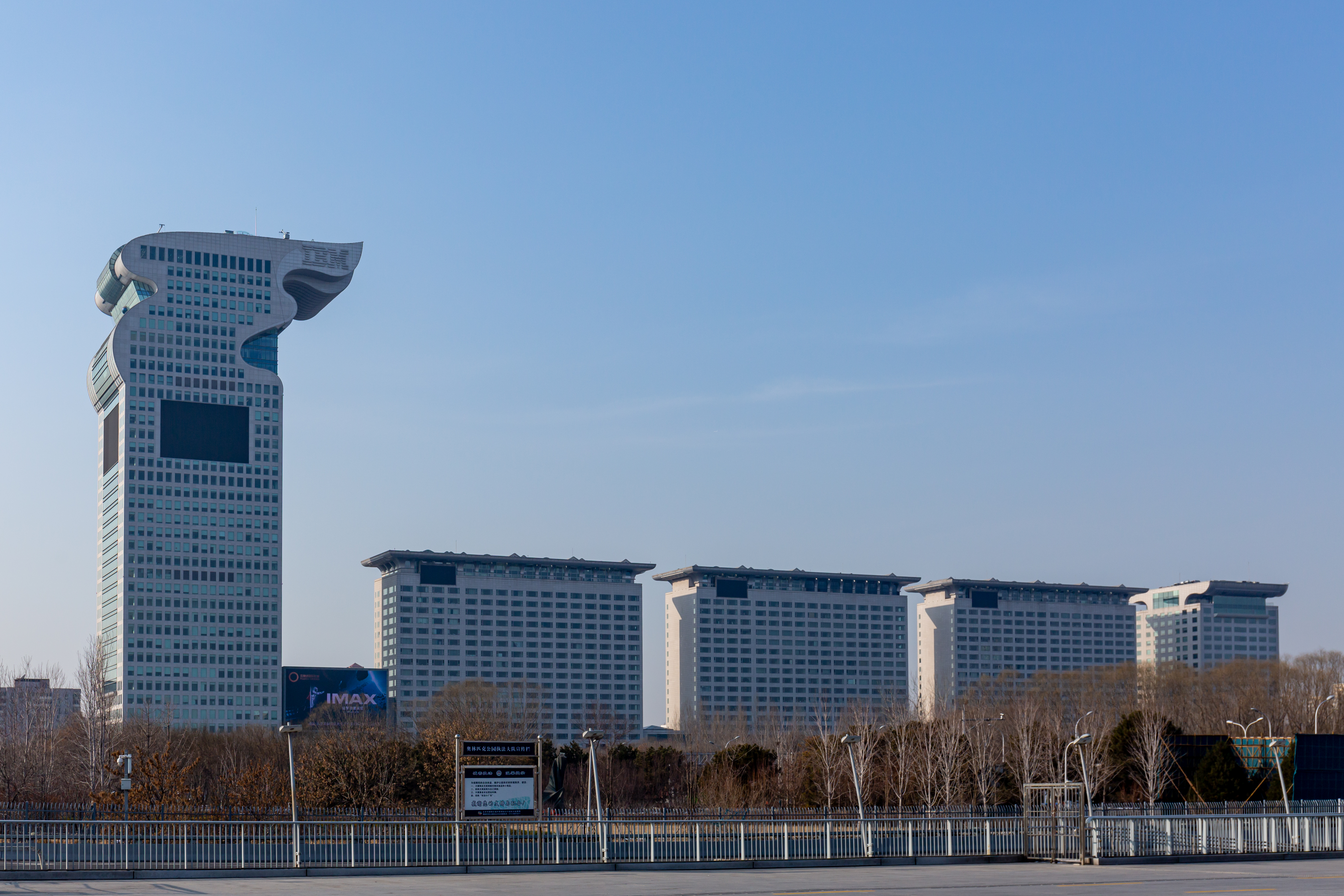
Pangu Plaza
From certain angles along Beijing's North Fourth Ring Road, the five buildings of Pangu Plaza compose the silhouette of a dragon -- head rearing at one end, tail tapering at the other. It was deliberate: the complex was designed to evoke the mythological creature that symbolizes power and fortune in Chinese culture. Built to coincide with the 2008 Summer Olympics, Pangu Plaza rose next to the Bird's Nest and the Water Cube as a private-sector counterpart to the state's Olympic spectacle.
A Dragon by the Bird's Nest
The five-building complex at 27 North Fourth Ring Middle Road in Chaoyang District comprises an office tower, three residential buildings, and the Pangu 7 Star Hotel -- a property that claimed to be one of only two seven-star hotels in the world. The dragon-shaped profile was not subtle, and it did not need to be. This was Beijing in 2008, a city announcing itself to the world through architecture of extravagant ambition. Bill Gates reportedly stayed at the hotel during the Olympics. The complex also housed the headquarters of IBM's China division, anchoring its credentials as a hub of international commerce alongside its role as a symbol of Chinese mythology rendered in glass and steel.
Fortune and Downfall
The story behind Pangu Plaza proved more dramatic than its architecture. The complex was developed by Guo Wengui, a Chinese businessman who would later become an international fugitive. In 2016, Chinese authorities seized ownership of the tallest building. By August 2019, the tower was auctioned online for nearly 5.19 billion yuan -- roughly $734 million -- in what observers called a bargain given the property's prime location near the Olympic Green. The seizure and sale laid bare the risks of entangling real estate ambition with political fortune in contemporary China, a country where the distance between a tycoon's penthouse and a government auction block can be measured in the span of a single indictment.
Olympic Legacy in Concrete
Pangu Plaza stands as a physical record of Beijing's Olympic era, when the city remade entire districts to project an image of modernity and prosperity. The Bird's Nest, the Water Cube, and the Olympic Green transformed the surrounding landscape, and private developers raced to build alongside the state's infrastructure investments. That era's confidence is frozen into Pangu Plaza's flamboyant form -- a dragon-shaped building that would be difficult to imagine being approved in a more cautious decade. The complex continues to operate as a mixed-use development, its hotel and offices serving a neighborhood that has settled into post-Olympic normalcy, the spectacle of the Games now a permanent backdrop rather than a headline.
From the Air
Located at 39.99N, 116.38E along Beijing's North Fourth Ring Road, immediately adjacent to the Olympic Green. The dragon-shaped profile of the five buildings is best appreciated from a northeastern or southwestern approach. The Bird's Nest (Beijing National Stadium) and Water Cube are directly to the east. Nearby airports: Beijing Capital International (ZBAA) 20 km NE, Beijing Daxing International (ZBAD) 50 km S. Best viewed at 2,000-4,000 ft.