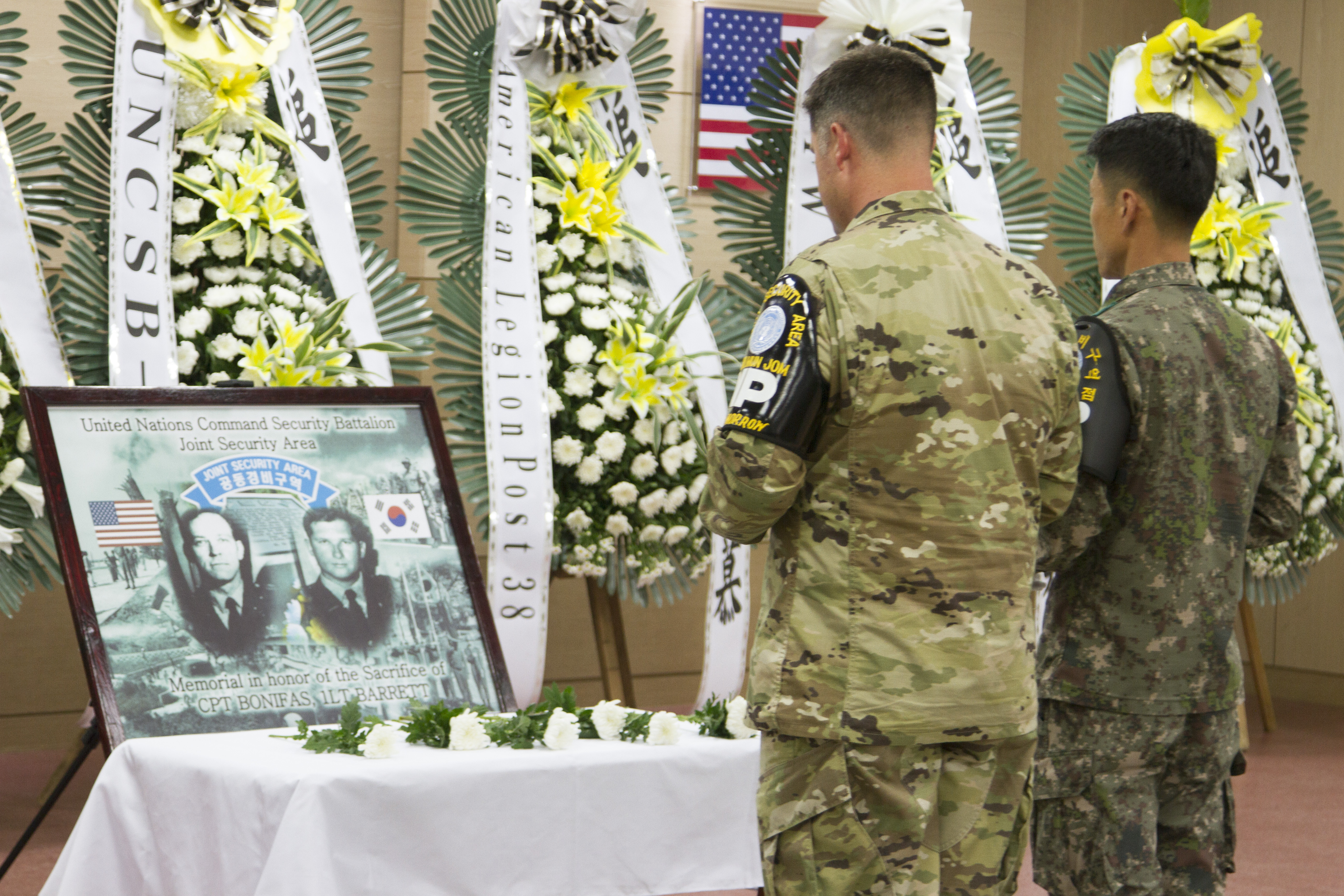
Panmunjom Axe Murder Incident
Senior Lieutenant Pak Cheol removed his watch. He wrapped it carefully in a handkerchief, placed it in his pocket, and shouted an order: "Kill the bastards." Within seconds, North Korean soldiers were swinging axes at American officers who had come to trim a poplar tree. The date was August 18, 1976. The place was the Joint Security Area at Panmunjom, the narrow strip of the Korean DMZ where soldiers from both sides worked in close proximity without physical barriers. Captain Arthur Bonifas and First Lieutenant Mark Barrett died that morning over a tree that blocked the line of sight between a United Nations Command checkpoint and an observation post. The fight lasted 20 to 30 seconds. Its consequences brought the Korean peninsula to the edge of a second war.
The Tree and the Bulldog
The 30-meter poplar stood near the Bridge of No Return, obstructing the view between UNC checkpoint CP#3 and observation post OP#5. It was a practical problem with a practical solution: send a work detail to prune the branches. But the tree had become a point of contention. North Korean soldiers had previously told work crews they could not cut it because it had been planted by Kim Il Sung -- a claim that was almost certainly untrue but carried the weight of a political threat. On the morning of August 18, Captain Bonifas led a detail of UNC soldiers and Korean Service Corps workers to do the trimming. Neither Bonifas nor Barrett carried sidearms; rules in the JSA limited armed personnel. About 15 North Korean soldiers arrived, led by Pak Cheol, whom the Americans had nicknamed "Lieutenant Bulldog" for his history of confrontations. Pak watched the pruning for fifteen minutes. Then he ordered it stopped.
Twenty Seconds
When Captain Bonifas ignored the order and turned his back, Pak sent a runner across the Bridge of No Return. Within minutes, a truck arrived carrying roughly 20 more North Korean guards armed with crowbars and clubs. Pak repeated his demand. Bonifas again turned away. That was when Pak removed his watch and gave the kill order. The North Koreans seized axes that the tree-pruning crew had brought and attacked. Bonifas was knocked to the ground and bludgeoned by at least five soldiers. Barrett jumped a low wall and fell into a tree-filled depression, where he was pursued and killed. All but one of the remaining UNC guards were wounded. The entire assault lasted less than half a minute. The North Korean soldiers placed Bonifas's body in their truck and left. The CIA later concluded the attack had been planned by the North Korean government.
Operation Paul Bunyan
The American response was calibrated to terrify without starting a war. President Gerald Ford held crisis talks in the White House, and General Richard G. Stilwell planned what became Operation Paul Bunyan -- named for the mythical lumberjack because the objective, almost absurdly, was to cut down a tree. But the force assembled was anything but absurd. On the morning of August 21, three days after the murders, a work detail entered the JSA backed by a U.S. infantry company in 20 utility helicopters and seven Cobra gunships. Behind them, B-52 Stratofortresses flew from Guam, escorted by F-4 Phantom IIs from Kunsan Air Base. South Korean F-5 and F-86 fighters swept the sky at high altitude. F-111 bombers from Mountain Home Air Force Base, Idaho, were on station. An aircraft carrier task force had moved offshore. The tree came down. The North Koreans watched but did not intervene.
What the Stump Became
In the aftermath, American readiness in South Korea was raised to DEFCON 3. North Korea, after initially protesting, accepted responsibility for the killings -- a rare concession from Pyongyang. The incident reshaped the Joint Security Area permanently. The Military Demarcation Line, which had previously gone unenforced within the JSA, was now marked and patrolled. Personnel from the two sides were physically separated for the first time. The North Koreans built a new bridge on their side of the line in 72 hours to replace their use of the Bridge of No Return. The tree stump was left standing until 1987, when it was replaced by a stone monument with a brass plate honoring Bonifas and Barrett. The nearby checkpoint, CP#3, was abandoned and sealed with concrete bollards. General William J. Livsey, commanding the Eighth U.S. Army from 1984 to 1987, carried a swagger stick carved from the poplar's wood -- a piece of the tree that started one of the Cold War's most dangerous confrontations, whittled down to something a man could hold in his hand.
From the Air
The incident site is located at approximately 37.956N, 126.673E within the Joint Security Area of the Korean DMZ. The JSA complex is visible from altitude as a cluster of buildings at Panmunjom. Strict flight restrictions apply throughout the DMZ corridor. The site of the former poplar tree is now marked by a stone monument. Nearest accessible airports: Gimpo International (RKSS, ~50 km south), Incheon International (RKSI, ~70 km southwest). Military airfields including Osan Air Base (RKSO) and Kunsan Air Base (RKJK) played roles in Operation Paul Bunyan.