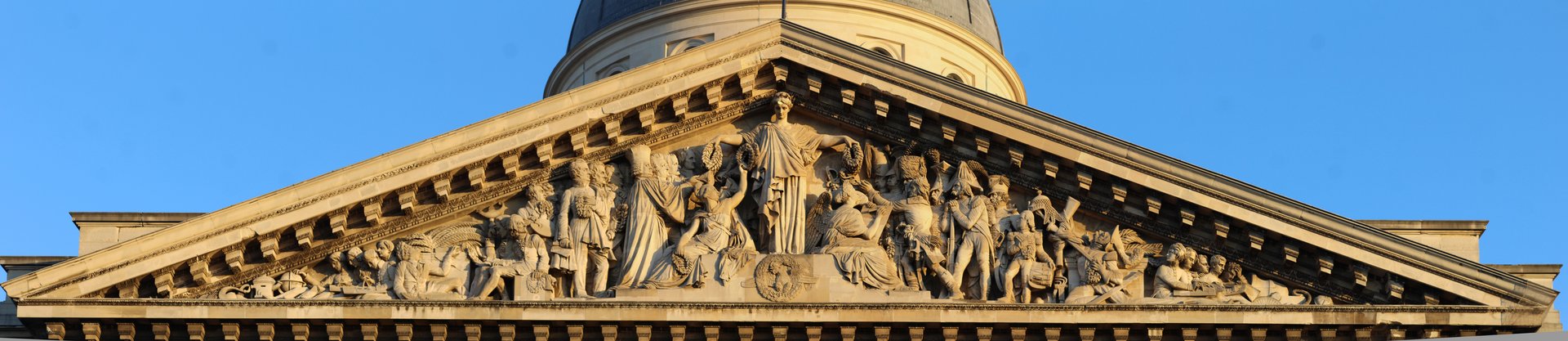
Panthéon
Neither its architect nor the king who commissioned it lived to see it finished. Jacques-Germain Soufflot began designing the church of Sainte-Geneviève in 1758 at the behest of Louis XV, who wanted a grand temple on the highest hill of the Left Bank to honor Paris's patron saint. Soufflot died in 1780, still refining his creation. Louis XV had died in 1774. When the building was finally completed in 1790, the Revolution was already underway, and the National Assembly had other plans for it. They renamed it the Panthéon, stripped the religious imagery, and declared it a mausoleum for the great men of the nation. In the two centuries since, the building has toggled between church and secular monument four times -- a tug of war between faith and republic written in stone.
Soufflot's Impossible Vision
Soufflot wanted to combine the lightness of Gothic structure with the grandeur of classical form -- a synthesis that his contemporaries considered impossible. He achieved it by hiding the Gothic engineering inside a neoclassical shell. The building's dome, inspired by St. Paul's Cathedral in London and St. Peter's Basilica in Rome, rises 83 meters above the hilltop of Montagne Sainte-Geneviève. The interior is cruciform, supported by slender columns that create a sense of spaciousness unusual for the period. But the lightness came at a cost: cracks appeared in the structure during construction, and Soufflot spent his final years defending the design against critics who predicted its collapse. His successors reinforced the piers and walled up many of the original windows, darkening the interior that Soufflot had intended to flood with light.
The Republic's Shrine
The Revolution's first use of the Panthéon set its tone. In April 1791, the remains of Mirabeau were interred in the crypt with enormous ceremony -- then removed three years later when his correspondence with Louis XVI was discovered. Voltaire entered the same year and remains. Rousseau followed in 1794. The building became a barometer of political legitimacy: those who fell from favor were expelled, while new heroes were added. Napoleon returned it to the Church in 1806. The July Monarchy reclaimed it for the nation in 1830. Napoleon III gave it back to the Church. The Third Republic seized it permanently in 1885, on the occasion of Victor Hugo's funeral, when two million people lined the Champs-Élysées to follow the cortège. Hugo's body lay in state under the dome before descending to the crypt.
Foucault's Proof
In 1851, physicist Léon Foucault hung a 67-meter pendulum from the center of the dome and invited Paris to watch the Earth rotate. The pendulum, swinging in a fixed plane while the floor beneath it turned, provided the first direct visual proof that the planet spins on its axis. The demonstration was a sensation -- science performed as public spectacle in a building that had been built for religious devotion and repurposed for national glory. A replica of Foucault's pendulum swings in the Panthéon today, its brass bob tracing slow arcs above the marble floor, knocking over small pins arranged in a circle as the hours pass. It remains one of the most elegant physics demonstrations ever conceived.
Who Belongs Here
The question of who deserves the Panthéon has always been political. For nearly two centuries, it was exclusively male. Marie Curie became the first woman interred on her own merits in 1995, sixty-one years after her death. Résistance hero Germaine Tillion entered in 2015. Josephine Baker, the American-born dancer and French Résistance spy, was panthéonized in 2021. As of today, the crypt holds over eighty individuals, including Émile Zola, Alexandre Dumas, Louis Braille, and Jean Moulin. Each induction is a presidential decision, a statement about which values the Republic wishes to honor. The inscription above the entrance -- "Aux grands hommes, la patrie reconnaissante" (To great men, the grateful nation) -- has never been altered, though its meaning has broadened.
Hilltop Beacon
The Panthéon commands the summit of the Montagne Sainte-Geneviève, the highest natural point on the Left Bank. From its steps, the Latin Quarter spreads downhill toward the Seine. The dome, visible across much of central Paris, anchors the skyline of the 5th arrondissement the way Notre-Dame anchors the river and the Eiffel Tower anchors the west. The surrounding Place du Panthéon, designed to isolate the building in a formal square, gives it a severity that few Parisian monuments share. There are no cafés at its base, no vendors, no casual activity -- just the building and the sky above it, which is precisely the effect Soufflot intended when he placed a temple on a hilltop.
From the Air
Located at 48.8462°N, 2.3461°E atop the Montagne Sainte-Geneviève in Paris's 5th arrondissement. The dome is a prominent landmark from the air, visible from most approaches to central Paris. Best viewed from 2,000-3,000 feet AGL. The building sits approximately 800 meters south of Notre-Dame. Nearest airports: Paris-Orly (LFPO) 14 km south, Paris-Le Bourget (LFPB) 12 km northeast, Paris-Charles de Gaulle (LFPG) 25 km northeast.