The Pantheon: Two Thousand Years Under an Open Sky
Rain falls inside the Pantheon. It has fallen inside for nearly two thousand years, through the 27-foot oculus at the apex of the dome, pooling on the gently sloped marble floor before draining through holes that Roman engineers cut into the pavement. This is not a flaw. The oculus was the building's entire point - a circular eye open to the heavens, flooding the interior with a column of light that rotates through the day like a sundial made of architecture. Emperor Hadrian ordered the present building around AD 126, replacing an earlier temple that Marcus Vipsanius Agrippa had commissioned during the reign of Augustus. Hadrian kept Agrippa's original inscription on the facade, a gesture of modesty so unusual for a Roman emperor that scholars debated for centuries who actually built the structure.
The Dome That Should Not Stand
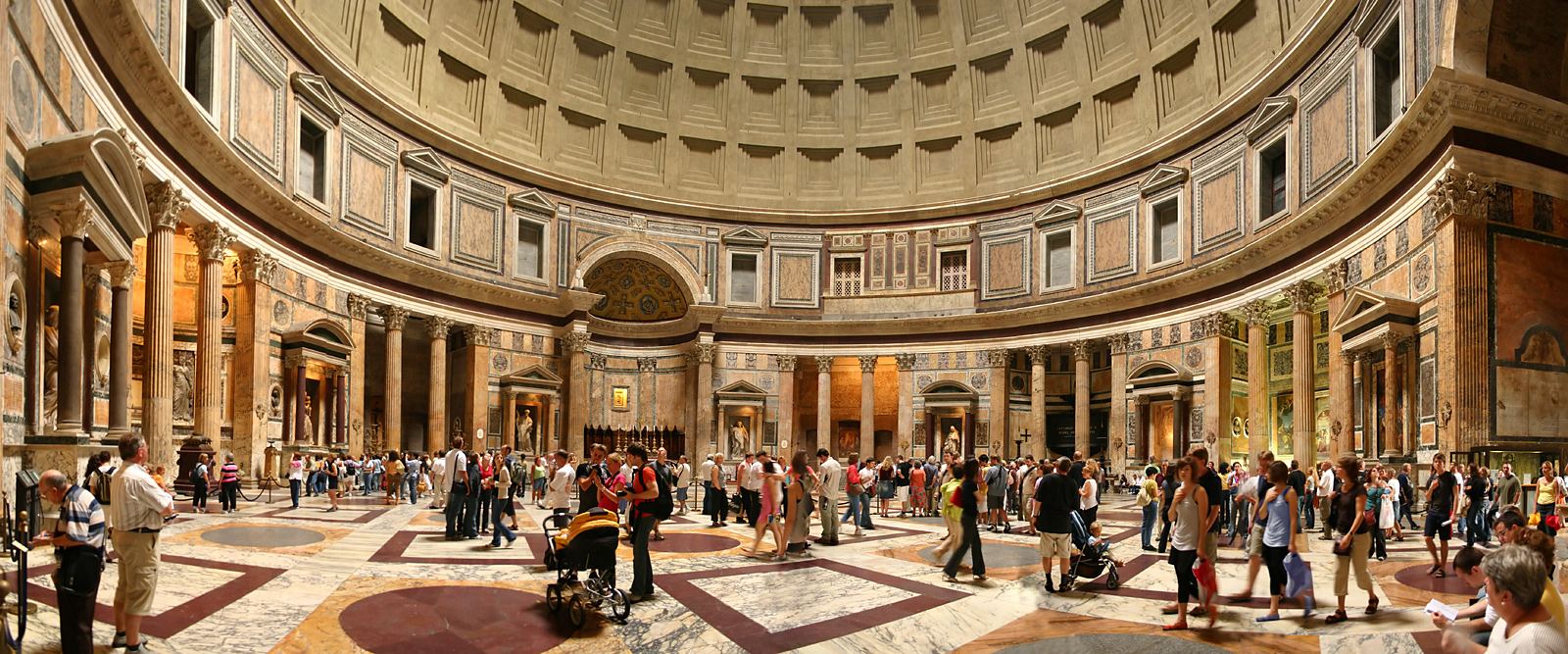
The numbers alone are staggering. The dome's interior diameter is 142 feet - identical to its height from floor to oculus, meaning a perfect sphere 142 feet across would fit exactly inside the rotunda. Nearly two thousand years after construction, it remains the world's largest unreinforced concrete dome, surpassing even modern structures that benefit from steel reinforcement and computer modeling. How did Hadrian's engineers achieve this? They varied the concrete's density, using heavy basalt aggregate near the base and progressively lighter tufa and pumice toward the top. The dome's thickness decreases from 21 feet at the base to less than 5 feet at the oculus. Twenty-eight coffers - sunken panels arranged in five concentric rings - reduce the dome's weight while creating the geometric pattern that visitors crane their necks to study. The coffers may once have held gilded bronze rosettes representing stars, turning the interior into a map of the heavens.
A Temple for All Gods
The name itself reveals the ambition: Pantheon derives from the Greek "pantheion," meaning "of or relating to all the gods." Whether the original temple actually honored every deity in the Roman pantheon or served some other function remains debated. Cassius Dio, writing in the 3rd century, suggested the building's dome resembled the vault of the heavens. The sixteen granite Corinthian columns of the portico - each 39 feet tall, weighing 60 tons, quarried at Mons Claudianus in Egypt's eastern desert and dragged more than 100 kilometers to the Nile - announce the scale of what lies within. But nothing prepares a visitor for the transition from the columned porch to the rotunda. The rectangular vestibule acts as a compression chamber: you pass through a forest of stone into a relatively narrow corridor, and then the space explodes outward into the dome's perfect hemisphere, with the sky visible above.
Survival Through Transformation
The Pantheon endured because it adapted. In AD 609, the Byzantine Emperor Phocas gave the building to Pope Boniface IV, who consecrated it as the church of Santa Maria ad Martyres. That single act of conversion saved the Pantheon from the quarrying that reduced most of Rome's ancient temples to foundations. The bronze roof tiles were stripped by Emperor Constans II in 663, and Pope Urban VIII melted down the portico's bronze ceiling beams in 1632 to cast cannons for Castel Sant'Angelo and the baldachin in St. Peter's Basilica - prompting the famous pasquinade: "What the barbarians did not do, the Barberini did." Yet the building survived. Raphael chose to be buried here in 1520, and two Italian kings - Vittorio Emanuele II and Umberto I - rest in chapels along the walls. On Pentecost Sunday, firefighters on the roof shower red rose petals through the oculus onto the congregation below, a tradition that transforms engineering into ceremony.
The Circle of Light
Stand inside the Pantheon at noon and the sun pours through the oculus as a near-perfect disk of light on the interior wall, sliding across the coffers as the hours pass. The floor, patterned in alternating circles and squares of colored marble, establishes a geometry that the dome's concentric rings of coffers echo above. Each vertical zone of the interior follows a different decorative scheme, so that nothing quite aligns - a deliberate disorientation that draws the eye upward toward the only source of natural light. Over six million people visit annually, making the Pantheon one of Rome's most frequented sites. They come for the dome, the tombs, the sheer improbability of a building that has stood through earthquakes, floods, sieges, and two millennia of Roman weather with its roof open to the sky. The Pantheon does not merely display Roman engineering. It embodies the audacity that made it possible.
From the Air
Located at 41.899N, 12.477E in central Rome's historic district. The Pantheon's massive circular dome is one of the most distinctive structures visible from the air - a large round roof with the dark circle of the oculus at its center, set within the dense urban fabric near Piazza Navona. The dome diameter is 142 feet. Best viewed at 1,500-3,000 feet to appreciate the dome's scale relative to surrounding buildings. Nearest major airport: Leonardo da Vinci-Fiumicino Airport (LIRF), approximately 30 km southwest. Roma Urbe Airport (LIRU) is closer at about 7 km north. The Tiber River is approximately 400 meters to the west.