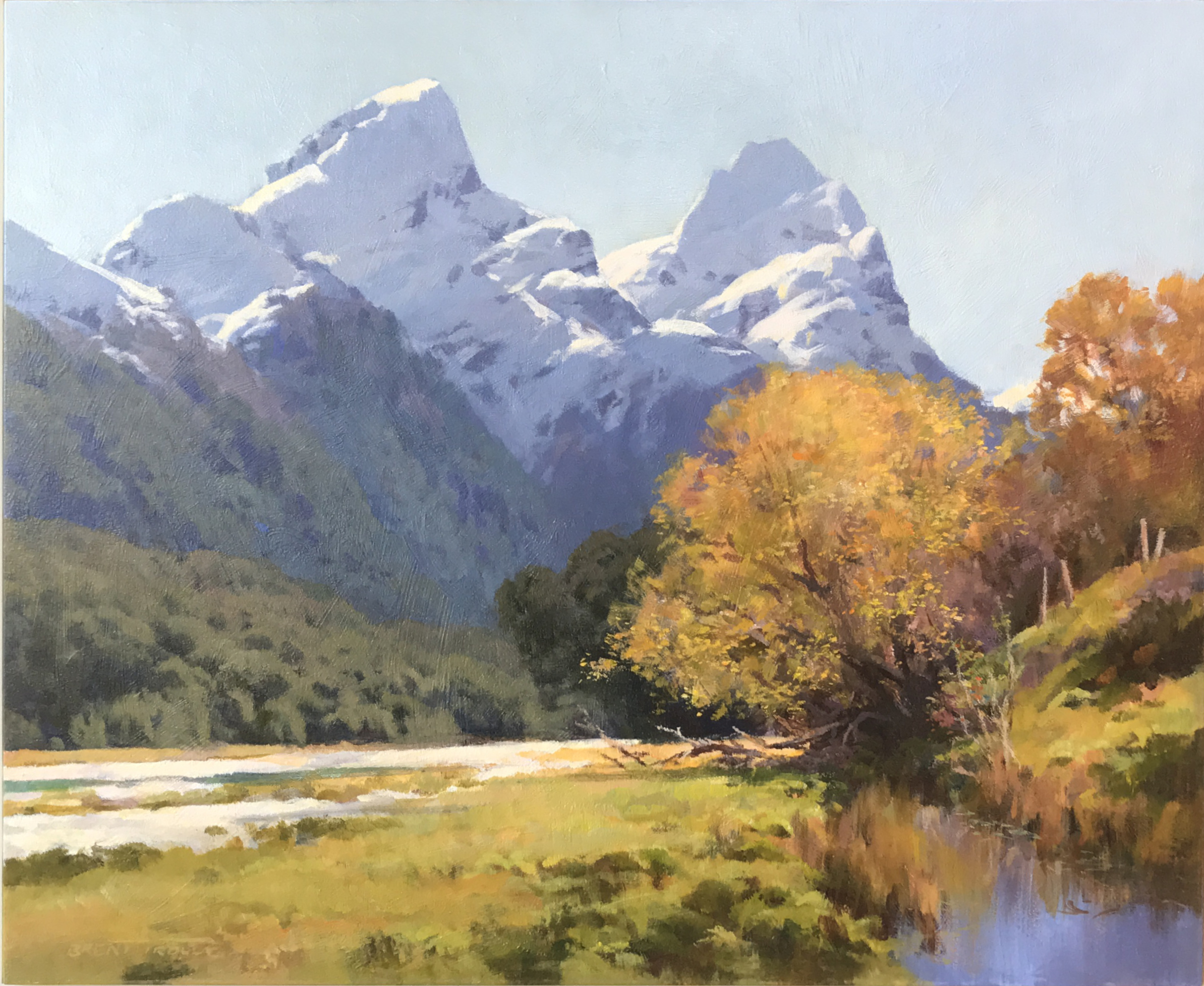
Paradise, New Zealand
Nobody agrees on why it's called Paradise. One theory credits the paradise shelducks - handsome, rust-and-black waterfowl that once congregated in noisy flocks across the valley floor. Another, published in the Lake Wakatip Mail back in 1860, simply says the name describes what people saw when they arrived: a flat, green expanse hemmed in by mountains so steep they seem painted on, with the braided channels of the Dart River threading through it all like silver wire. Both explanations feel equally plausible when you stand at the head of Lake Wakatipu and watch the afternoon light turn the beech forest canopy from green to gold.
Middle-earth, Found
When Peter Jackson's location scouts needed a forest that could pass for the elvish realm of Lothlórien, they drove the gravel road north of Glenorchy and stopped here. The native beech trees, draped in moss and standing in cathedral-like silence, became the woods where the Fellowship of the Ring first entered the domain of Galadriel. The same valley doubled as Parth Galen, the lakeside camp where the company fractures. Years later, Jackson returned for The Hobbit trilogy, using Paradise as the exterior setting for the shape-shifter Beorn's house - a choice that required a landscape wild enough to belong to a man who turns into a bear. The BBC miniseries Top of the Lake, starring Elisabeth Moss, was set in Paradise too, though the actual filming took place in nearby Glenorchy. It says something about this valley that filmmakers keep choosing it to represent places that are supposed to be fictional. The reality keeps outperforming the imagination.
The Dart and the Valley
The Dart River - Te Awa Whakatipu in Maori - is what built Paradise. Over millennia, the river carried sediment down from the Southern Alps and spread it across this flat alluvial plain, creating the farmland that settlers eventually used for sheep and cattle. The river itself is a thing of cold, glacial beauty: pale jade in color, braided into shifting channels that rearrange themselves after every heavy rain. It drains the mountains of Mount Aspiring National Park, collecting snowmelt and rainfall from peaks that hold their white caps well into summer. Where the Dart enters the northern end of Lake Wakatipu, the transition from rushing river to still lake happens with surprising abruptness - one moment the water is churning over gravel bars, and the next it spreads into the vast, deep blue of the lake. The surrounding mountains, including the Forbes and Humboldt ranges, rise sharply on either side, creating a natural amphitheater that funnels weather and light into the valley in dramatic fashion.
A Quiet Corner of Otago
Paradise has no shops, no petrol station, no pub. It is a locality rather than a town - a handful of farming properties scattered along a gravel road that eventually gives up and becomes a tramping track into the wilderness. The nearest settlement with services is Glenorchy, a small community at the northern tip of Lake Wakatipu that serves as the gateway to several of New Zealand's Great Walks. From Glenorchy, the road to Paradise winds through pastoral land before entering the beech forest, crossing streams on narrow bridges, and delivering visitors to a landscape that feels genuinely removed from the modern world. Sheep graze in paddocks backed by snow-capped peaks. The air smells of damp moss and tussock. In winter, frost crystallizes on every surface and the mountains take on a severity that the summer greens disguise. It is the kind of place where the name, regardless of its true origin, feels earned.
Shelducks and Namesakes
The paradise shelduck - putangitangi in Maori - is one of New Zealand's most recognizable native birds. The male is mostly black with white wing patches, while the female wears a striking chestnut body with a white head, making pairs easy to spot and distinguish. A.W. Reed recorded that the locality was first known as Paradise Flat, and that the most popular explanation for the name traces back to these birds and the large flocks that once gathered in the valley. Whether or not the shelducks deserve the credit, they remain a constant presence here, their distinctive honking calls echoing across the farmland. The alternative theory - that early visitors simply looked around and reached for the most extravagant word they knew - carries its own quiet authority. Some places earn their names through history, through events, through the people who lived there. Paradise earned its name by existing.
From the Air
Paradise is located at 44.72S, 168.36E at the head of Lake Wakatipu, nestled in a valley where the Dart River enters the lake. From the air, look for the distinctive braided river channels spreading across the flat valley floor, framed by steep mountain walls. Queenstown Airport (NZQN) is the nearest major airfield, approximately 45 km to the south. The nearby settlement of Glenorchy is visible at the lake's northern tip. Best viewed at 3,000-5,000 feet AGL, though surrounding terrain rises steeply on all sides. The Forbes and Humboldt ranges create dramatic valley walls. Expect variable mountain weather with frequent cloud cover, particularly in winter months.