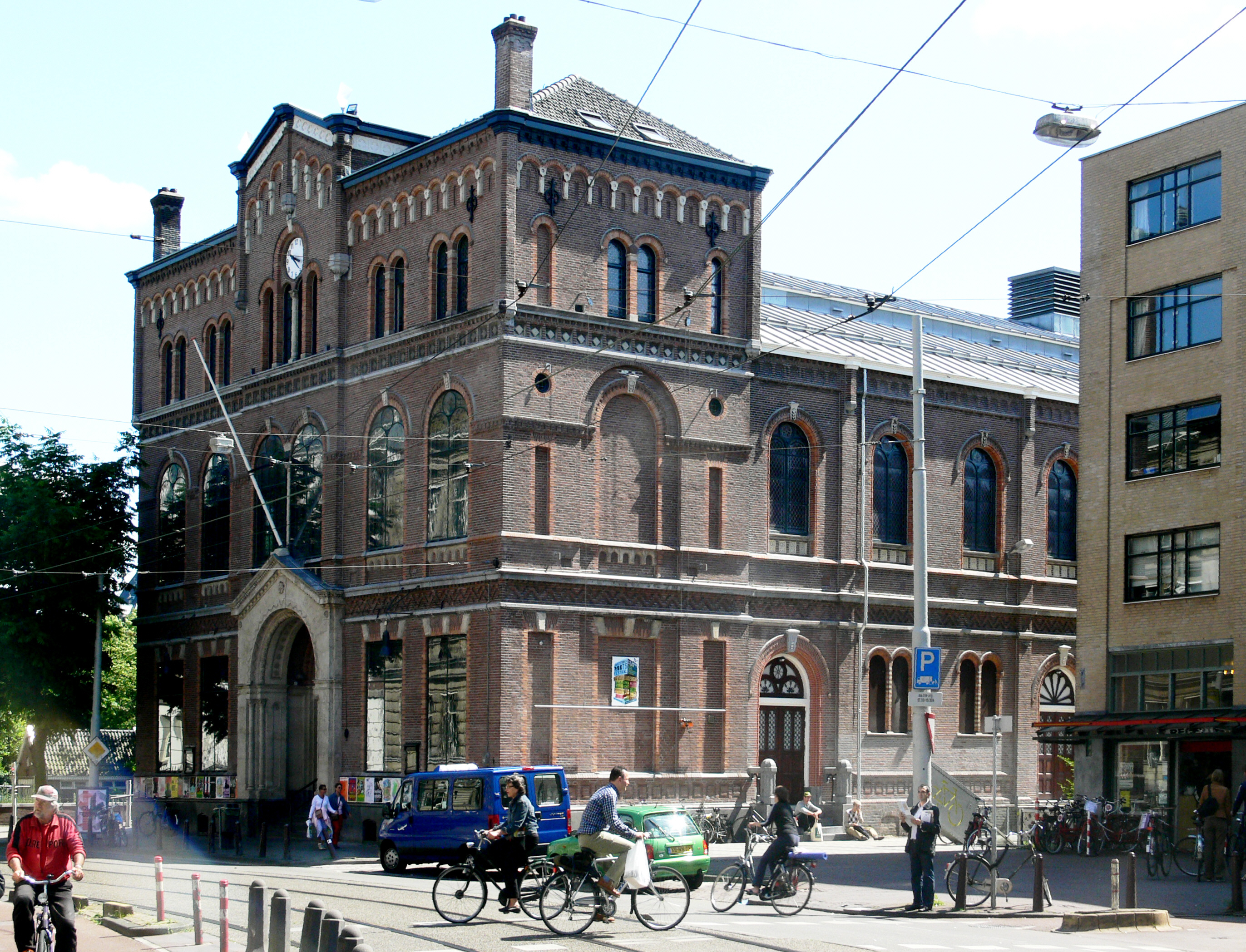
Paradiso (Amsterdam)
The stained glass windows are still there. Behind the stage, where you might expect a backdrop or a banner, the old church windows of De Vrije Gemeente catch the lights from the rig and throw them back in jewel colors. This is how Paradiso looks when Pink Floyd plays it, when Patti Smith stands there with her arms raised, when Iggy Pop gets jumped on stage by Hells Angels in 1979. The building was constructed between 1879 and 1880 as a meeting hall for a liberal religious congregation. In October 1967 a few hippies broke in and refused to leave. The city eventually shrugged and gave them permission to stay. They called it Cosmisch Ontspanningscentrum Paradiso - Cosmic Relaxation Center Paradiso - and opened the doors on 30 March 1968.
The Squat That Stuck
De Vrije Gemeente, the Free Congregation, had moved out of the Weteringschans 6 building in 1965 and sold it to a developer who planned a hotel by the architect Gerrit Rietveld. The hotel never happened. The space served briefly as a carpet store, then sat empty. In October 1967 Willem de Ridder, Koos Zwart, Matthijs van Heijningen and Peter Bronkhorst led a group of music fans through the doors and refused to leave. The police tried to clear them out and failed. The city did the practical thing: it gave them a permit. Less than two months after the official opening on 30 March 1968, Pink Floyd took the stage on 23 May - the same band that had just announced the departure of Syd Barrett, playing songs from The Piper at the Gates of Dawn under the church windows.
When the Smoke Was Legal
Amsterdam in 1971 was different. Hashish and marijuana were sold and smoked openly inside Paradiso, which is part of why The New York Times that July called the venue a "night-time mecca for American youths." The Rolling Stone reporter who came through in 1970 wrote that "dope, music and atmosphere were cheap and abundant." The atmosphere thickened, then soured. By the mid-seventies the venue had become rough, attendance had dropped, and Hells Angels had taken up residence as regulars. Iggy Pop, on stage in 1979, was beaten up mid-set by a gang member. Punk rock saved the place. The same energy that had become destructive in the hippie era became, with three chords and a different attitude, a reason to fill the room again.
The Best Show the Stones Ever Did
On 26 and 27 May 1995, the Rolling Stones played two acoustic shows at Paradiso during their Voodoo Lounge Tour. The venue had to build a second makeshift balcony to fit the recording equipment - that balcony was so useful that when Paradiso renovated in 2003 and 2004, they made it permanent. Outside the building, on the Museumplein, a crowd of somewhere between 50,000 and 80,000 people watched the show on a giant screen. The location had been a secret until two weeks before. Tracks from those nights ended up on the band's Stripped album later that year. Keith Richards, asked about the gigs afterwards, called them the best live shows the Stones had ever done. He was not given to small praise.
The Pop Temple
The Dutch nickname for Paradiso is poptempel. Pop temple. Adele played here. So did David Bowie, three times - 1987, 1989, 1997 - including the Tin Machine concert that became a live recording. Prince showed up unannounced in March 1995 after a stadium gig at the Brabanthallen, played a wild after-show, and told a confused Paradiso administration the next morning that he would be back that night for another. Nirvana's 25 November 1991 set was supposed to be at the smaller Melkweg around the corner, but ticket demand pushed it to Paradiso, and the recording of Lithium that ended up on From the Muddy Banks of the Wishkah was captured here. The main hall holds 1,500 people. There is a 250-seat room upstairs and a basement cafe where the smaller acts play. In 2023 the venue counted 727,000 visitors - a record.
Saved By Being Saved
In 1974 a hospitality entrepreneur named Nicolaas Bouwes proposed a 49,000-square-meter hotel complex on the Leidseplein that would have required demolishing Paradiso. The Amsterdam city council called it an unimaginative "piece of Manhattan" and refused. The plan died. On 16 September 1980 Paradiso was added to the Rijksmonumentenregister, the national list of protected monuments. The building cannot be torn down. In 2022 the organization spent 3.5 million euros buying the derelict lot next door to build a five-storey extension. The church that the Free Congregation built to gather around liberal theology, the carpet store that no one bought from, the squat that became a permit - all of it is still there. The stained glass still catches the lights.
From the Air
Paradiso sits at 52.36 N, 4.88 E on the Weteringschans in central Amsterdam, just off the Leidseplein. From above the building is a small dark rectangle set against the south edge of the Singelgracht canal, hard to pick out among the dense canal-belt townhouses. Schiphol (EHAM) is 12 km southwest. The Rijksmuseum and Vondelpark are 600 m to the west. Approach from the south during VFR transits gives the best view of the canal-belt grid that surrounds the venue.