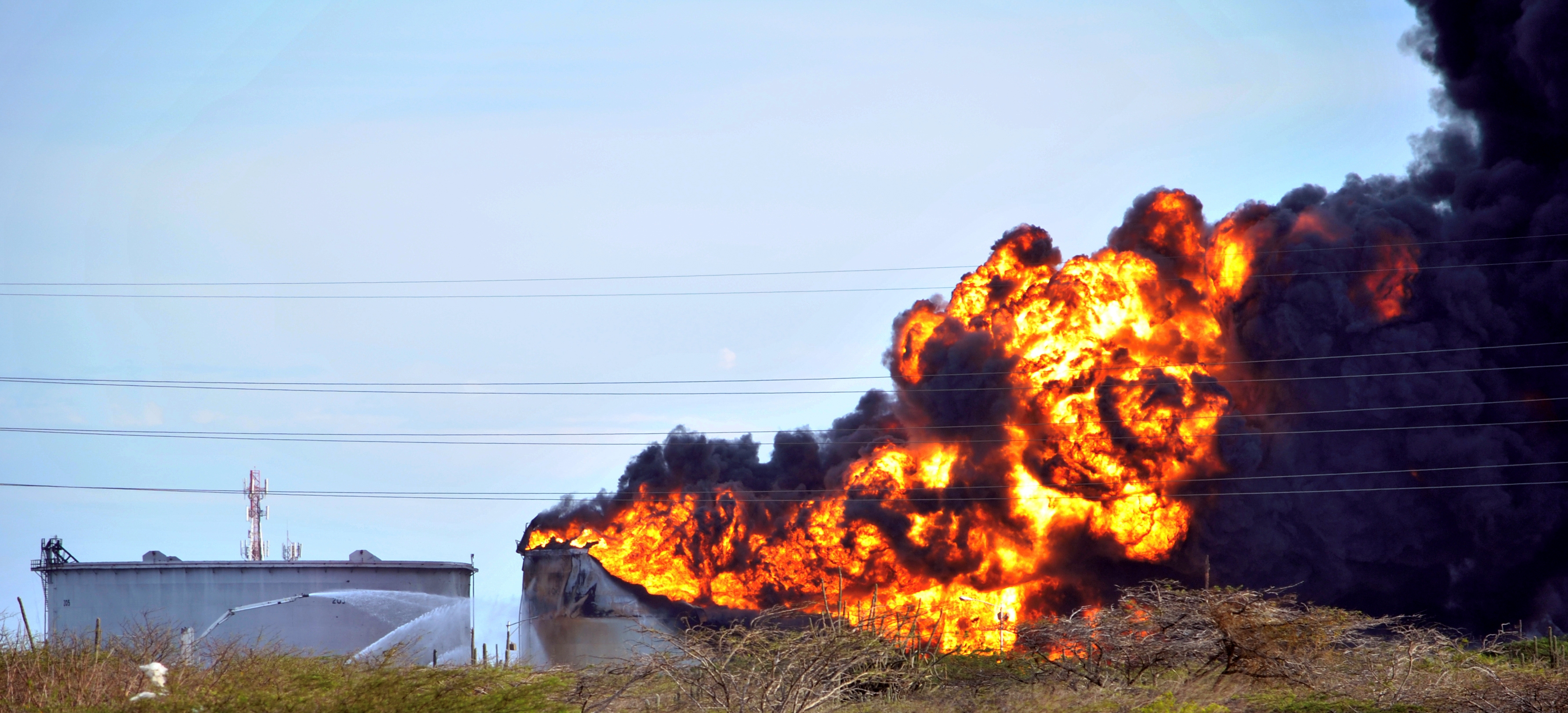
Paraguana Refinery Complex
At 1:11 in the morning on August 25, 2012, a propane and butane gas leak ignited at the Amuay refinery on Venezuela's Paraguana Peninsula. The explosion killed 48 people, most of them National Guard troops stationed at the plant, and shattered more than 1,600 homes in the surrounding community. A 10-year-old boy was among the dead. The blast marked the worst industrial disaster in Venezuela's modern history, but it was not a surprise. Workers had been warning about corroded equipment, missing spare parts, and ignored safety protocols for years. The Paraguana Refinery Complex - the largest in the Western Hemisphere and second largest on Earth after India's Jamnagar facility - had been deteriorating in plain sight.
Black Gold on the Peninsula
The complex owes its existence to a decision made in 1945, when Venezuela's national government authorized two transnational oil companies, Creole Petroleum Corporation and Shell de Venezuela, to build refineries near the small town of Punto Fijo. Shell's Cardon Refinery began processing crude in 1949 with a capacity of 30,000 barrels per day. Punto Fijo, previously a quiet settlement on the arid Paraguana Peninsula, transformed into an oil town almost overnight. The refinery complex eventually merged three facilities - Amuay, Cardon, and Bajo Grande on Lake Maracaibo's western coast - under the state-owned petroleum company PDVSA. At its peak, the combined complex processed 955,000 barrels per day, accounting for 71% of Venezuela's total refining capacity. The infrastructure stretched across an expanse of tanks, pipelines, catalytic crackers, and distillation columns visible from altitude as a dense industrial scar on the otherwise barren peninsula.
A Decade of Warnings
The trouble began before the 2012 explosion. After President Hugo Chavez fired 18,000 PDVSA employees following a 2002-2003 strike and replaced them with political loyalists, the safety record began its grim decline. In 2003, an explosion at an electrical substation injured two workers. In 2005 alone, six accidents struck the complex, including a November blast that killed five workers and injured twenty. The following year brought five more incidents, three more deaths, and the emergency shutdown of a 54,000-barrel-per-day catalytic reformer after a furnace fire. Fires continued through 2011 and into 2012. Union representatives complained publicly about damaged equipment, chronic shortages of spare parts, and a management culture that prioritized loyalty over competence. Each incident was contained and explained away. The pattern was unmistakable, but the response never matched the risk.
The Night Everything Broke
Investigators later determined that operators detected the propane and butane leak an hour before the Amuay explosion. The contingency plan was not activated. When the gas cloud found an ignition source, the detonation shattered the predawn quiet across kilometers. Three storage tanks caught fire. The shockwave flattened walls and blew out windows in a wide radius, damaging over 1,600 homes beyond the refinery fence. President Chavez declared three days of national mourning and ordered a probe. Energy Minister Rafael Ramirez assured the public that PDVSA had ten days of production stockpiled and that exports would continue without major disruption. Gasoline futures in the United States jumped 3.15%. Opposition candidate Henrique Capriles Radonski pointed to the long record of safety failures and blamed deferred maintenance. Chavez dismissed the criticism, saying it was too early to identify a cause - though the union's complaints had been naming causes for years.
An Empire in Decline
The Paraguana complex was built to be a monument to Venezuela's petroleum wealth. For decades, it functioned as exactly that - a massive engine of national revenue, processing crude from the Maracaibo Basin and the Orinoco Belt into refined products for domestic consumption and export. But the facility that once represented industrial ambition increasingly became a symbol of institutional decay. By 2022, Iran was helping to repair the complex, an arrangement that would have seemed unimaginable during the flush years when Venezuelan oil engineers were among the most respected in the world. The Cardon refinery, which started at 30,000 barrels per day in 1949, had grown to handle 305,000 barrels per day at its peak, but operational capacity has fluctuated sharply in recent years. The complex still stands on the Paraguana Peninsula, its tanks and towers catching the Caribbean light, but the gap between what it was designed to do and what it actually produces tells the larger story of Venezuela's oil industry.
From the Air
Located at 11.75N, 70.20W on Venezuela's Paraguana Peninsula in Falcon state. The refinery complex is visible from cruising altitude as an extensive industrial zone with storage tanks and processing towers along the peninsula's western coast. Josefa Camejo International Airport (SVJC) at Punto Fijo is approximately 10 km east. Lake Maracaibo is visible to the southwest; the Bajo Grande component of the complex sits on its western shore in Zulia state. The peninsula is connected to the mainland by the narrow Medanos Isthmus, clearly visible from altitude. The arid landscape provides strong contrast with the industrial infrastructure. Approach from the north over the Caribbean for the most dramatic view of the complex's full extent.