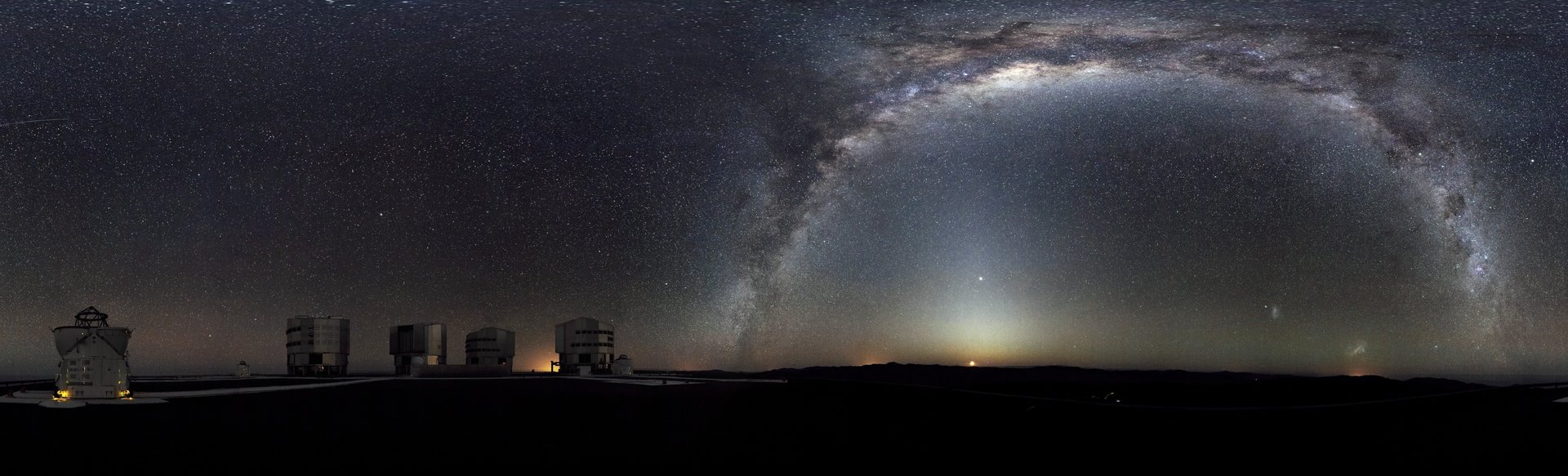
Paranal Observatory
The nearest town is Paposo, population 259, and it is thirty-eight kilometers away. That isolation is the point. Paranal Observatory sits at 2,635 meters on Cerro Paranal in Chile's Atacama Desert, 120 kilometers south of Antofagasta, in one of the driest and darkest places on the planet. The European Southern Observatory chose this location because the atmosphere here is almost perfectly transparent: negligible humidity, virtually no light pollution, and skies so clear that the Southern Hemisphere's stars present themselves with a sharpness that observatories in more populated regions can only approximate. By total light-collecting area, Paranal is the largest optical-infrared observatory south of the equator. Only Hawaii's Mauna Kea complex surpasses it worldwide.
Four Giants and Their Companions
The centerpiece of Paranal is the Very Large Telescope, which is not one instrument but four. Each of the VLT's unit telescopes carries an 8.2-meter primary mirror — though the secondary mirrors limit the usable aperture to 8.0 meters — and operates across visible and infrared wavelengths with adaptive optics that compensate for atmospheric turbulence in real time. On certain nights, the four main telescopes combine with four smaller 1.8-meter auxiliary units to function as an optical interferometer, merging their light-gathering power to achieve the angular resolution of a much larger instrument. The result is an observatory that can both survey wide swaths of sky and zoom in on individual objects with extraordinary precision. The VLT's unit telescopes were given names in the Mapuche language: Antu (Sun), Kueyen (Moon), Melipal (Southern Cross), and Yepun (Venus).
The Survey Fleet
Flanking the VLT are two wide-field survey telescopes that serve a different purpose: mapping large areas of sky to identify targets for deeper investigation. VISTA, the Visible and Infrared Survey Telescope for Astronomy, is a 4.0-meter instrument built by a consortium of eighteen British universities led by Queen Mary University of London. Handed over to ESO in December 2009, VISTA specializes in infrared surveys that peer through dust clouds invisible to optical instruments. The 2.6-meter VLT Survey Telescope complements it in visible light. Together, they function as scouts, cataloging millions of objects that the VLT can then examine in detail. A few kilometers from the main platform, two additional arrays hunt for planets around other stars: the twelve-telescope Next-Generation Transit Survey, operational since 2015, and the four-telescope SPECULOOS Southern Observatory, whose instruments — named Europa, Io, Callisto, and Ganymede — search for Earth-sized worlds orbiting ultracool dwarf stars and brown dwarfs.
Living at the Edge of Nothing
Three kilometers from the telescopes and two hundred meters lower on the mountainside, the Residencia provides quarters for the astronomers and engineers who keep Paranal running. Built half into the mountain with concrete tinted to blend into the desert landscape, the building was designed by Chilean architect Paula Gutierrez Erlandsen. It contains a restaurant, a gym, a swimming pool, and two enclosed gardens — amenities that might seem extravagant until you consider that the nearest alternative is a four-hour drive away. The Residencia gained an unexpected moment of fame when it served as a filming location for the 2008 James Bond film Quantum of Solace, its stark, futuristic architecture cast as a villain's desert hotel. In June 2012, the Pacific Alliance held its fourth summit at the observatory, formally launching the trade organization in one of the most remote conference venues on Earth.
The Next Generation
Paranal is not finished growing. Twenty kilometers to the east, on the 3,046-meter peak of Cerro Armazones, ESO is building the Extremely Large Telescope, whose 39-meter segmented primary mirror will make it the largest optical telescope ever constructed. The ELT will share base facilities with Paranal, extending the observatory's reach into an era of telescopes designed to image exoplanet atmospheres and probe the nature of dark matter and dark energy. Ten kilometers southeast of Paranal, the Cherenkov Telescope Array — an international project not owned by ESO — will detect gamma rays from the most violent events in the universe: colliding neutron stars, supermassive black hole jets, and the remnants of stellar explosions. The Atacama Desert, already home to the world's most powerful ground-based optical observatory, is becoming something larger: a corridor of instruments trained on every wavelength the universe emits.
From the Air
Paranal Observatory is located at 24.63°S, 70.40°W on Cerro Paranal in Chile's Atacama Desert, at 2,635 meters elevation. The observatory platform, with its four large telescope domes, is visible from altitude as a leveled mountaintop with distinctive white structures. It lies 120 km south of Antofagasta, whose Cerro Moreno International Airport (SCFA) is the nearest major airfield. The Extremely Large Telescope under construction on Cerro Armazones (3,046 m) is visible 20 km to the east. The terrain is arid and barren with virtually no vegetation. Light pollution is extremely low, and the area is subject to strong surface winds but generally clear skies.