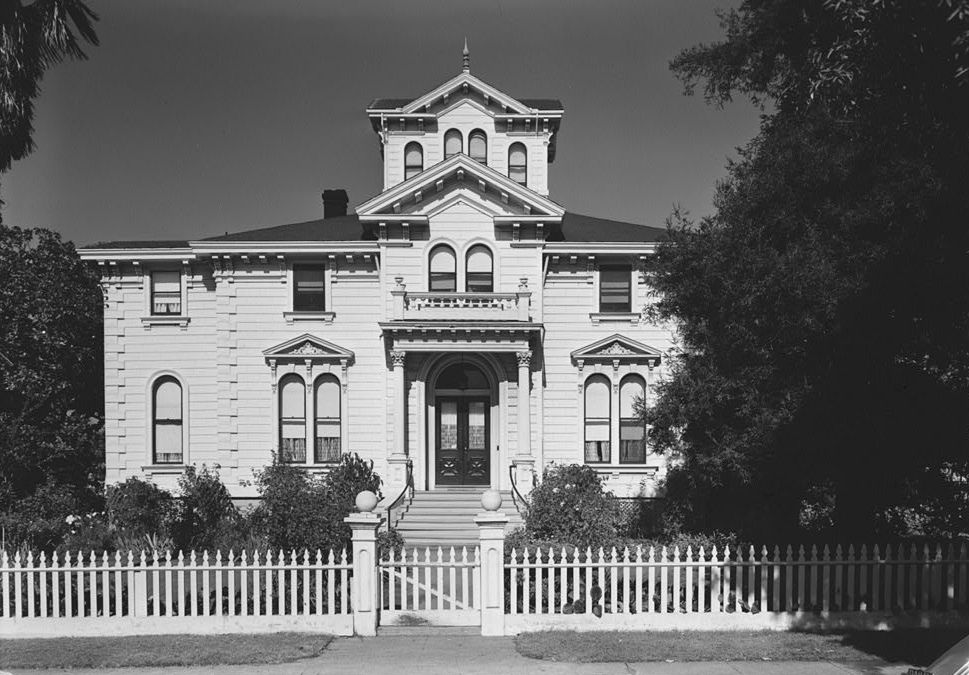
Pardee Home
Somewhere between the freeway overpass and the glass towers of downtown Oakland, a house refuses to change. The Pardee Home sits at the edge of Preservation Park, its Italianate facade looking exactly as it did when Enoch H. Pardee, a California state senator, had it built in 1868. Walk inside and you step into 1981 -- the year the last Pardee daughter died -- because nobody has moved a single object since. The tobacco pipes from the Philippines still hang where Helen Pardee displayed them. The Alaskan scrimshaw still catches the light from the parlor window. A giant elk head still watches from the wall, its glass eyes surveying the same rooms it has surveyed for over a century.
A Dynasty in Three Acts
The Pardee family story tracks the arc of California itself. Enoch H. Pardee arrived in a state still raw from the Gold Rush and built his career in its politics, serving as a state senator while practicing medicine on the side. He chose Oakland for his home, commissioning the Italianate house in 1868 at a time when the city was positioning itself as a serious rival to San Francisco across the bay. His son George inherited both the house and the political ambition, eventually becoming Governor of California. George's tenure coincided with the 1906 San Francisco earthquake, and his response to the disaster shaped his legacy. After George died in 1941, the house passed to his two daughters, Madeline and Helen, who lived there quietly for the next four decades. They changed almost nothing. When Madeline died in 1980 and Helen followed in 1981, the house was essentially a sealed chamber of family life spanning more than a century.
Helen's Cabinet of Wonders
The real character of the Pardee Home belongs to George's wife, Helen. She was a collector of relentless enthusiasm, filling the house with objects gathered from every corner of the world. Scrimshaw carved by Alaskan whalers. Tobacco pipes from the Philippines. Decorative arts and oddities that defied easy categorization. The giant elk head mounted on the wall was perhaps the most conspicuous piece, but the collection's charm lies in its accumulation -- shelves and mantels crowded with the curiosities of a woman who loved showing them off. Helen gave house tours during her lifetime, guiding visitors through rooms arranged like a personal museum. She would have been pleased to know that today's visitors see everything exactly as she left it. Every furnishing in the house is original, untouched by renovators or decorators. The Pardee Home is not a period recreation. It is the real thing, frozen at the moment its last occupants departed.
Saved from the Wrecking Ball
The house nearly vanished in the 1970s. Interstate 980, a short freeway connector between Interstate 580 and Interstate 880, was planned to cut directly through this part of Oakland. Homes, churches, and businesses were demolished to make way for the highway. The Pardee Home sat squarely in the path of destruction. Conservationists fought to save the building, and they succeeded -- though the freeway was built close enough that its roar is now part of the house's ambient soundtrack. The irony runs deep: a freeway that obliterated much of West Oakland's urban fabric stopped just short of erasing one of the city's most intact Victorian homes. The house opened as a public museum in 1991, joining Preservation Park, a cluster of restored Victorian houses that survived the same demolition wave. The original carriage house and stable still stand on the property, making the complex one of Oakland's most complete surviving Victorian estates.
The Parlor as Time Machine
What makes the Pardee Home extraordinary is not architectural grandeur -- Oakland has grander Victorians -- but continuity. Most house museums are assembled from fragments: period-appropriate furniture sourced from antique dealers, wallpaper patterns researched and reproduced, rooms arranged to suggest how people might have lived. The Pardee Home skips all of that artifice. Three generations of one family lived here from 1868 to 1981, and their belongings accumulated in layers rather than being curated for display. A senator's formality sits alongside a governor's ambition alongside a collector's whimsy. The house holds the full mess of a lived-in life, which is precisely what makes it feel alive. Today the Pardee Home operates as a nonprofit museum and holds the distinction of being a California Historical Landmark and a listing on the National Register of Historic Places. For a building that nearly became a freeway off-ramp, that is a remarkable second act.
From the Air
Located at 37.805°N, 122.278°W in downtown Oakland, near the western terminus of Interstate 980. From the air, look for Preservation Park's cluster of Victorian buildings adjacent to the freeway. Best viewed below 3,000 feet. Oakland International Airport (KOAK) lies 7 nautical miles to the south; Metropolitan Oakland International is the nearest major field. San Francisco International (KSFO) is across the bay to the southwest.