Park Guell
Nobody wanted to live here. That is the essential, wonderful fact about Park Guell. Count Eusebi Guell, the industrialist who bankrolled Antoni Gaudi's most ambitious projects, envisioned sixty luxury homes on this rocky hillside above Barcelona, inspired by the English garden city movement -- even the word "Park" is English, a marketing choice that was supposed to evoke refined suburban living. Sixty plots were laid out. Two houses were built. Neither was designed by Gaudi. One sat unsold for so long that Guell had to persuade his architect to buy it with his own savings. In 1906, Gaudi moved in with his father and niece. The housing development was a commercial catastrophe. The park it became is a UNESCO World Heritage Site.
The Failure That Freed the Genius
The site was unpromising: a barren hill called Muntanya Pelada -- Bare Mountain -- overlooking Barcelona's northern edge. Guell acquired it in the late 1890s, and Gaudi began transforming it in 1900. Construction continued until 1914, but buyers never materialized. The hill was too remote, too steep, too far from the Eixample's fashionable grid. What Guell intended as common areas for a private community -- the stairways, terraces, carriage roads, and gardens -- were designed by Gaudi with the same obsessive attention to organic form that would later consume the Sagrada Familia. The park's failure as real estate liberated these structures from any obligation to serve a residential development that did not exist. When the city of Barcelona acquired the property and opened it as a public park in 1926, what visitors found was Gaudi's imagination unshackled from commercial constraint.
Where Nature Designs the Architecture
Park Guell belongs to what scholars call Gaudi's naturalist period -- the first decade of the 20th century, when his study of organic forms led to structural innovations rooted in geometric analysis. The elevated pathways that thread through the park were meant for carriages, but Gaudi built them from local stone shaped to resemble tree trunks, their columns and vaulted supports mimicking natural growth rather than engineering convention. He used inverted catenary arches -- the same principle he would later apply at Colonia Guell -- to achieve load-bearing compression without the rigidity of classical design. The effect is a forest made of stone, where the boundary between architecture and landscape dissolves. Curves predominate over straight lines. Dynamic shapes replace static forms. Floral and organic decoration covers every surface that human hands have touched.
The Dragon and the Serpent
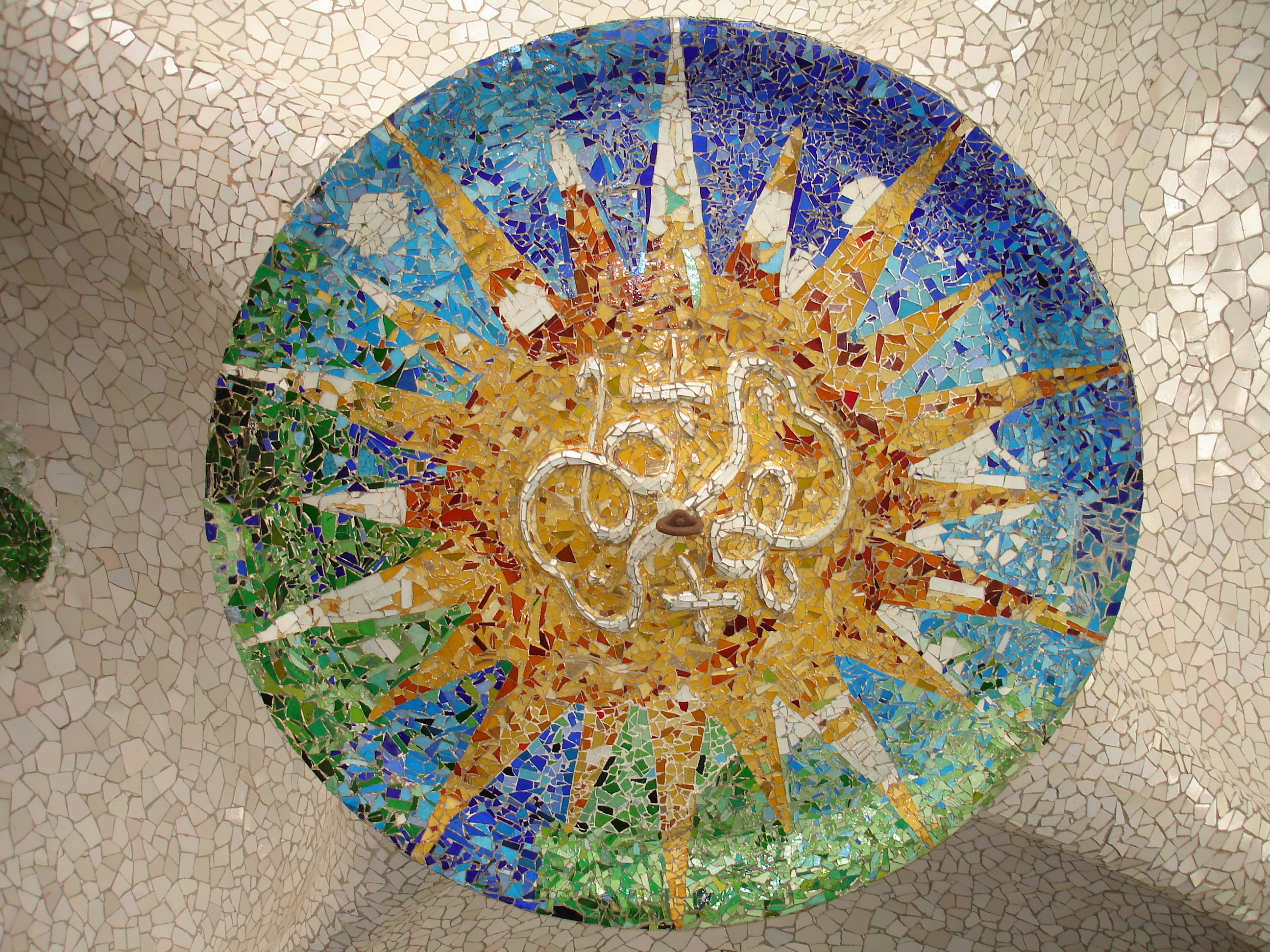
Two icons define the park in the popular imagination. The first is El Drac -- the dragon -- a multicolored mosaic salamander that guards the entrance stairway, its skin a patchwork of ceramic shards arranged with the precision of a jeweler and the abandon of a child with a box of tiles. The second is the serpentine bench that borders the main terrace, a continuous undulating seat designed by Gaudi's collaborator Josep Maria Jujol. Its ergonomic curves create natural alcoves along its length, small enclaves that encourage conversation -- a social feature embedded in furniture. The bench's surface is covered in trencadis, the broken-tile mosaic technique that Gaudi used throughout his work, each fragment of ceramic catching the light differently as the sun moves across the terrace. Below the bench, Doric columns support the terrace in the Hypostyle Room, their classical proportions a deliberate contrast to the organic chaos above.
The View from Three Crosses
At the park's highest point, stone steps climb to El Turo de les Tres Creus -- the Hill of the Three Crosses. Three simple stone crosses stand here: one pointing skyward, the other two marking the cardinal directions. Guell and Gaudi originally conceived this summit as a chapel site, and the religious intention lingers in the calvary arrangement. But what draws visitors up the steps is the panorama. From this point, the Sagrada Familia rises to the southeast, its cranes and spires marking the unfinished masterpiece that consumed the last decades of Gaudi's life. Torre Glories glints in the middle distance. Montjuic anchors the southwestern horizon. And beyond everything, the Mediterranean stretches flat and luminous to the edge of sight. The park supports a surprising variety of wildlife -- non-native parrots chatter in the trees, short-toed eagles have been spotted soaring above the hill, and hummingbird hawk moths hover among the gardens in summer. For a place designed to sell luxury real estate, it turned out to shelter a richer community than anyone imagined.
From the Air
Located at 41.414N, 2.153E on the southern slopes of the Turo del Carmel hill in Barcelona's Gracia district. The park is one of the city's most recognizable aerial landmarks, with its colorful mosaic terraces, serpentine bench, and the distinctive gingerbread-style gatehouses at the entrance visible from moderate altitude. The Collserola mountain range rises behind it to the northwest. Nearest airport: Barcelona-El Prat (LEBL), approximately 15 km southwest. The Sagrada Familia, 2 km to the southeast, provides an excellent visual waypoint. Best viewed at 2,000-4,000 feet for the full layout of the terraced hillside.