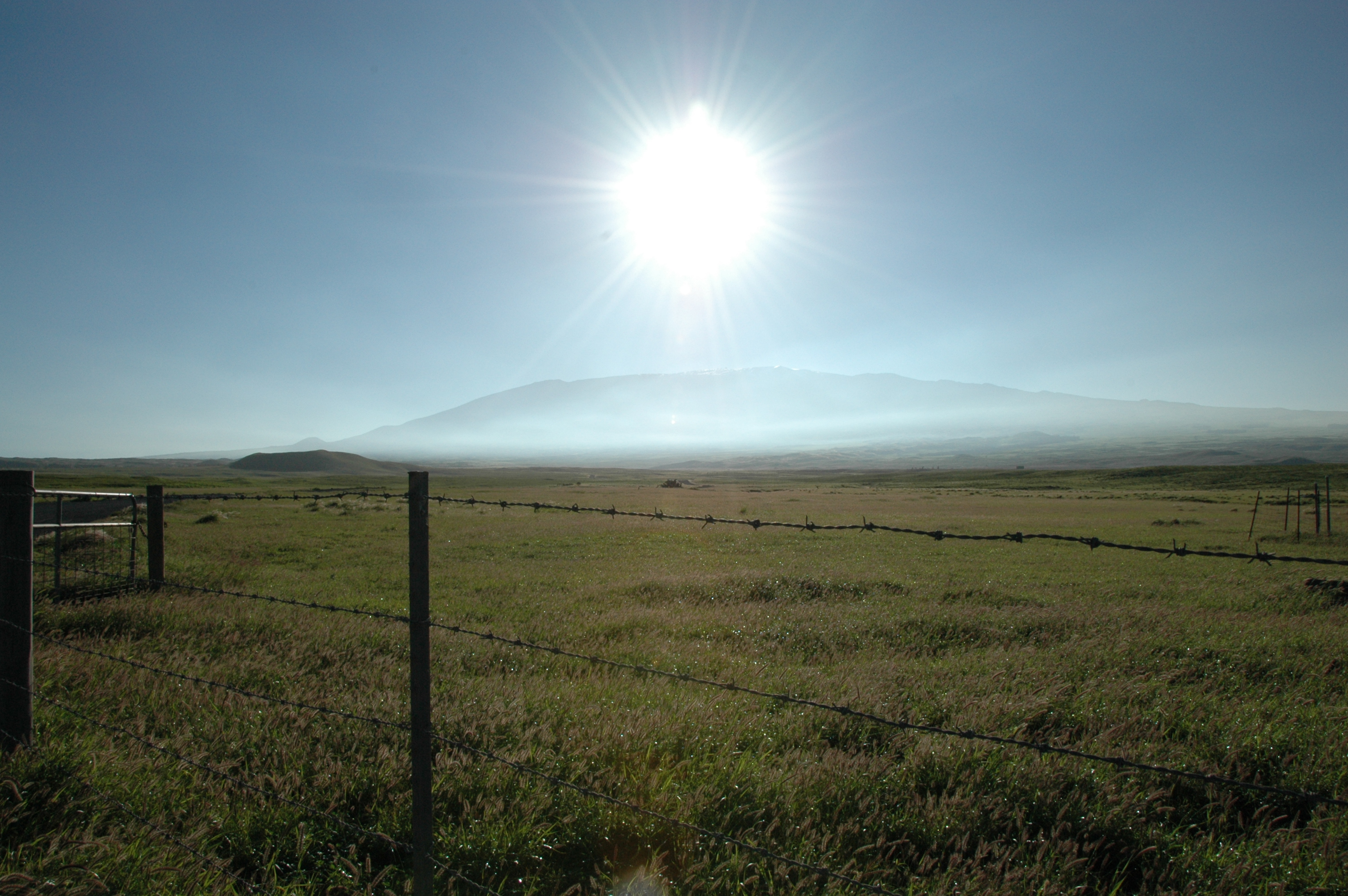
Parker Ranch
Cowboys in Hawaii predate cowboys in Texas. That fact surprises most people, but Parker Ranch makes the case plainly: founded in 1847, it was running cattle across the volcanic slopes of the Big Island more than thirty years before the great Texas ranches took shape. The Hawaiian word for cowboy is paniolo, a phonetic rendering of "espanol," because the first riders to work these highlands were Spanish-speaking vaqueros brought from Mexico to tame the feral cattle that had been multiplying across the island since Captain George Vancouver gifted a small herd to King Kamehameha I in 1793. The king placed a kapu on the animals, forbidding their slaughter, and within a generation they had become a dangerous nuisance. Enter John Palmer Parker, a sailor from Newton, Massachusetts, who arrived in Hawaii around 1809 and proved himself useful enough at hunting the wild bulls that the king granted him land to start a ranch.
A Dynasty Rooted in Royal Blood
Parker did not simply claim land and raise cattle. He married Chiefess Kipikane, granddaughter of Kamehameha I, weaving his family into the fabric of Hawaiian royalty. Their descendants would manage the ranch across generations, through the upheavals of the Great Mahele that introduced private land ownership in the 1840s, through the end of the Hawaiian monarchy, and through annexation by the United States. Parker purchased 640 acres around the arid uplands of Mana in 1850 and added another thousand acres the following year, leasing still more from King Kamehameha III. By the time Parker died in 1868, the ranch had become an institution. His grandson Samuel Parker entered politics, eventually serving in the Hawaiian Kingdom's legislature, while professional managers like Alfred Wellington Carter kept the operation running from 1899 to 1937.
Marines on the Rangeland
During World War II, the ranch's vast open terrain caught the attention of the U.S. military. Part of Parker Ranch was converted into Camp Tarawa, a Marine Corps training base where the Second and Fifth Marine Divisions rehearsed amphibious assaults and highland combat in preparation for the invasion of Iwo Jima. The rolling grasslands at 2,500 feet elevation, far from prying eyes and set against the backdrop of Mauna Kea, offered a convincing approximation of the harsh terrain the Marines would face in the Pacific. Thousands of young men trained here in conditions that, while beautiful, were meant to harden them for one of the war's bloodiest battles. The ranch's connection to Iwo Jima remains part of its identity, a reminder that this pastoral landscape once served a grimmer purpose.
The Actor and the Trust
The last private owner of Parker Ranch was Richard Smart, a Broadway actor and singer who inherited the property and managed it while pursuing a career on the mainland stage. Smart was an unlikely rancher -- cultured, theatrical, more at home in Manhattan than on horseback -- but he took his stewardship seriously. When he died in 1992, he left the ranch not to heirs but to a charitable trust. The Parker Ranch Foundation Trust now governs the property, directing its proceeds to the North Hawaii Community Hospital, Hawaii Preparatory Academy, and other local institutions. It was an act of generosity that transformed a family estate into a community resource, ensuring that the ranch's economic engine would benefit the broader population of the Big Island rather than a single family line.
Paniolo Country
Spread across approximately 130,000 acres, Parker Ranch remains one of the largest cattle operations in the United States. Its cowboys -- paniolos -- carry on a tradition that traces directly back to the Mexican and Spanish vaqueros who first taught Hawaiians to ride and rope in the early nineteenth century. The Hawaiian language lacks an "s" sound, so "espanol" became "paniolo," and the word stuck. In 2014, the ranch launched the Paniolo Cattle Company, a joint venture with the Ulupono Initiative focused on grass-fed beef production. Starting with 1,400 head, it represented the largest single-ranch commitment to grass-fed beef in the state and increased the supply of grass-fed steers to local markets by nearly 35 percent. Two of the ranch's historic homes, Puuopelu and Mana Hale, are open for self-guided tours just outside the town of Waimea, and the Parker Ranch Arena still hosts the annual Fourth of July rodeo -- a tradition that captures the unlikely convergence of Hawaiian culture, Spanish horsemanship, and American frontier spirit that defines this place.
From the Air
Located at 20.01N, 155.67W in the Waimea highlands of the Big Island, at roughly 2,500 feet elevation on the saddle between Mauna Kea and the Kohala Mountains. The ranch's vast green pastures are clearly visible from altitude, contrasting sharply with the drier leeward coast below. Nearest airport: Waimea-Kohala Airport (PHMU) approximately 5 nm northwest, or Kona International Airport (PHKO) approximately 25 nm south-southwest. The area is generally clearer than the windward side but can develop afternoon clouds.