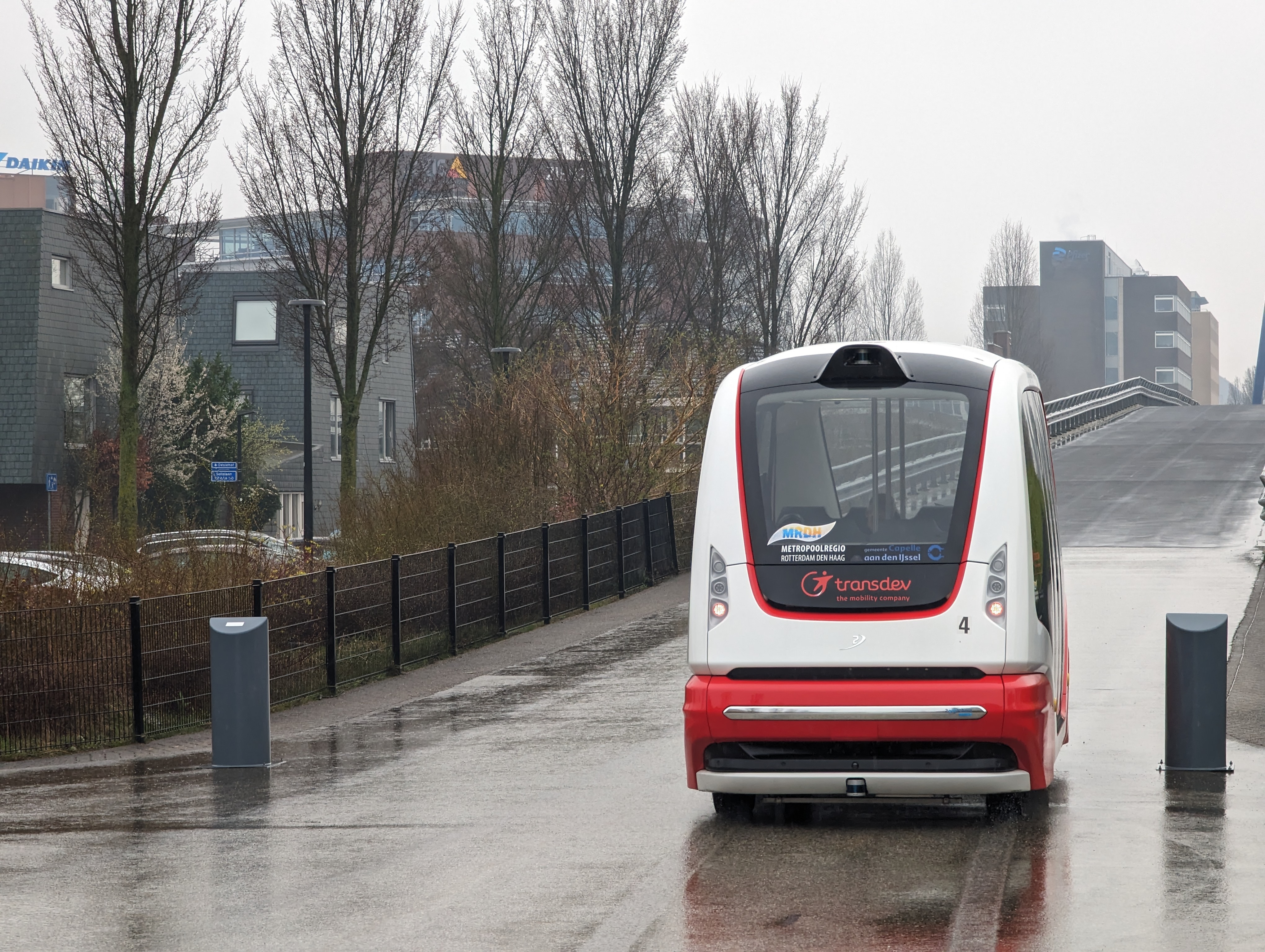
ParkShuttle
Press the button at the stop and a small white pod arrives empty, doors hissing open with no driver inside. No safety steward stands by. No engineer hovers with a laptop. You step in, press the button for your stop, and the vehicle moves off down its narrow lane, threading past cars and cyclists at level crossings, slowing for pedestrians, parking itself precisely at the next platform. This is not a 2030s prototype. The ParkShuttle has been doing exactly this, in revenue service, on the outskirts of Rotterdam, since 1999.
The Quietest Pioneer
While Silicon Valley spent the late 2010s burning billions on robotaxis that needed safety drivers and still made the evening news every time they collided with a traffic cone, a small Dutch consortium had already been running driverless vehicles between an office park and a metro station for two decades. The route is humble - 1.8 kilometres of dedicated right-of-way connecting Kralingse Zoom metro station in Rotterdam to the Rivium business park in Capelle aan den IJssel, with intermediate stops including the residential district of Fascinatio. In 2018, when the operator surveyed the field, the ParkShuttle was the only fully autonomous road vehicle anywhere in Europe in permanent, fare-paying service. Everyone else was still trialling. Rotterdam was simply running the thing.
Magnets in the Road
The original engineering trick was elegant and a little anti-climactic. Instead of LIDAR, machine vision, and neural networks, the early ParkShuttles followed a string of small magnets embedded in the road surface, checking their position against virtual reference points. The vehicles were front-wheel-steered and unidirectional, reversing direction only at turning loops at each end of the line. Obstacle detection was good enough to bring a shuttle to a controlled stop when something - a person, a delivery van, a stray dog - crossed its path. The system has been called a horizontal elevator, and the analogy fits. You summon it. You pick your floor. It moves. The third generation of vehicles, which entered service in November 2022 after pandemic delays, are lighter, air-conditioned, and bidirectional, so the turning loops are no longer needed.
One Crash, Then Quiet Decades
The system was not flawless. Shortly after the original opening, two empty shuttles collided during a start-up procedure. A supervisor, acting after a communications loss, allowed two vehicles to enter the same single-lane section from opposite ends. The obstacle detection systems reacted but could not prevent the collision, and a separate fire damaged another vehicle in storage. The shuttles were repaired. Since then, by the operator's own account, the ParkShuttle has run 'without any significant problems' - more than two decades of paying passengers, in mixed weather, with cyclists and cars at every crossing, and almost no headlines. That absence of headlines is itself the story. The route was even temporarily shut from April to December 2011, not for a safety issue, but because a parking garage was being built across the lane.
The Slow Extension
On 7 March 2018 the Rotterdam-The Hague metropolitan area awarded operator Connexxion a new concession running until December 2033. The plan called for new vehicles, an extended route, and - more ambitiously - autonomous driving in mixed traffic on some stretches of public road, the first time the system would share lanes with other vehicles rather than operate on dedicated right-of-way. The eventual destination is the Nieuwe Maas waterway at the Van Brienenoord bridge, where passengers will transfer to the Waterbus. It is an unglamorous map for what would, in any other country, be a press conference. The Netherlands has a habit of doing radical infrastructure as if it were utility work. The ParkShuttle is one of the most quietly radical things on European roads.
From the Cockpit
From above, the ParkShuttle route is almost invisible - a thin band of asphalt threading between low office buildings and the A16 motorway, on the south bank of the Nieuwe Maas just east of central Rotterdam. The big Van Brienenoord bridge arcs across the water nearby, and the Erasmus University campus lies a short distance north. Coordinates 51.92°N, 4.53°E. Best viewed at 2,000-4,000 feet, ideally from the south so the white pods stand out against the dark lane surface. Nearest airport: Rotterdam The Hague (EHRD), 8 km west. Schiphol (EHAM) is 65 km north.
From the Air
Located at 51.9213°N, 4.5335°E between Rotterdam and Capelle aan den IJssel. The 1.8 km route runs on its own right-of-way next to the A16 motorway near the Van Brienenoord bridge over the Nieuwe Maas. Recommended viewing altitude 2,000-4,000 feet. Visual landmarks: Van Brienenoord bridge arch, Rivium office park towers, the A16/A20 junction. Nearest airports: Rotterdam The Hague (EHRD) 8 km W; Amsterdam Schiphol (EHAM) 65 km N. North Sea weather - expect frequent overcast.