Quebec's Parliament Building: Four Centuries of Governance on Cap Diamant
Workers went on strike three times before the building was finished. When wages dropped from sixty cents to fifty cents a day in 1878, the laborers building Quebec's new Parliament demanded double pay. Strikebreakers failed. Premier Henri-Gustave Joly was attacked on the street. The military suppressed the demonstrations. Yet the building rose anyway -- an eight-storey Second Empire monument that architect Eugène-Étienne Taché deliberately styled after French Renaissance architecture, not the British Parliament in Ottawa. Completed in 1886 after nearly a decade of turbulent construction, this was a political statement rendered in stone: Quebec's legislature would look to Paris, not London.
Ghosts of Governance
The Parliament Building stands on a lineage of power that reaches back to 1620, when Samuel de Champlain ordered the construction of a fort on Cap Diamant, the easternmost point of the Promontory of Quebec. Governor Charles de Montmagny built the first permanent government residence, the one-storey Château St. Louis, in 1648. Governor Frontenac replaced it with something grander in 1694, on the same foundations. That site is now buried beneath the Terrasse Dufferin, in the shadow of the Château Frontenac hotel. Governor Frederick Haldimand built yet another seat of power in 1784, which the Château Clique -- an oligarchy with outsized influence -- used as their meeting ground until the building was demolished in 1892. Before Taché's Parliament rose, the government even rented an old Episcopal Palace from the Catholic Church, built in the 1690s by the Bishop of Quebec. Each predecessor was destroyed, repurposed, or outgrown. The current building inherited centuries of ambition.
A Construction of the Century
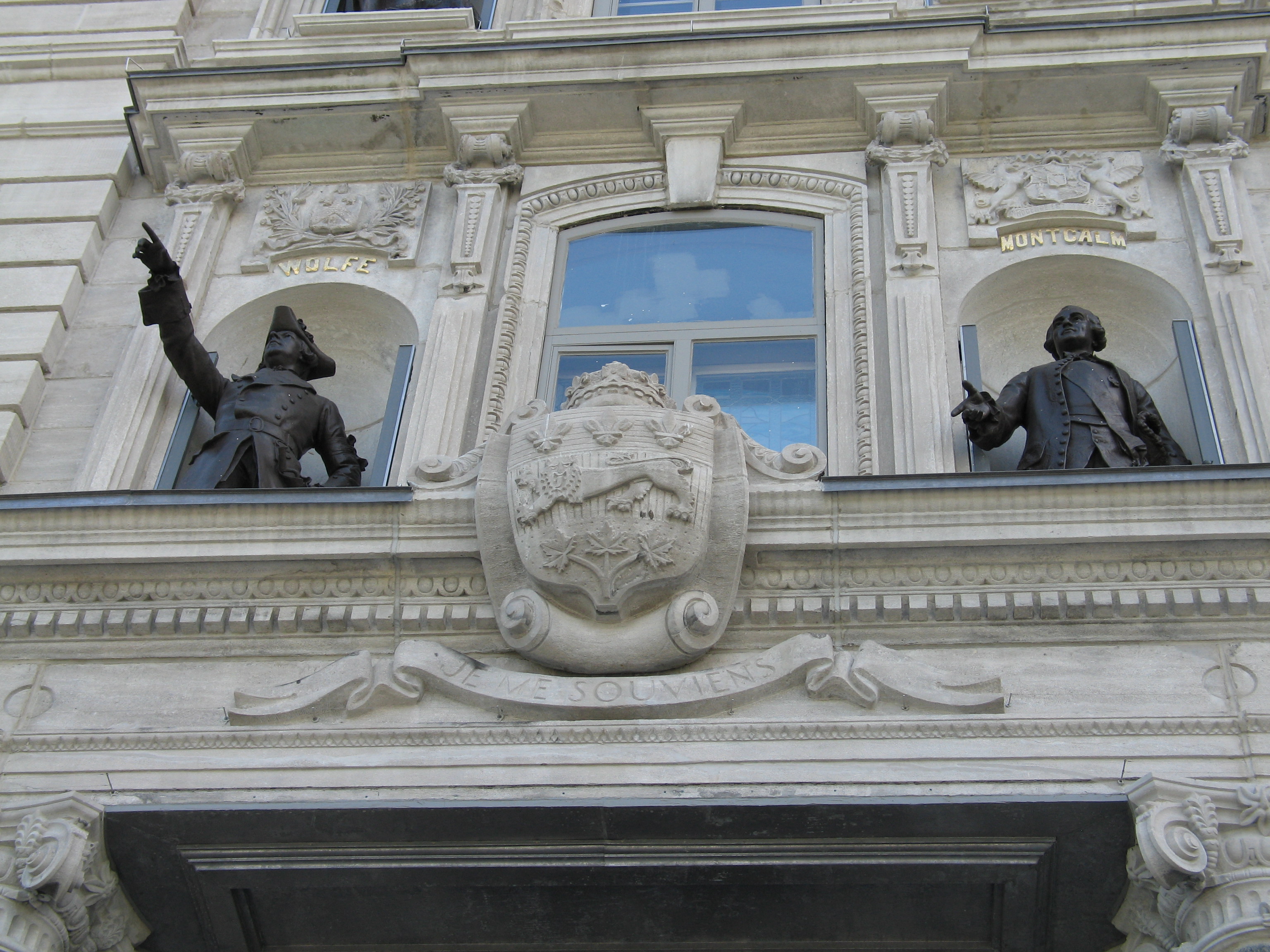
Taché won the commission while working at Quebec's provincial ministry of public works. His vision was unmistakable: the building's mansard roof, elaborate facades, and ornamental program drew from the French Second Empire tradition. Twenty-six statues line the front wall, depicting political and intellectual figures central to Quebec's identity. The Fountain of the Abenaki, inaugurated in 1890 below the main entrance, featured statues of Indigenous peoples including The Nigog Fisherman. A clock crowned the central tower by 1888. The contractor, Simon-Xavier Cimon, was deeply unpopular -- his cost-cutting triggered four strikes during construction. With up to 400 workers employed at the peak, contemporaries called it a 'construction of the century.' The National Assembly first met inside on March 27, 1884, two years before the building was fully completed on April 8, 1886.
Blue Room, Red Room
The Blue Room is where Quebec's democracy operates. Its 124 desks face each other across a central corridor in the Westminster tradition -- government and opposition locked in permanent confrontation. A painting by Charles Huot hangs behind the president's elevated chair. The Red Room once housed the upper chamber, the Legislative Council, until it was abolished in 1968. Now it hosts parliamentary committees and ceremonial occasions, its furniture rearranged as needed. A second Huot painting depicts a debate of New France's colonial government. In a remarkable break with tradition, the National Assembly voted to abandon the adversarial Westminster seating layout during renovations that began in 2024. The redesigned Blue Room will adopt a horseshoe arrangement of seats, similar to the Australian House of Representatives. Until the renovation is complete in 2026, legislators sit in the Red Room -- the former upper chamber hosting all of Quebec's elected representatives.
A Fountain from Bordeaux
The Fountain of Tourny traveled a strange path to Quebec. Cast in 1853-1854, two copies stood in Bordeaux, France, from 1858 until 1960, when both were dismantled for an underground parking lot. One went to Soulac-sur-Mer; the other was cut into pieces and ended up in an antique shop in Saint-Ouen, near Paris. In the early 2000s, Quebec entrepreneur Peter Simons acquired the scattered fragments, had them restored, and donated the reassembled fountain to Quebec City. It was inaugurated on July 3, 2007, on the roundabout at Honoré-Mercier Avenue -- just in time for the quadricentennial celebrations of the city's founding. A French fountain in front of a French-styled parliament in a French-speaking city on an English-speaking continent: the symbolism was not accidental.
The Modern Fortress
After a shooting at Parliament Hill in Ottawa in October 2014, security concerns reached Quebec. In November 2015, National Assembly president Jacques Chagnon unveiled a sixty-million-dollar project for a new underground entrance with enhanced security, a conference room, and space for parliamentary committees. The expansion opened to the public on June 1, 2019. Architectural critics mostly approved: the provincial trade organization gave awards for preserving the building's heritage character while improving accessibility. But the project reduced the area of the historic Abenaki fountain, drawing criticism from historian Gaston Deschênes, who argued the change violated the original architect's intentions. The building that started with labor strikes continues to generate passionate debate -- fitting for a place where Quebec decides its future.
From the Air
Located at 46.81°N, 71.21°W on Quebec City's Parliament Hill, just outside the walls of Old Quebec. From altitude, the Parliament Building's Second Empire mansard roof and central tower are distinctive on the western edge of the fortified old town. The building sits on the colline Parlementaire (Parliament Hill), elevated above the St. Lawrence River. The Fountain of Tourny is visible on the roundabout in front. The Citadelle of Quebec and the Ramparts are immediately to the east. Nearby airports include Jean Lesage International Airport (CYQB), approximately 15 km west. The Château Frontenac's iconic silhouette is visible to the east along the bluff.