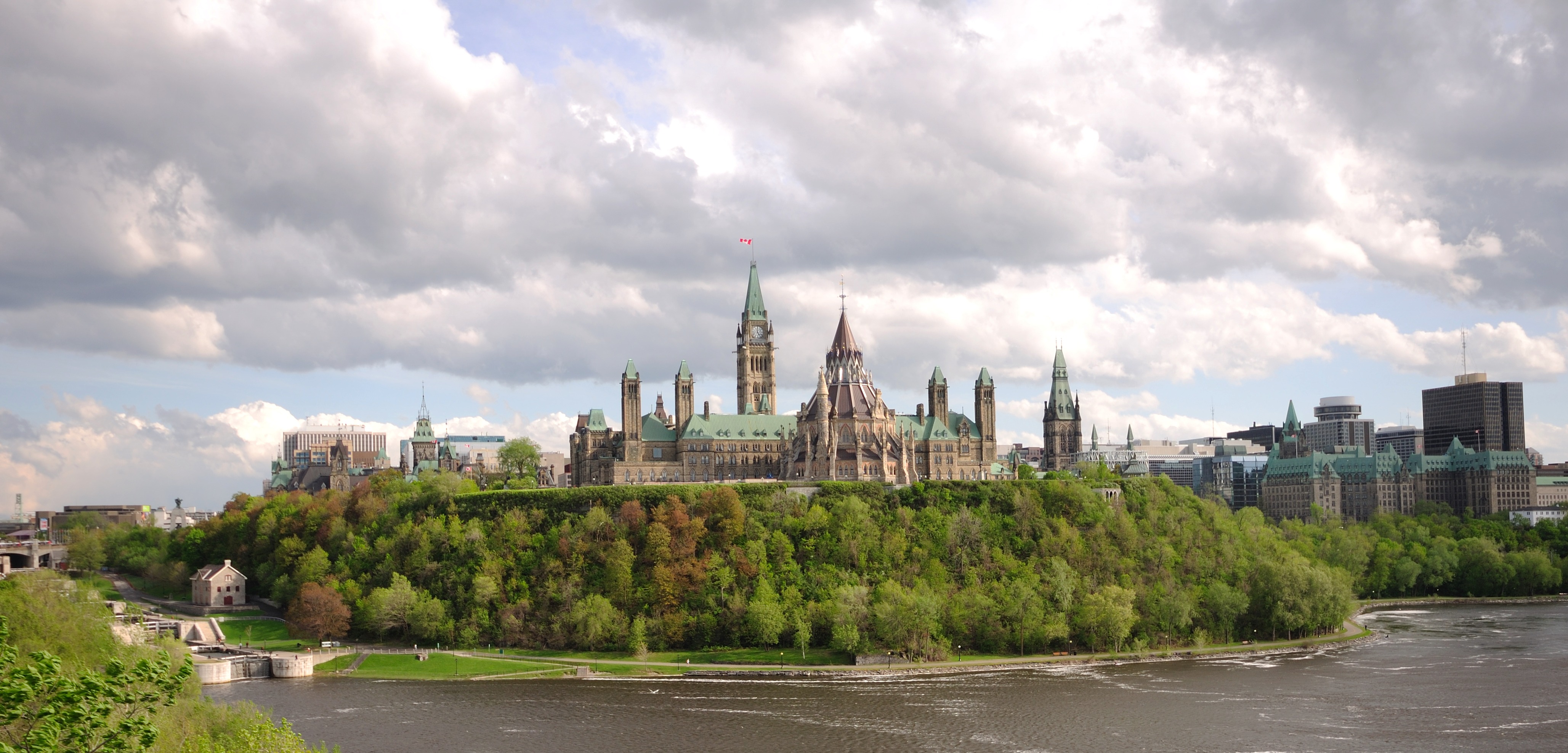
Parliament Hill
For hundreds of years before any parliament convened here, the limestone bluff above the Ottawa River served as a landmark for First Nations people and European traders navigating toward the continent's interior. They knew it as a waypoint, a distinctive rise of rock once blanketed in primeval beech and hemlock forest. When Queen Victoria selected Ottawa as the capital of the Province of Canada in 1858, she set this ancient landmark -- then called Barrack Hill, for the military base it housed -- on a course to become the most symbolically charged piece of ground in the country. Today, Parliament Hill draws approximately three million visitors each year to its Gothic Revival towers, its sprawling forecourt of statues and memorials, and the ongoing spectacle of Canadian democracy at work.
The Biggest Build in North America
Ground was broken on December 20, 1859, and when the Prince of Wales laid the cornerstone of the Centre Block the following September, the project was already becoming the largest construction effort North America had seen. Workers struck bedrock sooner than expected, forcing blasting to complete foundations that architects redesigned to sit deeper than originally planned. The winning design came from Thomas Fuller and Chilion Jones, whose Victorian High Gothic scheme combined a formal, symmetrical front facing a quadrangle with a more rustic, picturesque rear overlooking the Ottawa River's bluffs and escarpments. Thomas Stent and Augustus Laver won the competition for the East and West Blocks. By 1876, the parliamentary complex and its surrounding wrought-iron fence were complete, the grounds landscaped with help from Calvert Vaux, the famed co-designer of New York's Central Park.
The Night the Centre Block Burned
On February 3, 1916, fire consumed the Centre Block. Only the Library of Parliament survived, saved by an alert employee who closed its iron doors. Despite the First World War raging overseas, Governor General Prince Arthur re-laid the original cornerstone on September 1, 1916 -- exactly fifty-six years to the day after his brother, the future King Edward VII, had first set it. Reconstruction produced the current Centre Block and its crowning feature, the Peace Tower, completed in 1927 as a memorial to Canadians who died in the Great War. The fire also gave the hill a relic: the Victoria Tower Bell, the original bell that fell from its perch in the blaze, now stands on the grounds canted at the angle it was found in the rubble.
Witness to History
Parliament Hill has served as the stage for defining moments of Canadian identity. In 1939, King George VI became the first reigning Canadian sovereign to visit his Parliament. On May 8, 1945, a massive celebration on the main lawn marked Victory in Europe Day. The first raising of Canada's new maple leaf flag took place on the hill on February 15, 1965, and on April 17, 1982, Queen Elizabeth II issued the royal proclamation enacting the Constitution Act, patriating Canada's constitution. Not all events have been celebratory. In April 1989, an armed man hijacked a Greyhound bus and drove it onto the Centre Block lawn, leading to a six-hour standoff. On September 14, 2001, 100,000 people gathered to honor the victims of the September 11 attacks. And on October 22, 2014, a gunman fatally shot a soldier at the nearby National War Memorial before storming the Centre Block, where Sergeant-at-Arms Kevin Vickers and RCMP officers ended the attack.
Ghosts, Guardians, and a Colony of Cats
More than 20 bronze statues populate the grounds, commemorating figures from Queen Victoria to Sir Galahad. That last one is unexpected: the statue of the Arthurian knight honors Henry Albert Harper, a young man who drowned in the Ottawa River in 1901 trying to rescue a girl who had fallen through thin ice. It was installed in 1905 at the initiative of his friend, the future Prime Minister William Lyon Mackenzie King. One of the hill's more unusual features was a colony of feral cats, maintained for decades by volunteers, that became an unofficial mascot until the last cats were rehomed. The grounds also contain the Summer Pavilion, a 1995 reconstruction of a gazebo originally built in 1877 for the Speaker of the House of Commons, now serving as the National Police Memorial.
The Longest Renovation
Since 2002, a three-billion-dollar renovation project has been reshaping the parliamentary precinct. The West Block was completed in November 2018 and now serves as the temporary home of the House of Commons. The Senate relocated to a renovated building in 2019. The Centre Block itself is undergoing its most extensive transformation since the 1916 fire, with 500 seismic base isolators being installed in its foundation to protect the structure from earthquakes. A new Visitor Welcome Centre is rising alongside. The Parliament of Canada Act protects the name itself -- no other establishment in the National Capital Region may call itself Parliament Hill, and merchandise bearing the name is prohibited. The Gothic Revival buildings, designated as National Historic Sites in 1976, remain a work in progress even after more than 160 years, their sandstone and copper perpetually renewed against the Ottawa winters.
From the Air
Located at 45.425N, 75.699W on the southern bank of the Ottawa River. The Gothic Revival complex is highly visible from the air, with the Peace Tower (92.2 m tall) serving as the primary landmark. The Rideau Canal borders the east side, and the Ottawa River provides a clear northern reference. Nearby airports include Ottawa/Macdonald-Cartier International (CYOW, 10 km south) and Gatineau-Ottawa Executive (CYND, 8 km north). Best viewed from the north or northeast to see the dramatic bluff rising above the river.