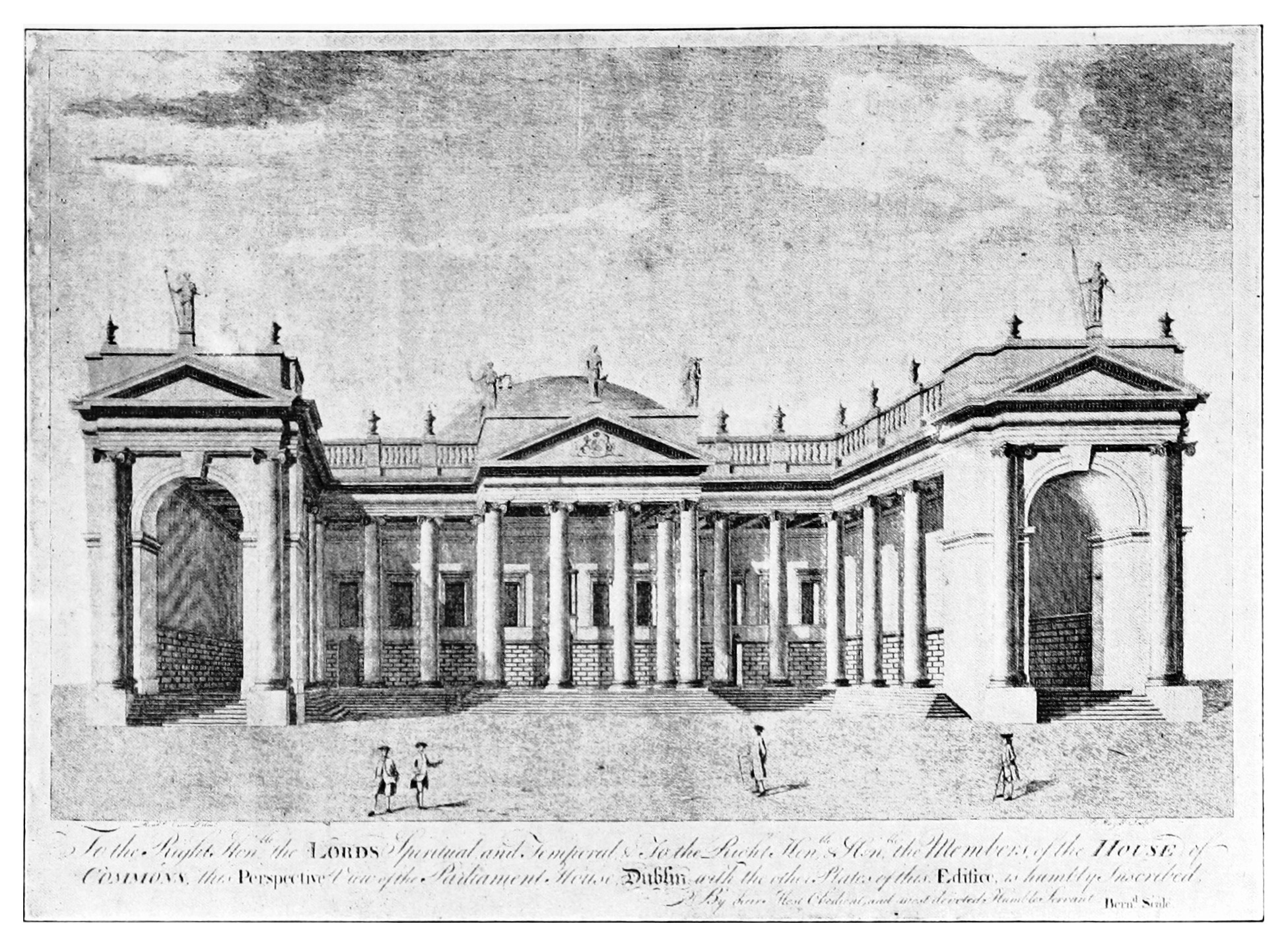
Parliament House, Dublin
Before the United States Congress had a building, before Westminster's Palace was rebuilt, before any legislature on Earth had commissioned an architect to design a home for democratic debate, Dublin built one. Parliament House on College Green, completed in the 1730s, was the world's first purpose-built bicameral parliament. Walk through its grand portico today and you'll find bank clerks where lawmakers once sat -- a transformation that says as much about Irish history as any textbook.
From Nunnery to Nation's Forum
The site has witnessed power in many forms. A medieval nunnery once stood here until Henry VIII dissolved it. Sir George Carew built a grand house on the spot, which later bore the name of its subsequent owner, Sir Arthur Chichester. In that house, the legal paperwork for the Plantation of Ulster was signed on 16 November 1612 -- a document that would reshape the north of Ireland for centuries. By the 1670s, the Irish Parliament had moved into Chichester House, but the building was cramped and inadequate. Fire damage and overcrowding finally forced a decision: Ireland's parliament would get a home worthy of its ambitions.
Pearce's Revolutionary Design
Edward Lovett Pearce, who had studied under the great Italian-influenced architects of his age, won the commission in 1727. His design was audacious: a purpose-built parliament with separate chambers for the Commons and the Lords, connected by grand corridors and surrounded by a colonnade of Ionic columns. Construction began in 1729, and the House of Commons first met in the new building on 3 October 1731. Pearce's octagonal Commons chamber was an architectural sensation -- a domed room lit from above that became the model for legislative chambers around the world. Tragically, Pearce died in 1733 at just thirty-three, barely two years after seeing his masterpiece completed. James Gandon later added the curved porticos on the east and west wings, giving the building the sweeping neoclassical facade that still commands College Green.
The Chamber That Voted Itself Out of Existence
For seven decades, the building housed the parliament of what was then the Kingdom of Ireland. It was here that Henry Grattan championed legislative independence in the 1780s, winning what became known as Grattan's Parliament -- a brief era of relative autonomy. But the 1798 Rebellion changed everything. The British government, alarmed by revolution, pushed the Acts of Union through in 1800, merging the Irish and British parliaments. On 2 August 1800, the Irish Parliament voted itself out of existence. The building that had been purpose-built for democratic debate fell silent. Within three years, it belonged to the Bank of Ireland, purchased for 40,000 pounds. The sale came with a pointed condition: the interior must be altered so it could never again serve as a parliament, a stipulation that speaks to British anxiety about Irish self-governance.
Banking on History
The Bank of Ireland took possession in 1803, and architect Francis Johnston was tasked with converting the space. The House of Commons was divided into offices, its famous octagonal shape lost forever. But the House of Lords survived almost intact -- its tapestries depicting the Battle of the Boyne and the Siege of Derry still hanging where they were placed in the 1730s, its silver-gilt mace from 1767 still on display. Today, you can step into the former Lords chamber during banking hours and stand beneath the coffered ceiling where peers once debated. The contrast is striking: marble floors polished by centuries of footsteps, ornate chandeliers illuminating ATM queues, classical columns framing ordinary transactions.
A Monument to What Was and What Might Have Been
Parliament House stands at the nexus of Dublin's cultural geography, directly facing Trinity College across the bustle of College Green. Its curved colonnade stretches 150 meters along the street, making it one of the most imposing public buildings in Ireland. From the air, the building's neoclassical symmetry is unmistakable, its Portland stone facade bright against the darker Georgian streetscape. For Irish history, the building carries a particular weight. It represents both the ambition of an independent Irish legislature and the abruptness with which that ambition was extinguished. That the world's first purpose-built parliament became a bank is an irony too perfect to be merely architectural.
From the Air
Located at 53.344°N, 6.259°W on College Green in central Dublin. Visible from low altitude as a large neoclassical building with curved colonnades directly across from Trinity College. Nearest airport: Dublin Airport (EIDW), approximately 10 km north. The building sits in dense urban Dublin, best spotted by its distinctive curved portico along College Green.