Pars Museum
The name alone carries a riddle. Kolah Farangi -- "the foreign hat" -- is what the people of Shiraz called the octagonal pavilion that Karim Khan Zand built in the heart of Nazar Garden during the 1770s. The shape struck them as unusual, something vaguely European, though everything about the building is deeply Persian: the intricate tilework, the muqarnas ceilings dripping with honeycomb geometry, the stone dadoes carved by hands that understood proportion as a form of devotion. Today the pavilion goes by a more official name -- the Pars Museum -- but the old nickname lingers, a reminder that this building has always been a meeting point between worlds.
The People's Advocate
Karim Khan Zand never called himself king. When he consolidated power over western Iran in the mid-eighteenth century, he took the title Vakil al-Ra'aya -- Representative of the People -- a choice that still distinguishes him from every other ruler in Iranian history. He made Shiraz his capital and set about rebuilding it, constructing the Arg fortress, the Vakil Bazaar, the Vakil Mosque, and this octagonal pavilion in Nazar Garden. The Kolah Farangi, completed around 1773, stood over fourteen meters tall on two floors and served as the place where Karim Khan received foreign ambassadors and dignitaries. Here, official ceremonies unfolded against a backdrop of painted walls and elaborate tilework. The building was a statement: Shiraz under the Zand dynasty was not a provincial backwater but a capital worthy of the world's attention.
A Garden of Safavid Memory
Nazar Garden predates the pavilion by centuries. During the Safavid era, from 1501 to 1736, it was one of the largest gardens in Shiraz, a city already famous for its gardens. When Karim Khan chose this site for his reception hall, he was layering Zand ambition onto Safavid legacy, placing his most important diplomatic space within a landscape that already carried the weight of Persian horticultural tradition. The garden's reflecting pools, pathways, and plantings framed the octagonal pavilion like a jewel in a setting. After the fall of the Zand dynasty, Nazar Garden survived neglect and upheaval partly because the pavilion anchored it to public memory. A garden with a purpose endures longer than one kept merely for beauty.
From Throne Room to Museum
In 1936, the pavilion became the Pars Museum, the first museum established outside Tehran in modern Iran. The transformation came under Reza Shah Pahlavi as part of a broader campaign to preserve Iran's pre-Islamic and dynastic heritage. Inside, the collection reflects the pavilion's dual identity as both Zand reception hall and national repository. Visitors encounter nearly thirty handwritten Qurans, a gathering that spans centuries of calligraphic tradition. Among the paintings hangs a famous work by Jafar Naqash depicting Karim Khan smoking a shisha -- a portrait of the Vakil at his most informal, relaxed in the building he created for pomp. Also within these walls lies Karim Khan himself. During the Pahlavi era, his remains were returned and reinterred in Nazar Garden, bringing the ruler back to the pavilion he built for entertaining the world.
Stone, Tile, and Light
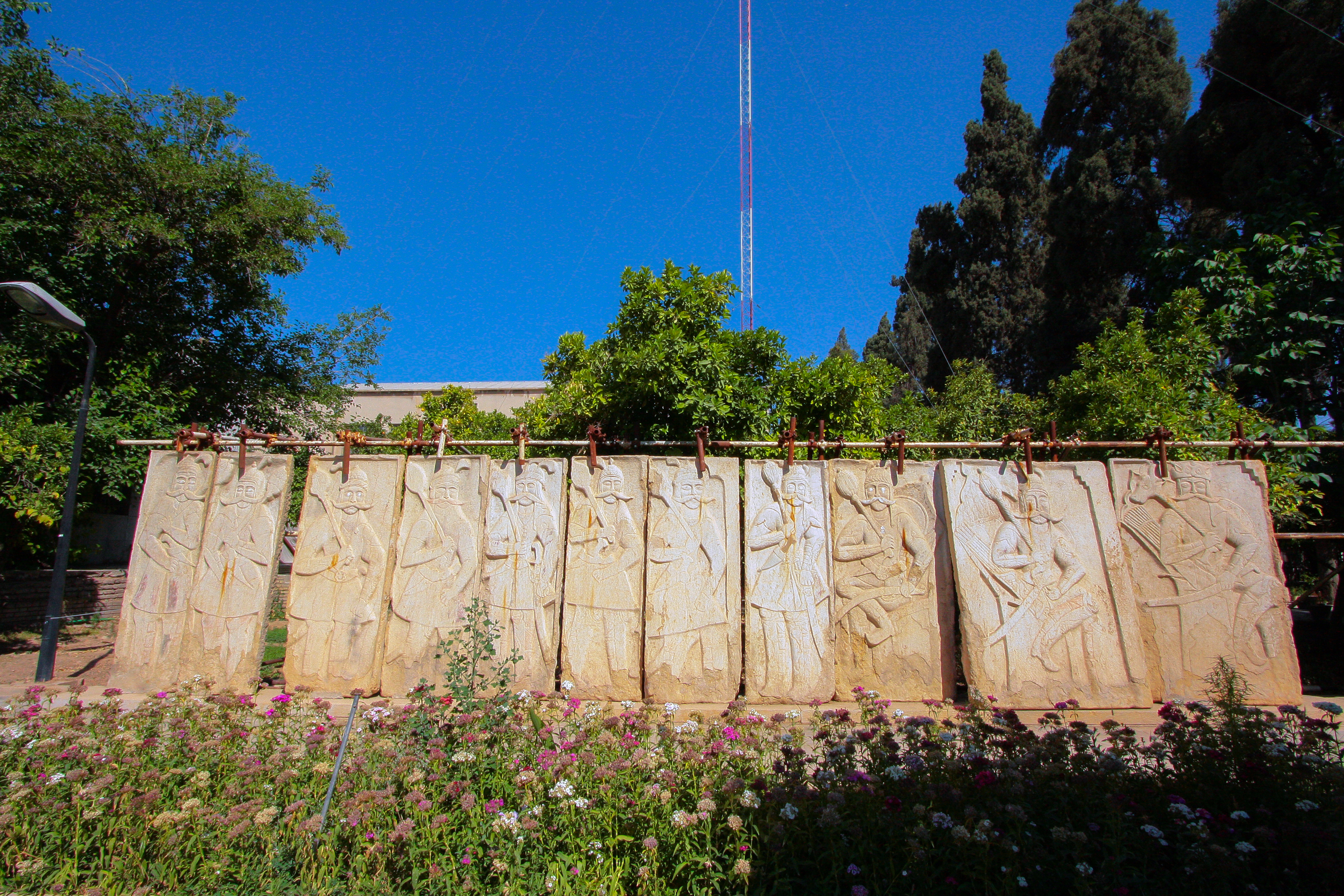
The building rewards close looking. The exterior tilework depicts floral patterns and geometric designs characteristic of Zand craftsmanship -- less exuberant than Safavid work, more controlled, with a palette that favors blues and yellows against cream. Inside, the muqarnas ceiling dissolves solid surfaces into cascading tiers of plaster, each niche casting its own small shadow. The stone dadoes on the lower walls anchor the room with weight and permanence. Big windows on the upper floor let light flood in, changing the interior mood with the time of day. In the morning, the tiles glow warm. By afternoon, the deeper recesses of the muqarnas pull into cool shadow. The architects understood that a building designed for ceremony needed to perform as the light shifted, holding attention hour after hour.
From the Air
Located at 29.616N, 52.545E in central Shiraz, Iran. The Pars Museum sits within Nazar Garden, visible as a green patch amid the urban fabric. Shiraz Shahid Dastgheib International Airport (OISS) lies approximately 8 km to the south. From altitude, the garden's rectangular outline and the octagonal pavilion are distinguishable near Zand Street, close to the Arg-e Karim Khan citadel. The surrounding Zagros foothills rise to the north and west.