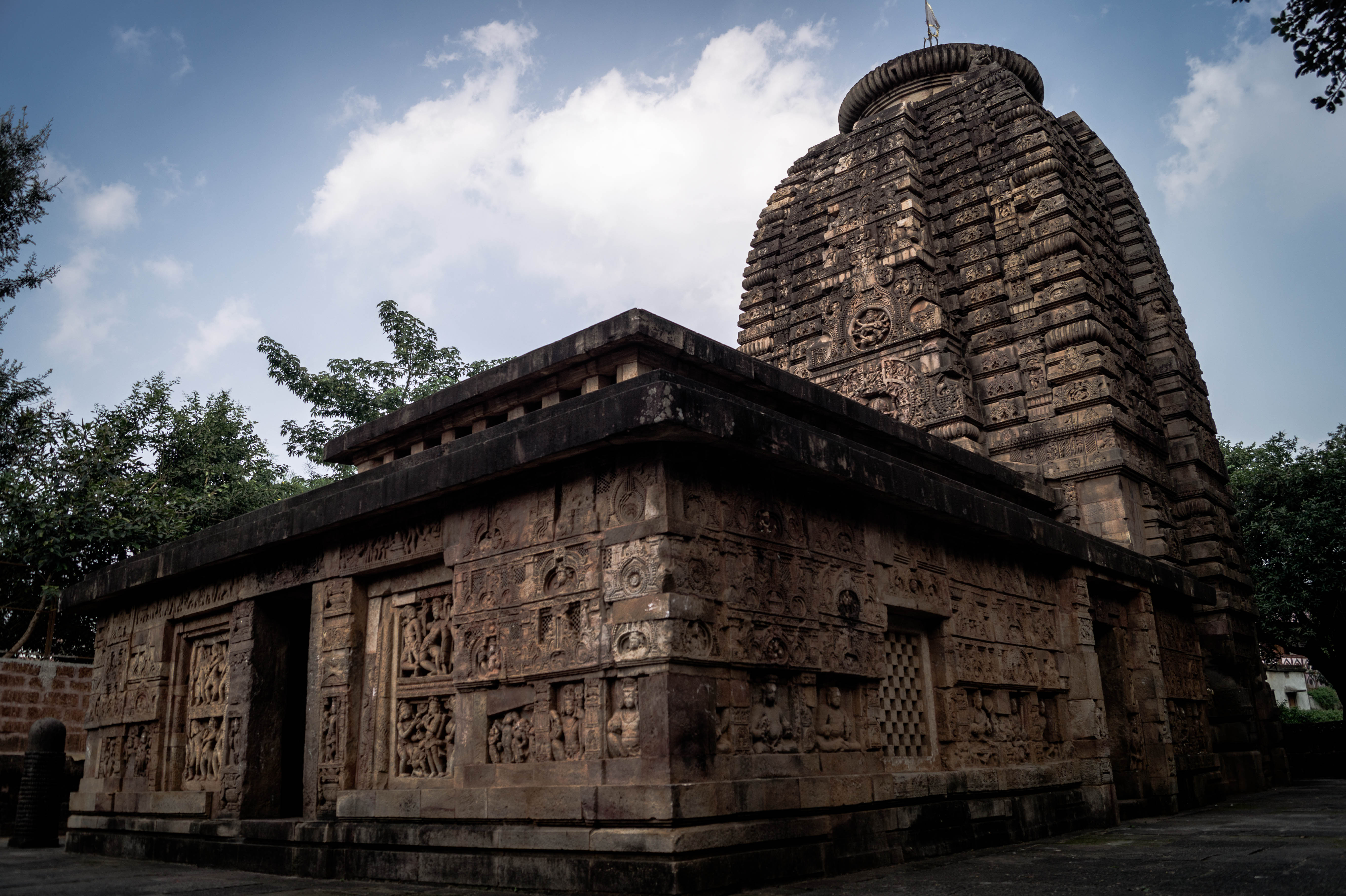
Parsurameswara Temple
Count the planets above the doorway. Eight celestial bodies are carved over the entrance to the inner sanctum of the Parsurameswara Temple -- not nine, as later Odisha temples would show. That missing ninth planet is one of the clues that dates this shrine to approximately 650 CE, making it among the oldest surviving temples in Bhubaneswar. Built by the Shailodbhava dynasty, who worshipped Shiva as their family deity, the Parsurameswara is the best-preserved specimen of early Kalingan architecture in the city. It is also the building where Odisha's temple tradition took its decisive step forward: the addition of a jagamohana, a hall for worshippers to view the sanctum, transforming the temple from a simple tower into the two-part structure that would define the region's sacred architecture for centuries.
The First Hall of Worshippers
Before the Parsurameswara, Odisha's deul temples consisted of a single structure -- the vimana, housing the sanctum and topped by a curvilinear spire. Pilgrims worshipped from outside. The Parsurameswara changed this by attaching a rectangular jagamohana, a hall where devotees could gather to view the inner sanctum. The innovation seems simple, but it restructured the entire experience of Hindu worship in the region. The jagamohana has a two-element sloping roof with clerestory windows between the tiers, allowing light to filter into the interior through latticed stone screens. The stone screens, called pata jali, feature square and rectangular perforations, while trellised windows contain carved slabs depicting dancers and musicians. Later temples would add further halls -- the nata-mandapa for festivals, the bhoga-mandapa for offerings -- but the Parsurameswara established the basic two-part vocabulary.
Seven Mothers on the Walls
The temple is dedicated to Shiva, but its walls tell a different story. Sculpted across the exterior are images of Shakta deities -- goddesses associated with the feminine divine power -- that would normally belong on a Shakta temple, not a Shaiva one. Most notably, the Parsurameswara is the first temple in Bhubaneswar to depict the Saptamatrikas, the seven mother goddesses: Chamunda, Varahi, Indrani, Vaishnavi, Kaumari, Shivani, and Brahmi. The temple also contains the earliest known representation of a six-armed Mahishamardini, the demon-slaying form of Durga, shown inside a gavaksha frame holding a sword, trident, bow, and shield while pressing down on the face of the demon buffalo. A similar image appears at the nearby Vaital temple, a prominent Shakta center. The coexistence of Shaiva and Shakta iconography on the same temple suggests a period when these devotional streams flowed together rather than running in separate channels.
Monkey Business and Hunting Scenes
Beyond the divine, the Parsurameswara overflows with the secular and the playful. On the outermost frame around the jagamohana's latticed window, monkeys are carved in every imaginable prank -- chasing each other, snatching objects, generally causing the kind of chaos monkeys have always caused around Indian temples. Elsewhere on the vimana, a hunting scene unfolds above the central niche on the south side: stags bolt from a hunter in a cascade of motion captured in stone. Pilgrimage scenes appear on multiple faces, depicting travelers in various stages of their journeys. Nagas and their female counterparts, nagins, are shown in poses the scholars describe as graceful but chaste. Grotesque vetalas -- ghost figures from Hindu folklore -- crouch on the pilasters of the jagamohana. A floral motif trailing from a bird's tail connects this temple stylistically to the Vaital Deula, while a vase-and-flowers pattern links it forward to the Mukteshvara Temple built three centuries later.
Built to Last on the Eastern Coast
The temple's survival owes something to geography. Located on India's eastern coast, far from the main invasion corridors that swept through northern and central India during the 12th and 13th centuries, the Parsurameswara escaped the destruction that befell many Hindu temples in other regions. The Shailodbhavas built it using a construction method where completed portions were buried in inclined layers of earth, up which heavy stone blocks were dragged into position -- a technique that produced a structure solid enough to stand for nearly 1,400 years. The sanctum rises to 40.25 feet, modest by later standards but impressive for its era. Today the Archaeological Survey of India maintains it as a ticketed monument. Each year during June and July, the festival of Parashurashtami draws worshippers who celebrate the temple's namesake -- Parashurama, one of Vishnu's avatars, whose penance is said to have earned the grace of Shiva and given this place its name.
From the Air
Located at 20.233N, 85.850E in the Old Town temple district of Bhubaneswar, very close to the Mukteshvara Temple and the Bindusagar tank. The nearest airport is Biju Patnaik Airport (VEBS), approximately 4 km northwest. The temple district is identifiable from the air as a cluster of stone structures in the older part of the city. The Parsurameswara itself is a relatively small structure, its 40-foot tower visible mainly at lower altitudes. Use the large Bindusagar water tank as a landmark -- the temple cluster surrounds it.