Parthenon
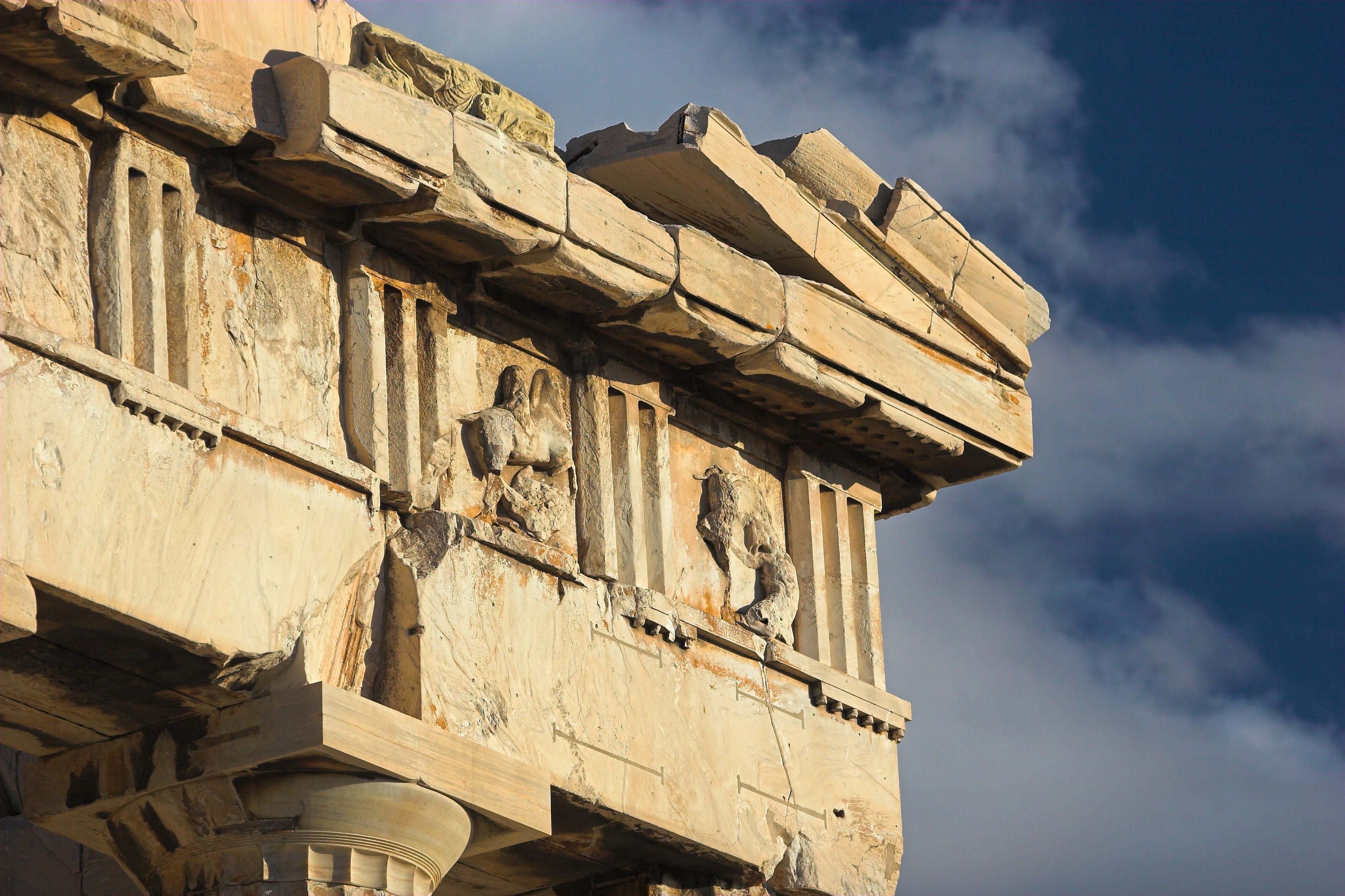
The columns are not straight. Look closely along the colonnade of the Parthenon and you can see the slight swelling near the middle, the entasis the architects worked into every shaft to counter the optical illusion that perfectly straight columns appear to taper inward. The stylobate, the platform the temple stands on, is not flat either. It bulges upward at the center by 10.3 centimeters over a 70-meter span, a curve so subtle most visitors never notice it but precise enough that the building seems to lift off the rock. Iktinos and Callicrates, working under Phidias's overall supervision between 447 and 432 BC, did this on purpose. The Parthenon's perfect appearance is a deliberate forgery of perfection, engineered to deceive the eye toward an effect even more ideal than geometric truth.
The Building That Wasn't a Temple
It looks like a temple, and it has been called one for 2,500 years, but the Parthenon may not have functioned as one in the conventional Greek sense. No daily cult ritual is attested for the chryselephantine statue of Athena Parthenos that filled its central chamber, the 12-meter-tall ivory-and-gold figure Phidias dedicated in 438 BC. Thucydides has Pericles telling the Athenians, on the eve of the Peloponnesian War, that the statue's forty talents of pure gold could be removed, melted down, and minted into coins to pay for the war effort, which is not how Greeks normally talked about their cult statues. The opisthodomos at the rear of the building held the treasury of the Delian League, the alliance Athens had turned into an empire. Some scholars now argue the Parthenon was less a religious building than a national monument, a votive offering scaled up to the size of an architectural statement. The shrine to Athena that mattered for actual cult worship was the modest, irregular Erechtheion next door, where the olive-wood xoanon of Athena Polias lived.
The Mathematics Underneath
Walk around the Parthenon counting columns. Eight on the short ends, seventeen on the long sides, octostyle and peripteral, and the ratio of length to width works out to 9 to 4. So does the ratio of column diameter to spacing, and the ratio of height to width. Greek architects loved this proportion, and the Parthenon's architects pushed it everywhere they could. They probably did not use the golden ratio, despite a popular nineteenth-century claim that traced phi through every dimension of the building. They almost certainly did use a unit of measurement particular to the Parthenon, what Anne Bulckens has called the Parthenon foot of 343.04 millimeters, derived from the recurring 858-millimeter triglyph width. Recent analysis suggests the dimensions also encode Pythagorean musical ratios, the perfect fifth at 3:2, the great fourth at 4:9. Whether the architects intended this or not, the building has the visual cleanness of music written down in stone.
The Day the Parthenon Exploded
The Parthenon survived as a working building for over 2,100 years. Late in the sixth century AD it became a Christian church dedicated to the Virgin Mary, then the Church of the Theotokos, the fourth most important Christian pilgrimage site in the Eastern Roman Empire. After the Ottoman conquest of Athens in 1458, it became a mosque, with a minaret rising from one of its corners. Through all these conversions, the structure stayed essentially intact. Then on 26 September 1687, during the Morean War, a Venetian army under Francesco Morosini besieged the Acropolis. The Ottomans had stored their gunpowder inside the Parthenon, calculating that no Christian artillery officer would deliberately fire on the most famous classical building in the world. They calculated wrong. A Venetian mortar round, fired from the Hill of Philopappos across the valley, dropped through the roof and detonated the magazine. The explosion blew out the central section of the building, collapsing the cella walls and most of the colonnade. The Parthenon never recovered. Most of what we call ruin today is what the explosion left behind.
The Marbles in London
Between 1801 and 1812, Thomas Bruce, 7th Earl of Elgin, then British ambassador to the Ottoman court, removed about half the surviving sculptures from the Parthenon and shipped them to Britain. Elgin claimed Ottoman permission, which the legality of has been disputed continuously ever since. The pieces eventually went to the British Museum, where they have remained as the Elgin Marbles or, more recently, the Parthenon Marbles. The Greek government formally requested their return in 1983. UNESCO has been involved since 1984. In 2021, UNESCO formally called on the UK government to resolve the matter at the intergovernmental level. Talks between Greek Prime Minister Mitsotakis and British Prime Minister Starmer in December 2024 produced what George Osborne, chair of the British Museum trustees, called significant progress without final agreement. The proposed solution would be a long-term loan rather than transfer of ownership, with rotating displays of other Greek antiquities sent to London in exchange. Four pieces have already come back from elsewhere: three from the Vatican, one from a museum in Sicily. The dispute is unresolved, and remains the most prominent ongoing argument in modern museology.
The Restoration
Air pollution and acid rain damaged the Pentelic marble of the Parthenon throughout the twentieth century, and the 1981 earthquake cracked the east facade. In 1975, the Greek government established the Committee for the Conservation of the Acropolis Monuments, known by its Greek acronym ESMA, to oversee a restoration project that has now run for half a century. The original blocks had been pinned together with iron H-clamps coated in lead to prevent rust. Repairs in the nineteenth century used uncoated iron, which corroded and cracked the marble around it. Modern restorers have replaced the iron with titanium, a metal the ancient builders did not have but would have used if they had. The fragile sculptures still on the building have been moved into the new Acropolis Museum, with replicas filling their places. In 2019 a major project began to restore 360 ancient stones to the cella's interior walls, using only 90 new pieces of Pentelic marble. In September 2025, the scaffolding came down from the western side after fifteen years. Greece intends to remove the rest by the end of 2026. For the first time in nearly two decades, you can see the Parthenon as it actually stands.
From the Air
The Parthenon stands at 37.972 N, 23.727 E on the southern crown of the Acropolis of Athens, at approximately 156 meters elevation. The platform is 31 meters wide by 70 meters long, oriented east-west. From altitude, look for the rectangular outline of the surrounding marble plaza. Best viewed from 2,000-3,500 ft AGL during morning light when the columns cast clean shadows. The Acropolis is restricted airspace; commercial overflights are not permitted. Nearest airport: Athens International Airport Eleftherios Venizelos (LGAV / ATH), 30 km east. Lykavittos Hill, 1.5 km north, is a useful navigation landmark.