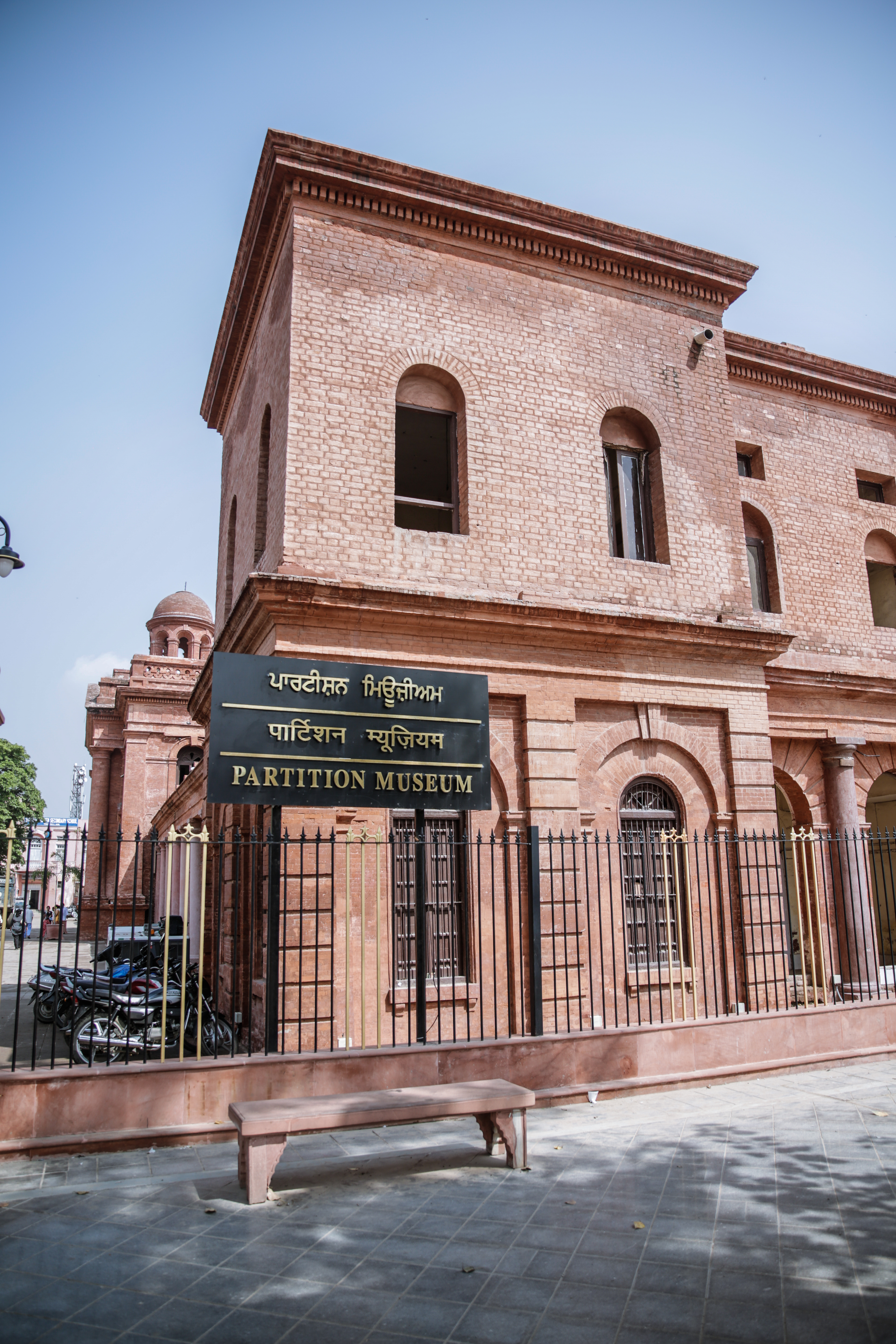
Partition Museum
A cooking pot. A pair of gold earrings. A leather briefcase with the initials still legible. These are the objects people grabbed when they had minutes to leave everything behind. In Amritsar's Town Hall -- a building that once served as British headquarters and a jail -- fourteen galleries now hold the material remnants of the largest mass migration in recorded history. The Partition Museum opened because someone asked the question that India and Pakistan had avoided for decades: where do the memories go when the last survivors die?
A Line Drawn by a Stranger
In the summer of 1947, British lawyer Cyril Radcliffe arrived in India with a task and a deadline. He had never visited the subcontinent before. Given five weeks, he drew a border through the provinces of Punjab and Bengal, dividing them along religious lines -- Muslim-majority areas to Pakistan, Hindu- and Sikh-majority areas to India. The line split villages, bisected farms, and severed families. Overnight, millions of people found themselves on the wrong side. What followed between August 1947 and January 1948 was carnage on a scale that defies clean accounting: more than 800,000 Muslims, Hindus, and Sikhs killed in communal violence, and over 1.4 million people turned into refugees. Trains arrived at stations carrying only the dead. Entire neighborhoods burned. Amritsar, sitting just 30 kilometers from the new border, witnessed some of the worst violence in Punjab.
The Things They Carried
The museum's power lies not in grand narrative but in the particular. Its collections are built from oral testimonies recorded from first-generation survivors -- people who lived through partition as children or young adults and carried their memories for seven decades before anyone thought to preserve them systematically. Alongside the testimonies sit material memories: the objects that individuals managed to take when they fled. Jewelry, clothing, cooking utensils, documents. Each artifact anchors a personal story that the wall text recounts. A BBC profile documented one exhibit: a jacket and a briefcase that traced a love story across the border, objects that meant nothing to anyone except the people who carried them and everything to the history they represent. Mallika Ahluwalia, the museum's co-founder and managing trustee, collected many of these stories in her book Divided by Partition, United by Resilience: 21 Inspirational Stories from 1947.
Fourteen Galleries, One Chronology
The museum moves visitors through time in a deliberate sequence. The first gallery asks "Why Amritsar?" -- establishing the city's significance as a witness to both colonial resistance and communal violence. Subsequent galleries trace the arc: Punjab's identity, resistance movements from 1900 to 1929, the rise of independence forces from 1930 to 1945, growing differences in 1946, the prelude to partition, the drawing of boundaries, independence itself, the new borders, mass migrations, communal divisions, refuge, and finally hope. The physical exhibits match the emotional trajectory. Early galleries display photographs and documents. The middle sections reconstruct a jail cell, a train platform, a riot-damaged house. There is a metal saw, a well, hanging banners. Near the end, a refugee tent. The final installation is a tree of hope -- paper leaves attached to barbed wire, where visitors write their own messages. The progression from document to artifact to participatory installation mirrors the museum's conviction that partition is not finished history but living memory.
A Building with Its Own Scars
The choice of venue carries its own weight. Amritsar's Town Hall served as British headquarters during the colonial period and functioned as a jail -- a building where imperial power was administered and resistance punished. Housing a museum about the consequences of imperial withdrawal inside the architecture of imperial control creates an unspoken dialogue between the walls and what they now contain. The Government of Punjab established the museum in partnership with the Arts and Cultural Heritage Trust of the United Kingdom, an institutional collaboration that mirrors the tangled Anglo-Indian history the museum documents. Amritsar's proximity to the Wagah border crossing, where Indian and Pakistani soldiers still perform an elaborate flag-lowering ceremony each evening, gives the city a particular relationship to the border that Radcliffe drew. The partition did not happen somewhere else and get remembered here. It happened here -- in these streets, to these families, within sight of the Golden Temple.
Before the Last Witnesses Are Gone
Time is the museum's most pressing adversary. The survivors who were children in 1947 are now in their eighties and nineties. Each year narrows the window for first-person testimony. The museum's oral history program races against this biological clock, recording accounts that might otherwise vanish into the silence that has surrounded partition for most of its history. For decades, families on both sides of the border spoke of it only in private, if at all. School textbooks treated the event in broad strokes. No national memorial existed in either country. The Partition Museum, which describes itself as the world's first museum dedicated to the subject, attempts to fill that silence with specificity -- not statistics but names, not policy decisions but the pot someone grabbed off the stove. Its galleries argue, without lecturing, that the scale of a catastrophe is best understood one story at a time.
From the Air
Located at 31.63N, 74.88E in central Amritsar, Punjab, India, housed in the Town Hall building. Sri Guru Ram Dass Jee International Airport (ICAO: VIAR) is approximately 11 km northwest. The museum sits near the Golden Temple complex and the historic walled city. The Wagah border crossing with Pakistan is roughly 30 km to the west. Best viewed in context with the broader Amritsar cityscape at 3,000-5,000 feet AGL.