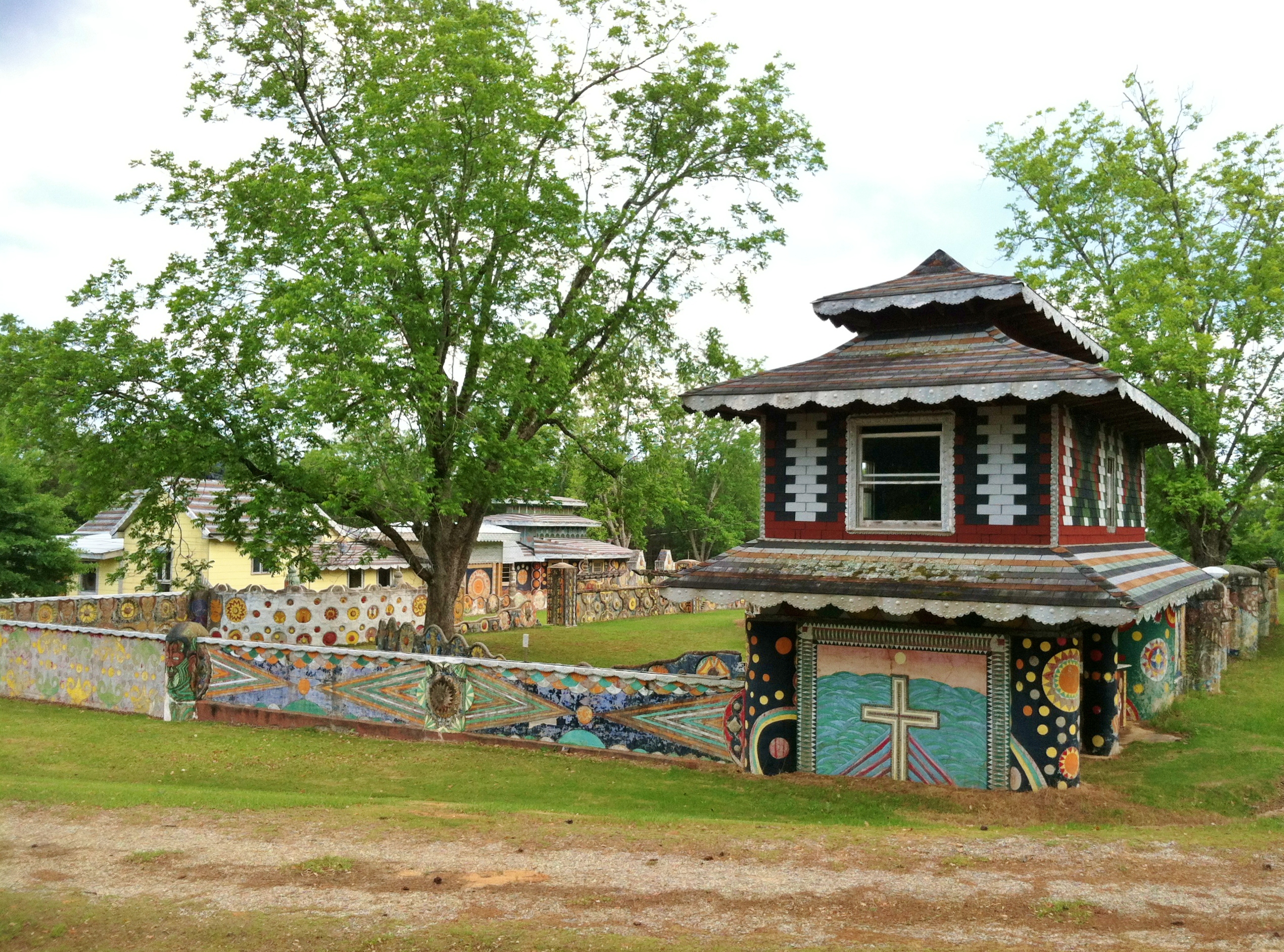
Pasaquan: One Man's Concrete Vision
The name means roughly 'the past coming together,' coined from Spanish and Chinese by a man who called himself Saint EOM and claimed a spirit told him to build it. Pasaquan sits on seven acres of former farmland near Buena Vista, Georgia -- six major structures, painted concrete walls stretching in every direction, sculptures staring from every angle, all of it blazing with color that has no business being this deep in rural Marion County. Eddie Owens Martin created this compound over decades, funding it with fortune-telling money, building it with his own hands and local materials. It is internationally renowned, listed on the National Register of Historic Places, and utterly impossible to mistake for anything else on Earth.
Born on the Fourth of July
Eddie Owens Martin came into the world on July 4, 1908, in Glen Alta, a village in Marion County, Georgia. He was one of nine children in a sharecropper family. His father was abusive, and by fourteen Martin had fled to New York City, where he survived as a sex worker. His early years skirting the law landed him a one-year prison term in 1942. After his release from Federal Narcotics Prison on March 17, 1943, Martin reinvented himself as a fortune teller. It was a dramatic pivot -- from the margins of society to a profession built on reading people, on channeling something beyond the visible world. That channeling would eventually produce something far more lasting than card readings.
The Spirit and the Saint
Martin claimed a spirit inspired him to create a religion called Pasaquoyanism, which emphasized connection to the natural world and the use of hair. The spirit also bestowed his new name: Saint EOM. When his mother died in 1950, Martin inherited the family house and seven acres of land. He continued fortune-telling in New York until a dispute with his brother Julius in 1957 prompted him to relocate the business to the Georgia property. What began as a homecoming became a lifelong artistic obsession. Martin started collecting local natural materials and hired D. W. Milner to help construct his first wall. His original decorated fence, made from wood, rotted away. Edwin Stephens, who became Martin's romantic partner, brought technical construction skills to the project. After ten years of building, Martin began painting his structures with images drawn from his personal acquaintances and his spiritual visions.
Concrete Prophecy
What Martin built defies easy categorization. Six major structures anchor the compound, including a redesigned 1885 farmhouse that was already on the property. Painted concrete sculptures stand guard throughout the grounds. Walls of painted masonry concrete stretch between structures, covered in swirling designs, faces, and totems that blend influences from multiple cultures into something entirely Martin's own. The compound is simultaneously folk art, outsider art, visionary environment, and personal temple. Every surface is a canvas. Every structure is a statement. Martin funded the entire project with proceeds from fortune-telling, spending decades transforming seven acres of Georgia farmland into a monument to his singular inner vision. President Jimmy Carter visited the site in the early 1980s. CNN recommended it as a tourist destination in 2016. The Tedeschi Trucks Band named a track after it in 2022.
Rescue and Restoration
Martin died on April 16, 1986. The Marion County Historical Society assumed ownership of Pasaquan, and a special committee formed to care for the site. That committee evolved into the Pasaquan Preservation Society, which operated the compound until 2014. Maintaining an outdoor art environment in the Georgia climate is relentless work -- concrete cracks, paint fades, humidity infiltrates. In 2004, the Preservation Society approached the Kohler Foundation for help. A decade later, the Foundation accepted the project and collaborated with Columbus State University on a full restoration. Two years of painstaking work followed, and on October 22, 2016, Pasaquan reopened to the public. The Kohler Foundation transferred ownership to Columbus State University, ensuring the compound's long-term stewardship. In 2015, the Pasaquan Preservation Society won Georgia's Governor's Award for the Arts and Humanities.
The World He Left Behind
Pasaquan endures as one of the most remarkable visionary art environments in the United States. In 2008, it was accepted for listing on the National Register of Historic Places. An opera celebrating Martin's life -- Eddie's Stone Song: Odyssey of the First Pasaquoyan -- was created by James Ogburn and Scott Wilkerson in 2017. The compound draws visitors from around the world to a patch of rural Georgia where a sharecropper's son, a runaway, a fortune teller, and a self-proclaimed saint poured concrete, mixed paint, and built something that looks like no place else. Martin's biography is one of suffering and reinvention, but Pasaquan transcends biography. It is the physical proof that an unshakeable inner vision, given enough time and enough concrete, can remake the world.
From the Air
Located at 32.35°N, 84.58°W near Buena Vista in Marion County, Georgia. The compound sits on four acres of rural land surrounded by farmland and pine forest. From altitude, the area is characterized by low-density rural landscape with scattered farms. The nearest airport is Columbus Metropolitan Airport (KCSG), approximately 30 miles to the southwest. Middle Georgia Regional Airport (KMCN) in Macon is roughly 60 miles to the east. The compound's colorful painted walls and structures are distinctive but small-scale -- best appreciated from ground level. The surrounding countryside is flat to gently rolling Piedmont terrain.