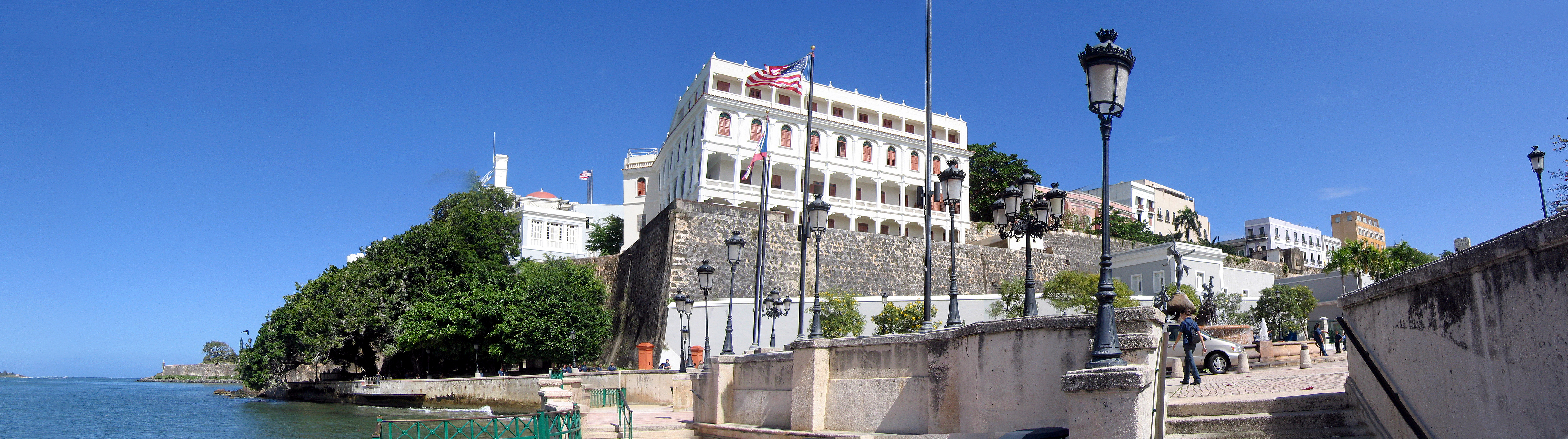
Paseo de la Princesa
The cannons are gone, but the promenade they made possible remains. Before it was a place for evening strolls and piragua vendors, the land along Old San Juan's southwestern wall was kept deliberately bare -- a cleared field of fire so Spanish gunners could defend the city without obstruction. Sometime in the 1850s, colonial administrators looked at that empty strip and saw something else: a promenade worthy of a princess. They named it for the Infanta Isabel, firstborn daughter of Queen Isabella II, and between 1852 and 1854, the Paseo de la Princesa took shape -- a half-mile pedestrian walkway running parallel to the walls, lined with benches and trees, anchored at one end by a prison and at the other by the oldest city gate still standing in Old San Juan.
The Princess and the Prison
The promenade's most prominent building is not a palace but a jail. The Antigua Prision La Princesa -- the Princess Old Prison -- was built in 1837 and named after the same young Queen Isabella II who gave the paseo its royal association. Governor Fernando de Norzagaray expanded the prison and added its tower in 1854. It held about 240 prisoners and operated until 1965, when it finally closed. The building survived its grim purpose: it now houses the Puerto Rico Tourism Company, which seems like exactly the kind of institutional reinvention Old San Juan specializes in. The Tourism Company installed a time capsule beneath the promenade in 1995. It was opened in 2020, and two more were buried afterward, set to be opened in 2045. The prison building itself hosts art exhibitions and cultural events, its thick walls now holding something lighter than they were designed for.
Roots in Bronze
At the midpoint of the promenade, overlooking San Juan Bay, stands the Fuente Raices -- the Roots Fountain. Created in 1992 by Spanish sculptor Luis Sanguino, the large sculptural fountain celebrates the three ancestral roots of Puerto Rican identity: the indigenous Taino culture, the European culture brought by Spanish colonizers, and the African heritage carried by enslaved people brought across the Atlantic. Bronze figures rise from the water in a composition that is both monumental and intimate. A small wooden dock near the fountain offers views across the bay toward the municipalities of Catano and Bayamon to the west, and on clear days you can see El Yunque and the Sierra de Luquillo rising to the east. The fountain has become the emotional center of the paseo -- the place where families gather, where tourists take photographs, and where the layered origins of Puerto Rican identity are rendered in metal and moving water.
Through the Water Gate
Walk the full length of the Paseo de la Princesa and you arrive at the Puerta de San Juan -- the San Juan Gate -- the only surviving city gate in the Walls of Old San Juan. Originally called the Puerta de Agua, the Water Gate, because it was the first entrance to offer access from the harbor, the gate has served as the symbolic threshold between the sea and the city for centuries. Bishops, governors, and soldiers passed through it. Beyond the gate lies La Fortaleza, the 16th-century executive residence of Puerto Rico's governor and the oldest such residence in continuous use in the Western Hemisphere. The Paseo del Morro continues from this point along the western defensive walls, following the waterfront toward Castillo San Felipe del Morro at the islet's westernmost tip. The paseo connects military history at every step -- bastions, walls, garitas -- but the mood along the walkway is anything but martial.
The Evening Promenade
The Paseo de la Princesa fell into disrepair during the 20th century, its trees overgrown, its Victorian lampposts dimming. A restoration in 1989 brought it back, and the paseo now functions as Old San Juan's communal living room. Artisan vendors set up along the walkway. Open-air cafes serve traditional Puerto Rican food. Piraguas -- shaved ice in tropical flavors -- and platanutres, fried plantain chips, are the unofficial currency of the promenade. On Friday and Saturday nights, live jazz fills the air; on weekends, salsa music and dance take over. The paseo moves at its own pace, unhurried by the traffic and commerce of the streets above. It is a place designed for walking slowly -- which is exactly what its builders, more than 170 years ago, intended a princess's promenade to be.
From the Air
Located at 18.462N, 66.117W along the southwestern wall of Old San Juan, running parallel to San Juan Bay. From the air, the promenade is visible as a tree-lined path between the massive defensive walls and the waterfront, with the Fuente Raices fountain plaza at its midpoint. The Puerta de San Juan (San Juan Gate) marks its western terminus near La Fortaleza. Nearest airport is San Juan Luis Munoz Marin International (TJSJ), approximately 8 nm southeast. Fernando Luis Ribas Dominicci Airport (TJIG) is directly across the harbor on Isla Grande. Best viewed below 2,000 ft AGL where the promenade's linear path along the wall is clearly distinguishable.