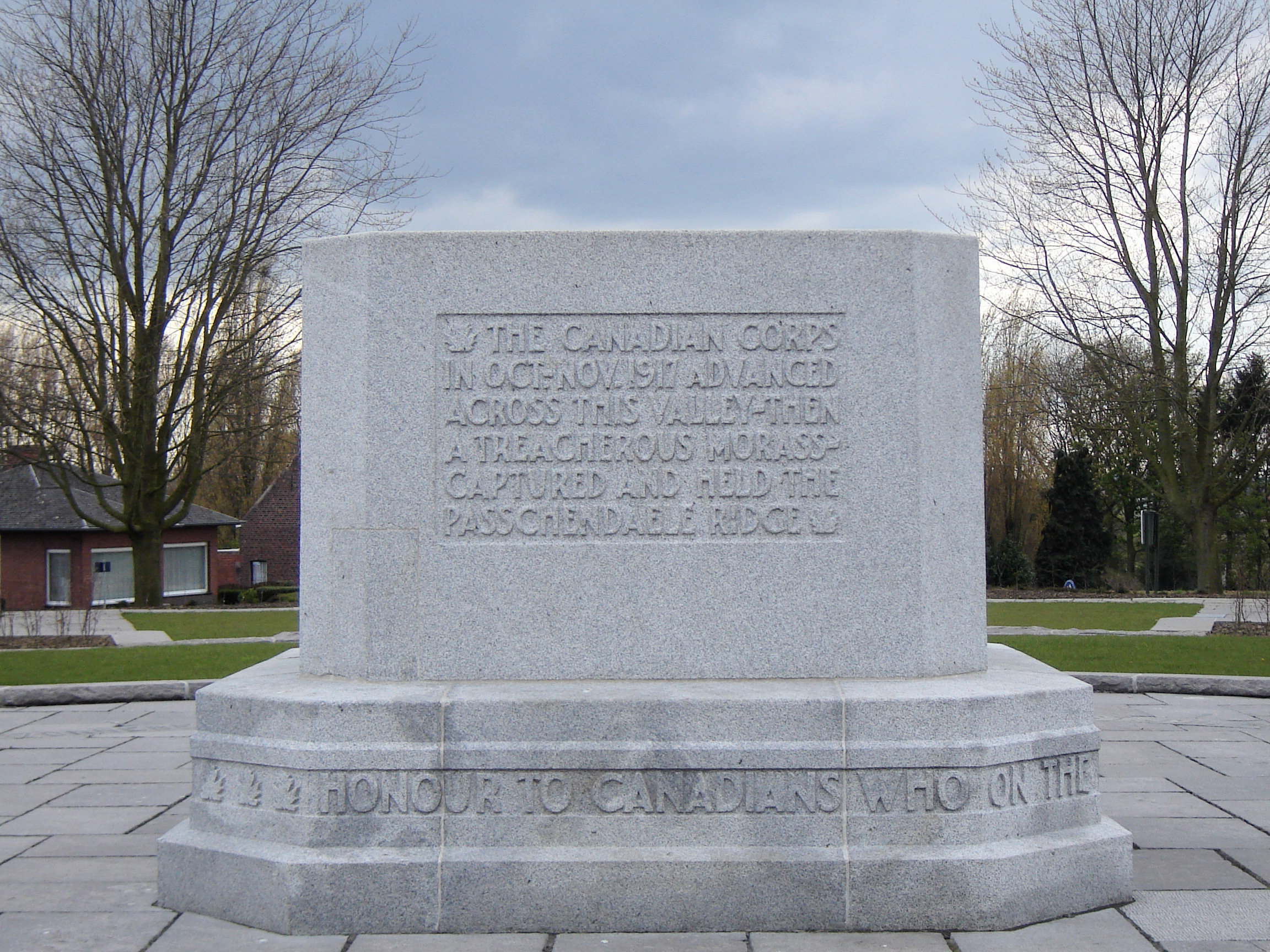
Passchendaele Canadian Memorial
The mud at Passchendaele swallowed men whole. Three months of artillery bombardment had destroyed the drainage systems of this low-lying Belgian ground, and when the autumn rains came in 1917, the battlefield transformed into a quagmire where soldiers drowned in shell craters, where horses disappeared without trace, and where every forward step meant wading through waist-deep muck under German fire. Into this nightmare the Canadian Corps was ordered to advance. The 13-tonne granite memorial that stands here today marks not just a military objective captured, but a testament to what human beings endured when asked to do the impossible.
Sixteen Days in Hell
The Second Battle of Passchendaele lasted just sixteen days, from October 26 to November 10, 1917, but those sixteen days cost the Canadian Corps 15,654 casualties, with over 4,000 dead. The Canadians were tasked with relieving the exhausted II Anzac Corps and capturing the high ground along the Passchendaele-Westrozebeke ridge. The operation was executed in a series of three attacks with limited objectives, each separated by three or more days to allow for regrouping. On October 30, 1917, the 4th Canadian Division assaulted Crest Farm, the site where this memorial now stands. It was here that the Germans mounted some of their most stubborn resistance of the entire war. Nine Victoria Crosses were awarded to Canadians during the battle.
Stone from Home
After the war, the Imperial War Graves Commission granted Canada eight sites across France and Belgium on which to build memorials. A design competition was held, and Toronto sculptor Walter Seymour Allward's monumental submission won first place. The commission decided his ambitious design would be reserved for Vimy Ridge, while the runner-up design by Frederick Chapman Clemesha would grace the other seven sites. Each memorial features a 13-tonne cube of white-grey granite, quarried near Stanstead, Quebec, and shipped across the Atlantic. The blocks bear carved wreaths on opposing sides and the inscription: 'Honour to the Canadians who on the fields of Flanders and France fought in the cause of the allies with sacrifice and devotion.'
The View from Crest Farm
The memorial sits in a keyhole-shaped park about 100 metres long by 60 metres wide, bordered by maple trees and a holly hedge. The granite block rests on a low circular flagstone terrace on what locals now call Canadalaan, the southwest fringe of Passendale village. From here, visitors can look northeast up the road to see the rebuilt church at the village center, north toward Bellevue Spur where Canadian troops attacked, and southwest down an avenue of trees toward the rebuilt spires of Ypres. The town was completely destroyed during the war and rebuilt afterward, but the memorial ensures that the ground where so many Canadians fell will never be forgotten.
Where Flanders Fields Bloom
The Ypres Salient, where this memorial stands, became synonymous with the horror of the Western Front. The name Passchendaele itself became shorthand for futile slaughter in mud, a word that still carries weight more than a century later. Today the memorial is one of dozens scattered across this landscape, a constellation of granite and marble marking where different nations' sons fell in the same cause. The maple trees that line the memorial park are a reminder that this small patch of Belgian soil is, in a sense, Canadian ground now, held in perpetuity by the sacrifices made here.
From the Air
Located at 50.898N, 3.013E near the village of Passendale, Belgium. The memorial park is visible as a small green space on the southwest edge of the village. The rebuilt church spire in Passendale village center serves as a reference point. Nearest major city is Ypres (Ieper), 10km southwest. Approach from the west over the flat Flanders terrain to appreciate the subtle ridge that made this ground so strategically important. Nearest airports: Kortrijk-Wevelgem (EBKT) 15km south, Ostend-Bruges (EBOS) 45km northwest.