Passing Mother's Grave
All three figures in the painting are barefoot. A fisherman in a dark coat walks past a churchyard, holding the hands of his two small children. They have just come from his wife's grave, or perhaps are passing it for the hundredth time on a route they cannot avoid. The sky is heavy, dark and ominous, but Jozef Israëls has left one sliver of blue along the upper edge — a deliberate trace of hope in an otherwise gray-brown canvas. The Austrian art historian Fritz Novotny described the painting's palette as "an almost monochrome grey-brown tonality of a fragile delicacy." The men who modeled for it were real: a fisherman named Klaas Helweg and the two children of Hendrik Helweg. The painting was finished in 1856, and it did something to Dutch art that had not quite been done before.
A Young Painter Turns Toward the Real
Jozef Israëls was born in Groningen in 1824 and trained, like most ambitious nineteenth-century Dutch artists, in the genres his teachers respected: portraits, genre scenes, biblical and historical subjects. In 1842, at the age of eighteen, he was working in Amsterdam in the studio of the portraitist Jan Adam Kruseman, learning the polished surfaces and theatrical compositions that earned commissions. Passing Mother's Grave, painted fourteen years later, broke with that training. Israëls turned his attention to peasant life and, more particularly, to the lives of fishermen — a subject that would occupy him for decades. The art historian Dieuwertje Dekkers has written that the painting "introduced into Dutch art a powerful variant of French Realism." It was a deliberate pivot. The earlier work had been in the manner of the German Romantics and the old masters. This was something else.
Beside Courbet
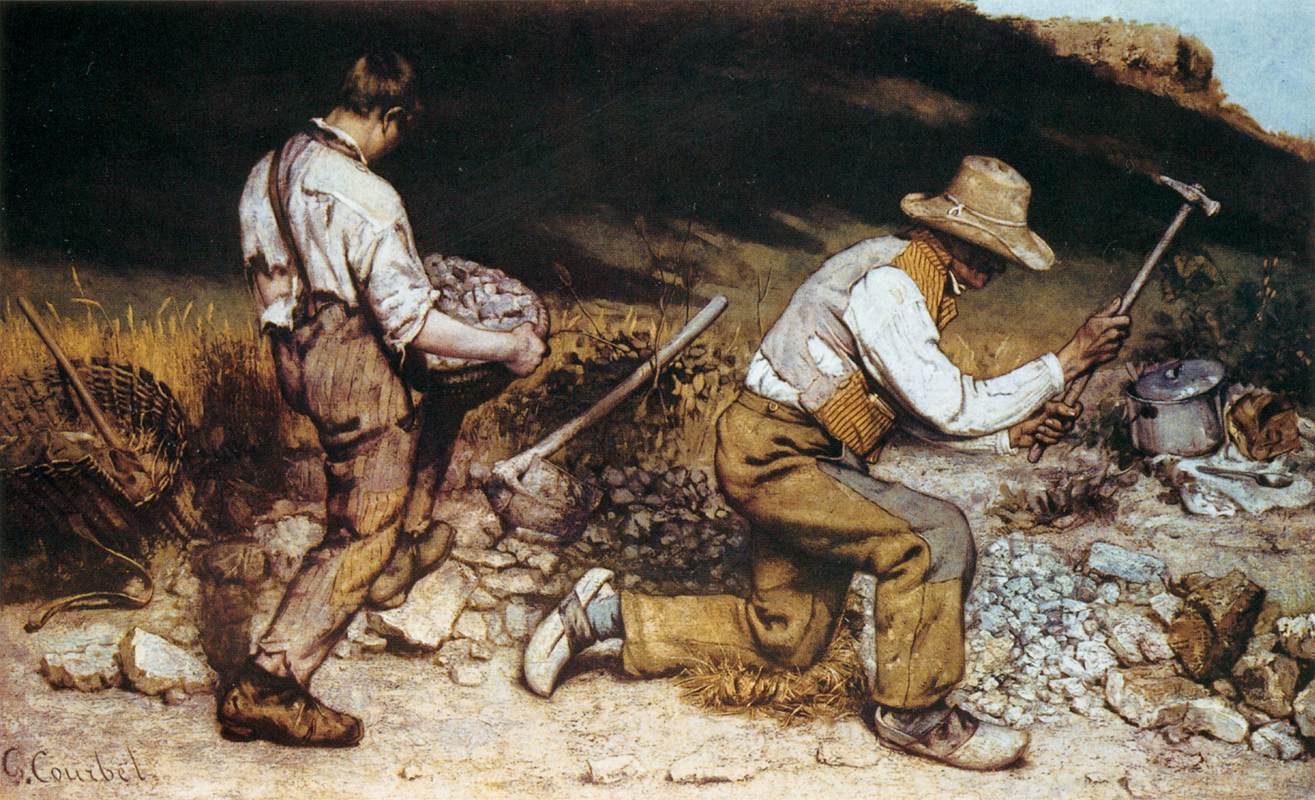
Critics have long set Passing Mother's Grave next to Gustave Courbet's The Stone Breakers, painted in France in 1849. Both pictures take the working poor as their subject and refuse to romanticize them. Courbet's two laborers crush rock by a roadside, faces averted; Israëls's fisherman walks his children past a grave on bare feet, in dim coastal light. The art historian Sheila D. Muller wrote that Israëls had achieved a "monumental treatment of the commonplace," which is exactly what realism set out to do — to insist that ordinary lives, including ordinary grief, deserved the seriousness of paint that earlier generations had reserved for kings and saints. The painting found admirers immediately. Print reproductions multiplied. Israëls himself made several copies in oil, and so the image traveled far beyond the original canvas.
Vincent's Favorite
One of those admirers was a young Vincent van Gogh, who counted Passing Mother's Grave among his favorite pictures. Van Gogh — who would later paint his own peasants, his own widows and laborers — compared Israëls's work to that of the French painter Eugène Delacroix, writing that the painting was "Delacroix-like and superb" in its technique. For van Gogh, this kind of art was a moral commitment as much as an aesthetic one: that the people who fished, farmed, and grieved at the edges of polite society were the proper subject of serious painting. Israëls had said as much, in canvas, almost three decades before van Gogh wrote his first letter about him. The art historian H. E. van Gelder later called Passing Mother's Grave "the obvious beginning of the second period of Israëls's development" — the moment a Romantic became a Realist.
Where the Painting Lives Now
Israëls completed multiple versions of Passing Mother's Grave; the best-known hangs in the Stedelijk Museum in Amsterdam. Another version is in the collection of The New Art Gallery Walsall, in England, and at least one more was sold to a private buyer in Vienna in 1907. The original 1856 canvas was bought, soon after it was painted, by the Amsterdam Academy of Fine Arts. The Dutch writer Nicolaas Beets gave the painting its lasting name in 1861 — before that, it was sometimes called Passing the Churchyard. In Israëls's home city of Groningen, a monument to him stands as part of the public art collection. The fishing village he had in mind for the painting was the kind of Dutch coastal community then living on the edge of survival, where a widowed father walking with his children past their mother's grave was not an abstract image but a frequent, ordinary scene.
From the Air
Jozef Israëls's monument in Groningen sits near 53.213 north, 6.570 east, in the city he was born in. Groningen Airport Eelde (EHGG) is about 6 nautical miles south. The painting itself lives in the Stedelijk Museum in Amsterdam, near Schiphol (EHAM). When overflying Groningen at 1,500 to 3,000 feet AGL on a clear day, the Martinitoren and the old city grid are the most visible landmarks; the Israëls monument is tucked among them at street level.