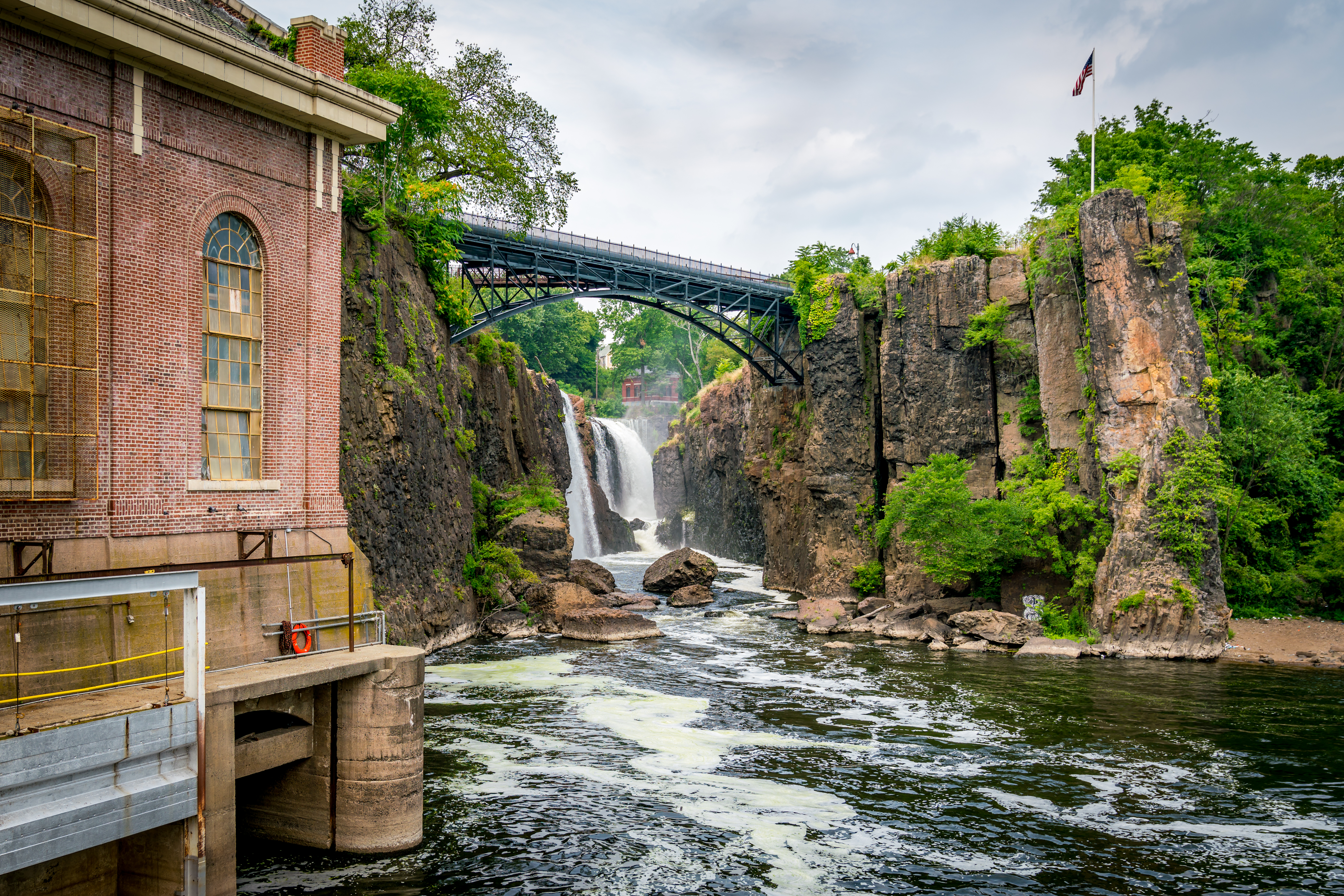
Paterson Great Falls: The Factory That Broke Hamilton's Heart
In 1778, Alexander Hamilton stood at the Great Falls of the Passaic River and saw the future. While other founding fathers dreamed of agrarian democracy, Hamilton envisioned factories - and these 77-foot falls, the second-largest waterfall by volume east of the Mississippi, would power them. He founded the Society for Establishing Useful Manufactures, created America's first planned industrial city at Paterson, and set in motion an industrial revolution that would transform the nation. Paterson prospered, inventing the Colt revolver and the first American locomotive, producing silk that dressed fashionable America. Then the mills closed, the city collapsed, and the falls kept falling - unchanged while everything Hamilton built crumbled around them. Today the Great Falls is a National Historical Park, water still thundering over the precipice, surrounded by ruins of the dream that made America industrial.
The Vision
Alexander Hamilton never trusted agriculture. He believed America's future lay in manufacturing - factories producing goods that Europeans exported, keeping wealth and employment at home. The Great Falls offered exactly what factories needed: reliable water power, year-round flow, proximity to New York markets. In 1791, Hamilton created the Society for Establishing Useful Manufactures (SUM) and platted Paterson as America's first planned industrial city. The scheme failed initially - financial scandal, mismanagement, Hamilton's attention diverted by political warfare. But the infrastructure remained, and by the 1830s, Paterson was booming: mills spinning cotton, forging iron, making everything industrial America demanded.
The Industry
Paterson invented America. The first American-built locomotives came from Paterson's Rogers Locomotive Works. Samuel Colt perfected his revolver here. John Holland built early submarines in the Passaic. The city became the 'Silk City,' producing more silk than any other American city, fabric that dressed society weddings and fashionable balls. The Paterson system - water power distributed through raceways to mills along the riverbank - was copied nationwide. By 1900, Paterson had 350 manufacturing plants, 25,000 workers, and the wealth that industry brings. It also had strikes, poverty, pollution, and the social costs Hamilton never anticipated.
The Collapse
Silk moved south, where labor was cheaper. Locomotives moved west, closer to expanding railroads. The strikes of 1913 broke the remaining mills' will to fight. One by one, the factories closed; the raceways went dry; the workers moved away. By the 1970s, Paterson was a cautionary tale - urban poverty, abandoned industry, a city that had made America rich and been left behind. The falls kept falling, indifferent to the ruins surrounding them. The industrial infrastructure decayed: raceway walls crumbling, mill buildings collapsing, Hamilton's dream becoming archaeological evidence.
The Park
In 2009, Congress established the Paterson Great Falls National Historical Park - an urban park centered on a waterfall and the industrial history it enabled. The falls remain spectacular: 77 feet high, 280 feet wide, roaring with the Passaic's flow. The industrial archaeology is fascinating: raceways, gatehouse, mill ruins showing how water was harnessed. The story is quintessentially American: vision, exploitation, prosperity, abandonment, and now preservation. The park is still developing, adding visitor facilities, stabilizing ruins, interpreting a complicated history that includes labor struggles and environmental damage alongside engineering achievement.
Visiting the Great Falls
Paterson Great Falls National Historical Park is located in Paterson, New Jersey, accessible via Route 80 or Route 19. The falls overlook is free and open daily. A visitor center provides exhibits on industrial history. Walking tours explore the raceway system and mill ruins. The best view of the falls is from the overlook on McBride Avenue; the base of the falls is visible from the park's lower level. Downtown Paterson has ethnic restaurants reflecting the city's immigrant history. New York City is 15 miles east. The falls are spectacular after rain; seasonal variations affect flow. Come for the waterfall, stay for the history - Hamilton's dream, realized and ruined, preserved for contemplation.
From the Air
Located at 40.91°N, 74.18°W in Paterson, New Jersey. From altitude, the Great Falls appear as a break in the Passaic River's flow - the river approaches through urban development, plunges over the falls, and continues through the city. The falls may show whitewater from altitude; the gorge below is visible as a darker gap. Paterson spreads around the falls, dense urban development continuing to the New York skyline visible to the east. The raceways that once distributed water power are largely invisible from altitude, running beneath and between buildings. The terrain is typical northeastern urban - cities blending into each other, the river providing the only natural corridor. Hamilton saw industry here; from altitude, you see what industry became.